Table of content
Table of content
If you’ve been thinking about a smile makeover in Turkey, but you’ve noticed bleeding gums, gum recession, or you’ve been told you may have gum disease, you’re not alone — and you’re not automatically disqualified from treatment.
This is one of the most common questions patients ask before cosmetic dentistry:
“Can I still get veneers or dental implants if I have gum disease?” The short answer is: sometimes — but only after the right steps are taken.
The long answer is what protects your health, your investment, and your smile years down the line.
First, let’s be clear: gum disease is not one single condition
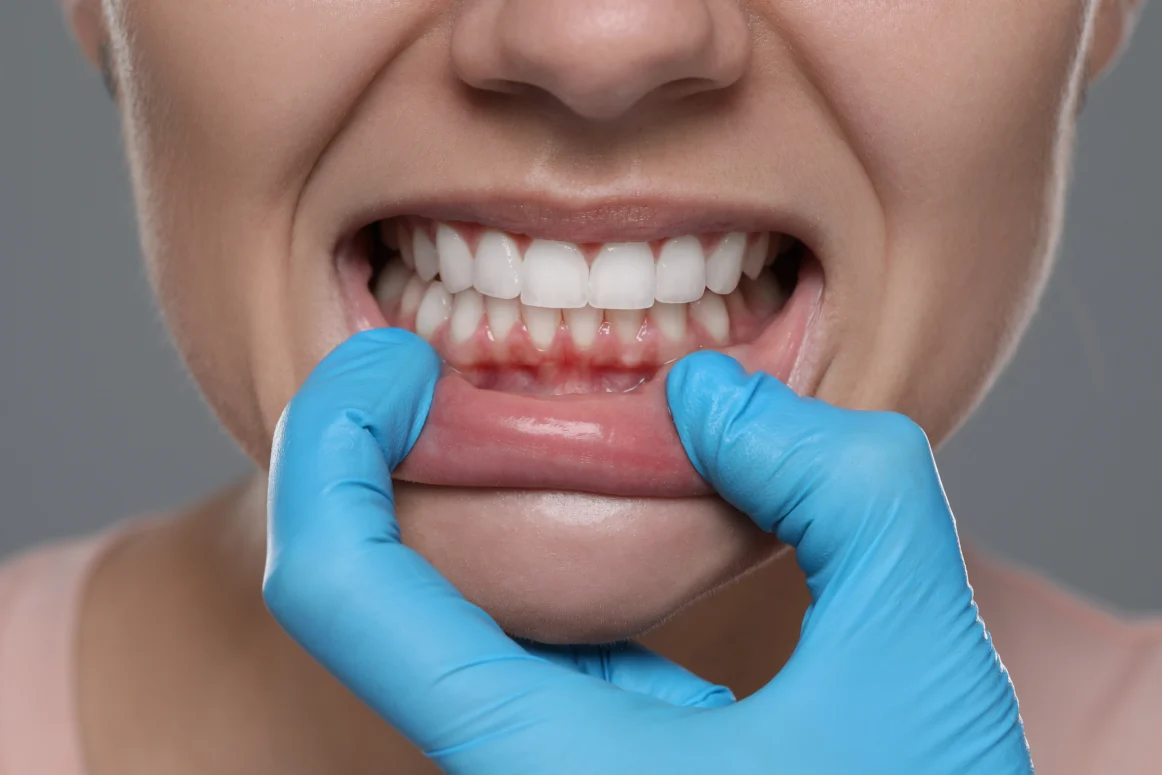
Gum disease usually starts as gingivitis, which is inflammation of the gums. If left untreated, it can progress to periodontitis, a more advanced condition where the infection affects the bone that supports the teeth.
It is also far more common than most people assume: a systematic review and meta-analysis put patient-level prevalence of periodontitis at 19.53%.3 Being told you have it is not unusual — and at the gingivitis stage it is reversible.
Gingivitis
This is the early and often reversible stage. Gums may bleed, look red, or feel swollen, but there is no permanent bone loss yet. With proper oral hygiene and professional cleaning, this stage can usually be stabilised completely.
Periodontitis
This is a more serious form of gum disease. At this stage, the infection affects both the gum tissue and the bone underneath. Bone loss, gum recession, and tooth mobility may occur. This form requires structured periodontal treatment before any cosmetic or implant work is considered.
The NHS lists teeth becoming loose or falling out among what gum disease can lead to if it is not treated.1 That’s why it’s never something to “work around” cosmetically.
What happens if gum disease is not treated first?
If gum disease isn’t treated first, it doesn’t really pause while you fix other things. It keeps going.
Most people think gum disease is just bleeding gums or some sensitivity. But that’s only the part you can see. What’s happening underneath is more important.
- Little by little, it affects the bone that holds your teeth in place — the process behind it, and how bone is rebuilt, is covered in our guide to bone loss in the jaw
- You don’t always feel it
- Things might seem okay for a while
- But the support is slowly getting weaker
That’s why this matters before doing things like implants.
- An implant needs strong bone to hold onto
- If bone loss is still happening and an implant is placed anyway, it might work at first, and then cause problems later
- This is usually when people are surprised, because everything looked “fine” in the beginning
Gum disease can also change how your smile looks, but very gradually.
- Gums can start to pull back
- Teeth may look a bit longer
- Small gaps can show up near the gum line
- The balance of the smile slowly changes
If veneers or crowns are done while the gums are inflamed or unstable:
- They can look good at first
- But as the gums continue to change, the edges can start to show
- Or feel rough
- Or just not feel right anymore
And even after treatment, the risk doesn’t stop if the gum disease is still active.
- Ongoing inflammation makes it harder for dental work to last
- Around implants, that inflammation can start affecting the bone holding the implant in place
- That’s what puts the whole result at risk
This doesn’t mean veneers or implants are off the table. It just means the mouth needs to be healthy first. Because no matter how good something looks on the outside, it won’t last if the foundation underneath isn’t stable.
So what are the actual treatment options for gum disease?
When patients hear “gum disease,” many imagine painful surgery or permanent damage.
In reality, modern periodontal care offers multiple treatment options, and the right one depends on severity, bone condition, and tissue stability.
Not every case needs surgery — and many gum problems are treatable and controllable when addressed early.
Common treatment options include:
1. Professional deep cleaning (scaling & root planing)
For mild to moderate gum disease, treatment often starts with a deep cleaning beneath the gum line.
This removes bacteria, plaque, and hardened deposits that regular brushing can’t reach.
For many patients, this alone is enough to:
- Stop bleeding
- Reduce inflammation
- Stabilise gum attachment
This is well-supported rather than a preliminary step: the ADA’s clinical practice guideline found that scaling and root planing showed a moderate benefit, that the benefits outweighed the potential adverse effects, and the panel voted in favour of it as the initial nonsurgical treatment for chronic periodontitis.2
One detail from the same guideline is worth taking into any consultation, because laser gum treatment is widely offered: the panel’s recommendations for the nonsurgical use of lasers as adjuncts to scaling and root planing were expert opinion against, because of uncertainty about their clinical benefit.2 A laser is not a substitute for the instrument work.
Once the gums have healed, cosmetic planning can safely move forward.
2. Periodontal curettage (infection control under the gums)
In cases where inflammation persists, curettage may be recommended.
This involves gently cleaning infected tissue from inside the gum pockets to allow proper healing.
It’s a controlled, targeted procedure — not cosmetic — and its goal is to restore gum health, not remove tissue unnecessarily.
3. Gingivectomy or gum reshaping (when indicated)
When excess or diseased gum tissue prevents proper cleaning or affects smile balance, a gingivectomy may be considered.
This can:
- Remove chronically inflamed tissue
- Improve access for hygiene
- Create a healthier, more stable gum contour
In some cases, it also improves aesthetics — but the primary goal remains health. Where the shape of the gum line itself is the concern once the tissue is healthy, that is gum contouring, and it is a separate conversation.
4. Gum grafting (for recession or exposed roots)
If gum recession has already occurred, grafting may be recommended to:
- Protect exposed tooth roots
- Improve gum thickness
- Restore long-term stability
Healthy gum tissue isn’t just about appearance, it’s essential for protecting teeth and implants over time.
5. Pinhole Surgical Technique (select cases)
For suitable patients, newer minimally invasive options like the Pinhole Surgical Technique may be available.
This technique:
- Requires no traditional incisions or sutures
- Can reposition existing gum tissue
- Often results in faster healing and less discomfort
Not every patient is a candidate, but when appropriate, it can be an excellent solution.
Now, can you get veneers if you have gum disease?
Gum disease doesn’t automatically disqualify you from veneers. But it changes the order of treatment.
A medically sound approach follows this sequence:
- Diagnose and stabilise gum health
- Restore bone and tissue stability if needed
- Plan cosmetic or implant treatment on a healthy foundation
This applies to porcelain veneers, composite veneers, and even dental crowns — and which of the three suits a given tooth is a question of what is left of it, set out in our comparison of veneers vs crowns.
- With mild gingivitis, veneers may still be possible after professional cleaning and stabilisation.
- With periodontitis, cosmetic work must wait until gum health is properly controlled.
Gum health should always be assessed first. In some cases, patients are advised to undergo gum alignment or periodontal treatment before veneers are even discussed.
This approach may feel slower, but it prevents expensive revisions later.
At DentSpa, cases involving gum disease are reviewed as part of a structured clinical assessment. Dr. Bürkan Berkay Baş, together with the periodontal and implant team, evaluates gum health, bone support, and long-term stability before recommending veneers or implants.
What about getting dental implants with gum disease?
Dental implants rely on healthy bone and stable gum tissue. If either is compromised, the risk of failure increases.
A history of periodontitis is one of the recognised risk factors for peri-implant disease, alongside smoking and poorly controlled diabetes — which is why the gum condition is assessed before an implant is planned rather than after.
What matters most is:
- Whether bone loss is present
- Whether active infection is controlled
- Whether the gums can heal and remain stable
In many cases, implants are still possible — but only after:
- Professional periodontal treatment
- Deep cleaning or surgical gum therapy
- Bone stabilisation or regeneration, if needed — the types of graft and what each involves are covered in our guide to bone grafting for dental implants
Gum health is assessed before an implant is planned — it is the foundation the implant depends on, and it is a reasonable thing to ask any clinic about.
Why choose DentSpa for veneers & implants
When gum disease is part of the picture, veneers and implants stop being simple cosmetic choices. They become medical decisions that carry real long-term risk. Many treatment failures happen not because a clinic lacks skill, but because important steps are skipped. DentSpa does not work that way.
Every case involving bleeding gums, bone loss, or previous periodontal issues is treated as a medical case first and a cosmetic case second. The question is never “Can we place veneers or implants?” It is “Should we — and if not now, what needs to be treated first?” If the foundation is not healthy, cosmetic work is delayed deliberately to protect the outcome.
What truly sets DentSpa apart is who makes these decisions and how they are made. Treatment planning is led by PhD-level specialist doctors, including professors and associate professors with formal expertise in periodontology, implantology, prosthodontics, and restorative dentistry. Decisions are guided by evidence, biomechanics, and long-term tissue behaviour — not cosmetic trends or pressure to move quickly.
DentSpa’s clinical strength is built on:
- Specialist teams led by professors and associate professors
- Extensive experience with complex and high-risk cases, not only routine cosmetic work — for implants specifically, Straumann publishes and verifies on its own site the number of its implants placed here over a full year, more than a thousand: see the Straumann Achievement Award and the verification page itself4
- Use of internationally approved, high-quality materials for veneers, crowns, and implants
- Independent recognition — DentSpa was named best dental clinic in Europe in the odontology category at the European Awards in Medicine5
With more than 50,000 patients treated across the past years, DentSpa combines academic leadership with high clinical volume. This scale allows for consistent protocols, refined workflows, and predictable outcomes — systems shaped by thousands of similar cases, not isolated decisions.
Patient trust is reflected in long-term follow-up and documented outcomes. Many international patients stay in contact well after their care is complete. This trust is supported by:
- Verified patient reviews and real treatment outcomes
- Before-and-after cases showing true clinical complexity, not only ideal situations
- Structured aftercare plans and long-term accountability
For patients travelling for treatment, DentSpa also provides structured international patient care. Clear communication in your own language, coordinated planning, and guided aftercare help ensure that medical decisions remain consistent — before, during, and after treatment in Turkey. That side of care is independently assessed: DentSpa holds the Certification for Excellence in Medical Travel Patient Experience from Global Healthcare Accreditation.6
This combination of medical-first decision-making, academic expertise, clinical volume, and structured care is why DentSpa is chosen for cases where mistakes are costly and results need to last.
Making the Right Decision for Long-Term Oral Health
If you have gum disease, the most important question is not:
“Can I get veneers or implants?”
It is:
“Will this still be healthy in five or ten years?”
DentSpa is built for patients who want honest answers, medically sound planning, and results designed to last — not just results that look good quickly.
If you’re unsure where you stand, a proper assessment is the safest place to start.
Book a free online consultation with DentSpa and speak directly with our specialists about veneers, implants, or gum treatment. Our specialists will answer all your questions clearly and explain medical tourism in Turkey — safely, transparently, and without pressure.
Frequently asked questions
If treatment needs to be delayed, does that mean I’m not a candidate?
How do I know if my gums are healthy enough for veneers or implants?
Is periodontal (gum) treatment painful?
Can dental implants fail if gum disease is ignored?
Does having gum disease mean I’ll automatically need implants instead of veneers?
Can mild gum disease be treated quickly before veneers?
How common is gum disease?
Does laser gum treatment replace deep cleaning?
Sources
- NHS — Gum disease
- American Dental Association — Nonsurgical Treatment of Chronic Periodontitis Clinical Practice Guideline (2015)
- Global prevalence of periodontal disease: a systematic review and meta-analysis
- Straumann — Certificate verification: DentSpa
- The European Awards in Medicine — DentSpa Clinic — European Award in Medicine in Odontology
- Global Healthcare Accreditation — DentSpa Strengthens Global Trust in Turkey’s Dental Services with GHA Certification















 70%
70%