Table of content
Table of content
Here’s something most people do when their gums bleed: nothing. Maybe a bit more brushing for a week. Some mouthwash. Then life gets busy and the whole thing gets filed away under “deal with later.” The trouble is, gum disease doesn’t really wait around. It just gets quieter — and worse — while you’re not looking.
If you’ve landed here because a dentist mentioned scaling and root planing, or someone told you that you need a “deep clean,” I’m not going to sugarcoat it: you probably do need it. But it’s also nowhere near as frightening as the name suggests. Most patients walk out surprised by how manageable the whole thing was.
What follows is a proper breakdown — what the procedure involves, what recovery actually looks like, and the question a lot of people are quietly googling: whether getting it done in Turkey is a legitimate option or just a gamble.
What even is scaling and root planing?
Your regular dental cleaning — the one you’re supposed to have every six months and mostly don’t — handles the surface. Plaque, tartar, the stuff sitting above and right at the gumline. It’s maintenance. It works fine when your gums are healthy.
But here’s what happens with gum disease. The gums pull away from the teeth, creating pockets. Small at first, then deeper. And inside those pockets, plaque hardens into calculus — that’s just the clinical word for tartar that’s been left long enough to mineralise — and it sits there doing damage that your toothbrush will never reach. You can brush twice a day for a year and it won’t touch what’s sitting 5 mm below your gumline.
That’s what a deep clean is actually for. Scaling and root planing is a two-part process. The scaling part does what it sounds like — it clears the calculus and bacterial buildup out of those pockets, using ultrasonic instruments, hand scalers, or usually a combination of both.
Root planing comes after: the surfaces of the tooth roots are smoothed and cleaned, which does two things. First, it removes bacterial toxins that have worked their way into the root tissue. Second, it gives the gum a clean surface to actually heal against and reattach to, rather than a rough, contaminated one.
This isn’t a fringe treatment or a clinic’s preference. The American Dental Association’s clinical practice guideline reviewed the evidence and voted in favour of scaling and root planing as the initial nonsurgical treatment for chronic periodontitis, judging its benefits to outweigh the potential adverse effects.1 It’s what comes before anyone talks about surgery.
How do you know if you need it?
The number dentists look at is 4 mm. Periodontal pockets — the gap between your gum and tooth — should be 3 mm or under. Once they hit 4 mm and deeper, regular cleaning can’t adequately treat the infection. Bacteria are living in there, bone loss may have started, and the environment is doing ongoing damage with every day that passes.
Some people come in with obvious symptoms:
- Gums that bleed every single time they brush, not just once in a while.
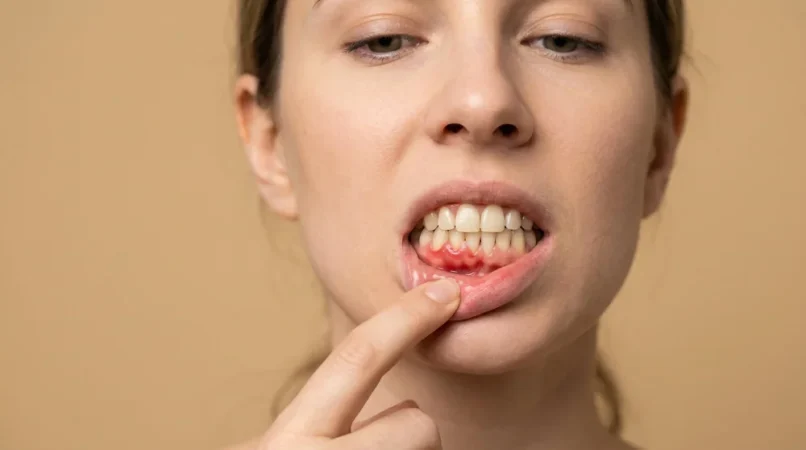
- Gum recession — suddenly your teeth look longer, or gaps have appeared between them that weren’t there before.
- Persistent bad breath, the kind that doesn’t shift with brushing or mouthwash, because it’s coming from infection rather than the surface.
- Swelling or tenderness in the gums.
- Occasionally, loose teeth or a bite that feels different.
But honestly? Plenty of people have deep pockets and none of those symptoms. Periodontal disease is famously quiet. You can have bone loss already under way and feel nothing at all. Which is why dentists measure pockets at every check-up, not just when something feels wrong. If what’s bothering you is how much gum shows rather than how it feels, that’s a different problem with a different answer — see gum reshaping.
A few things make gum disease more likely: smoking (this one matters a lot — smokers are more at risk and tend to respond less well to treatment), poorly managed diabetes, some medications that dry out the mouth, and genetics.
There’s also a reason the medical community treats this as more than a dental matter. A 2025 study matched 47,498 patients with periodontitis against 47,498 without and followed outcomes over 19 years. Compared with the control group, the periodontitis group showed higher odds of heart disease (OR 2.40), heart inflammation (OR 3.06), cancer overall (OR 1.64) and premature mortality (OR 1.42).2 Those are associations in observational data, not proof that gum disease causes any of it — but they’re a large part of why “we’ll keep an eye on it” stopped being an acceptable answer.
What actually happens during the appointment
Worth saying upfront: this is not a one-appointment procedure for most people. If your gum disease is mild and localised, maybe. But usually a periodontist works on one or two quadrants at a time — so the mouth gets treated in sections across two, three, sometimes four appointments. It’s more manageable that way, and the gum tissue gets a chance to begin healing between sessions.
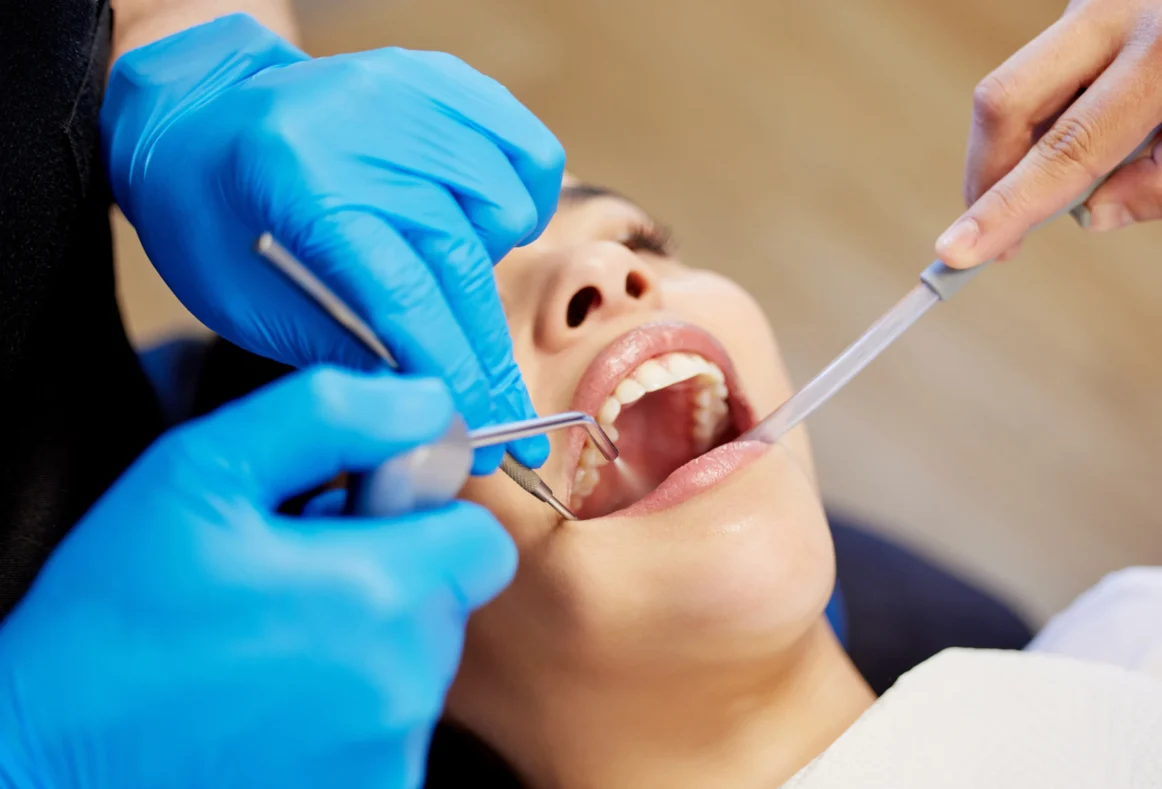
The first thing that happens is local anaesthetic. This matters because it’s the main reason the procedure isn’t painful — during the actual treatment you feel pressure, sometimes vibration from the ultrasonic scaler, occasionally movement. Not pain. Patients who’ve been anxious about it beforehand almost universally say it was less of an ordeal than they expected.
The scaling phase is the longer part. Your periodontist or hygienist works through each area methodically, clearing the calculus with ultrasonic instruments and then finishing by hand. The subgingival cleaning — everything below the gumline — is the part that takes time and skill. It isn’t something you can rush. Done properly, it’s thorough. Done too quickly, it isn’t effective.
Root planing comes after. The root surfaces are smoothed and decontaminated, to remove bacterial toxins that have penetrated the tissue and to create a surface the gum can heal against rather than just sit next to.
After treatment, antibiotics are sometimes used — a topical gel placed directly into the pocket, or a systemic course, depending on what was found. The ADA guideline supports certain adjuncts alongside scaling and root planing while recommending against others, including the use of lasers, on the grounds that the clinical benefit isn’t established.1 Not every case needs an adjunct at all; your periodontist makes that call from what they actually see.
Does it work? (The honest answer)
Yes — and the honest version of “yes” is worth stating precisely. The ADA’s expert panel graded the benefit of scaling and root planing as moderate, and judged that it outweighs the potential adverse effects.1 That’s the language of solid, dependable treatment rather than a miracle, and it’s the right expectation to walk in with.
Because what the procedure really is, is a reset. It removes the existing infection and gives the tissue a chance to heal. Whether that holds depends almost entirely on what happens afterwards.
Patients who smoke, skip follow-up appointments, or drift back to a loose brushing routine see the pockets deepen again. The bacteria come back. The disease restarts. That’s not a scare — it’s the single most useful thing to know before you book, because it tells you where the result actually comes from.
What patients typically notice — before and after
Most people don’t come in saying “I think I have periodontitis.” They come in saying their gums bleed every time they brush, or their breath hasn’t felt right in months, or their dentist mentioned something about pockets at the last check-up and they’ve been quietly worrying about it since.
What changes afterwards isn’t always dramatic. It’s not a cosmetic transformation. But for patients dealing with active gum disease, it’s often the first time in a long time that things feel stable.
| What patients describe before treatment | What typically improves after |
|---|---|
| Gums that bleed every time they brush, sometimes just from eating | Bleeding reduces as the inflammation settles |
| Persistent bad breath that mouthwash doesn’t fix | Breath improves once the bacteria below the gumline are removed |
| Gum tissue that looks red, swollen, or receded | Colour and tone normalise as the tissue heals |
| A feeling that teeth are looser or the bite has shifted | Stabilisation of the tissue supporting the teeth |
| Sensitivity or discomfort around specific teeth | Often improves once the source of infection is treated |
| Anxiety about being told they need surgery | Nonsurgical therapy is the recommended first step, before surgery is considered |
Scaling and root planing doesn’t give you a new smile. It gives your existing teeth a fighting chance.
Recovery — shorter than you’d think
Most people are back to normal within a few days.
Sensitivity is the most common complaint — hot drinks, cold water, sometimes just air. It’s the gum tissue adjusting and the roots being slightly more exposed than before during healing. It usually settles quickly, and sensitive toothpaste helps if it lingers.
Gum soreness is also normal, and manageable with whatever over-the-counter pain relief you’d take for a headache. Some mild swelling occasionally. Nothing that should stop you working or living normally.
The follow-up appointment — a few weeks later — is where your periodontist re-measures the pockets to see how the tissue responded. After that, most patients move to a more frequent maintenance schedule than the standard six months, at least for the first year or two. That maintenance isn’t optional; it’s what keeps the result.
The Turkey question: what actually determines the outcome
Unlike procedures that lean heavily on equipment, periodontal therapy is technique-dependent. It lives or dies on the training, thoroughness and patience of the person doing it. So the question isn’t really “is Turkey good for this” — it’s “who is holding the instrument, and can I check their background before I book?”
At DentSpa, periodontal treatment is carried out by specialists including Dr. Damla Öztürk, a periodontology specialist with 10 years of experience. She completed her specialisation in Periodontics at Marmara University Faculty of Dentistry, and her clinical interests include periodontal disease diagnosis and management, regenerative periodontal therapy, and the link between oral and systemic health. Her research has been presented internationally, including a poster on increasing keratinised attached gingiva around implants at EuroPerio9 in Amsterdam. Her full record — education, specialisations and every presentation — is on her profile page, which is the point: you can read it before you decide.
Diagnostics matter here too. Periodontal bone loss is mapped rather than estimated, using in-house panoramic X-ray and CBCT imaging, so the treatment plan is built on what’s actually there.
The clinic itself is licensed by the Turkish Ministry of Health, certified to ISO 9001 and ISO 10002, and a member of the Turkish Dental Association. It was named best dental clinic in Europe in the odontology category at the European Awards in Medicine, and holds the Certification for Excellence in Medical Travel Patient Experience from Global Healthcare Accreditation — which assesses the parts of treatment abroad a clinical inspection doesn’t reach.3 Over 50,000 international patients have been treated here; what they made of it is in the verified Trustpilot and Google reviews.
One thing that rarely comes up in dental tourism content but matters a great deal for this particular procedure: what happens after you fly home. For scaling and root planing the follow-up review is genuinely part of the treatment, not an optional extra — so a dedicated aftercare team that tracks healing remotely is worth factoring into the decision. How the wider process works for international patients is set out on the international guests page, and the medical advisory team covers English, Arabic, French, Russian and Turkish.
If your gum problem is around an implant rather than a natural tooth, that’s a related but separate condition — see peri-implantitis treatment and why implants fail.
Ready to take the next step?
If your dentist has flagged gum disease — or you’ve been putting this off longer than you should — the most useful thing you can do right now costs nothing.
Book a free consultation with DentSpa. Share your X-rays or photos, get a clinical review from a specialist, and walk away with a clear picture of what you actually need. No commitment, no flights booked until you’re ready.
Frequently asked questions
Will the procedure be painful?
How many appointments will I need?
How long before my gums go back to normal?
Does scaling and root planing actually work?
Why do dentists treat gum disease so seriously?
Is it covered by the NHS?
How much cheaper is Turkey, realistically?
References
- American Dental Association — Nonsurgical Treatment of Chronic Periodontitis Clinical Practice Guideline (2015).
- Weinbecker F, Nahles S, Preissner R, Heiland M, Kernen F, Preissner S. The systemic impact of periodontitis in about 100,000 patients: associations with heart diseases, cancer, and mortality. Clinical Oral Investigations. pubmed.ncbi.nlm.nih.gov/41420778
- Global Healthcare Accreditation — DentSpa Strengthens Global Trust in Turkey’s Dental Services with GHA Certification, 16 July 2026.
- Cleveland Clinic — Tooth Scaling and Root Planing.














 70%
70%