Table of content
Table of content
Before you can work out what a gum graft costs, there is a question almost nobody answers first: which graft are you actually being quoted for?
There are two different operations here, and they are not versions of the same thing. One thickens the gum. The other covers the exposed root. They cost different amounts, they leave you with different results, and a great many people pay for the first while expecting the second.
Privately in the UK, expect roughly £600 to £1,300 per site depending on which procedure you need. On the NHS it is a Band 2 charge of £76.60 — and the reason that number is not the end of the story has nothing to do with money.
Two different operations, two different results
“Gum graft” is an umbrella term. Under it sit procedures with genuinely different goals, and the distinction decides whether you will be happy with the outcome.
Free gingival graft — thickens the gum, does not cover the root
Where gums recede, the tough band of hard-wearing tissue that normally sits around the neck of the tooth can be lost. Without it, the recession is more likely to keep progressing. A free gingival graft rebuilds that band by taking a thin layer of tissue from the roof of the mouth and stitching it into the receded area.
Here is the part that surprises people, stated plainly by NHS specialist guidance: this procedure does not aim to cover the exposed root surface. Some coverage may happen, but it is unpredictable and it is not the objective. The goal is stability — stopping the recession getting worse and making the area easier to clean.1
If root coverage is what you are actually after, a second operation may be offered later. Which is precisely why it matters that you know which one you are being quoted for.
Connective tissue graft — the one that covers the root
Connective tissue sits beneath the surface layer of the gum. This operation takes a piece of it from the palate and places it under the existing gum to cover the exposed root, or to add bulk around a tooth or an implant.1
The modern approach is tunnelling. Rather than cutting a flap, the surgeon gently loosens the gum edge to create a tunnel, slides the graft underneath, and moves the gum upwards over the exposed root. The gum between the teeth stays undisturbed, and several teeth can be treated in one go.1
This is the technique with the strongest evidence behind it for root coverage, and it is the one that costs more. Both facts follow from the same thing: it is technically harder.
Pinhole and graft-free techniques
Some UK practices offer a pinhole approach, where the gum is loosened through a very small opening and eased down over the root without taking tissue from the palate. It avoids a donor site, which is its main appeal. Not every case is suitable, and the long-term evidence base is thinner than for connective tissue grafting — worth asking about directly rather than assuming it is simply a gentler version of the same operation.
What a gum graft costs privately in the UK
Private fees are usually quoted per site rather than per tooth, because one graft often treats two or three adjacent teeth in a single sitting.
| Procedure | What it is for | Typical UK cost |
|---|---|---|
| Free gingival graft | Thickening the gum, stopping further recession | £600 – £1,000 per site |
| Connective tissue graft (tunnelling) | Covering the exposed root | £750 – £1,300 per site |
| Pinhole technique | Root coverage without a donor site | £500 – £1,500 per area |
| Specialist periodontist consultation | Assessment and planning | £100 – £250, usually charged separately |
Three things push a quote up. The number of teeth involved is the obvious one. The second is who performs it — a specialist periodontist charges more than a general dentist, and for tunnelling that experience is not a luxury. The third is the groundwork: grafting is not the first thing that happens.
Before any grafting surgery, your gum health and home cleaning have to be excellent. In practice that means hygiene instruction and a course of scaling first, then a review to confirm the gums are healthy enough to proceed.1 That preparatory work sits outside the graft fee, and it is the most common reason a final bill lands higher than the quote. Our guide to scaling and root planing — the deep clean that comes before any gum surgery explains what that stage actually involves.
Who a gum graft is not suitable for
This is the section most price guides skip entirely, and it may save you a consultation fee.
- If you smoke. NHS specialist guidance is unambiguous: periodontal surgery is not usually suitable for smokers, because of the effect of smoking on how gums heal.1 This is not a lecture attached to the treatment — it is a reason clinics decline to operate.
- If plaque control is not yet good enough. Grafting into gums that are still inflamed sets the surgery up to fail. The hygiene phase comes first, and it is not optional.1
- If the recession is not actually causing a problem. Recession does not always shorten the life of a tooth.1 Where there is no sensitivity, no difficulty cleaning and no sign of progression, watchful monitoring can be the right answer — and it is free.
Grafting becomes worth considering when the exposed roots are sensitive, when the area is hard or uncomfortable to clean, when the recession is measurably getting worse, or when the appearance genuinely bothers you. If you are still trying to work out why your gums receded in the first place, our article on the causes of receding gums and what can be done about them covers the ground before surgery enters the picture.
What recovery actually involves
Most UK pages describe recovery in a sentence. It deserves more, because the part people are least prepared for is not the gum — it is the roof of the mouth.
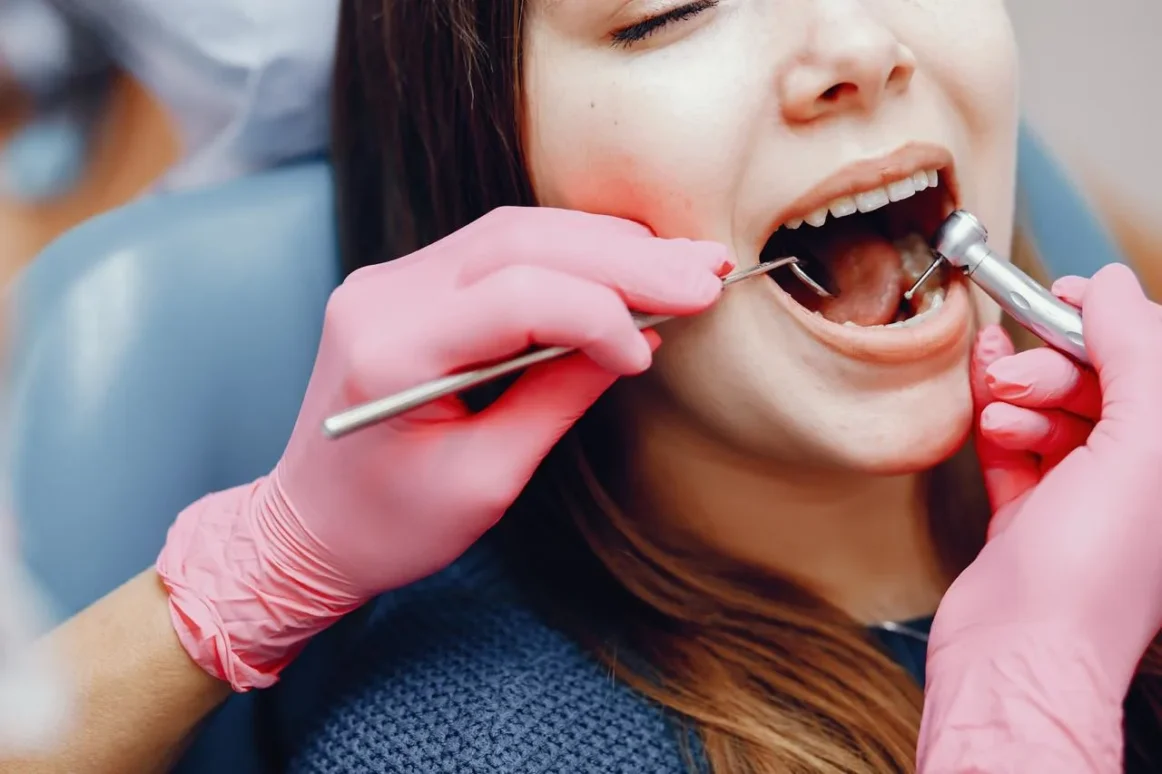
On the day. The appointment can run up to three hours depending on how many teeth are treated. You are awake throughout under local anaesthetic and can go home straight afterwards, though it is sensible to arrange a lift and take the day off. No vigorous exercise and no alcohol for 24 hours.1
The donor site. Where tissue has been taken from the palate, the area heals over on its own — and in the first days it feels much like a burn on the roof of your mouth.1 A protective dressing pack may be placed over it. Packs feel bulky and can interfere a little with speech and eating, which tempts people to pick at them. Leaving them alone is the single most useful thing you can do.
The first two weeks. Stitches come out one to two weeks later. Until then you do not brush the treated area at all — an antiseptic mouthwash does that job instead. Resist the urge to pull your lip back to inspect the graft: it needs to stay undisturbed to take.1
Afterwards. Swelling, bruising, bleeding and sensitivity are all recognised and usually settle within weeks. Once healed, excellent daily cleaning is what stops the recession returning — the surgery buys you a better starting point, not immunity.1,5
Why full root coverage is not guaranteed
A gum graft is not a repair with a predictable end state, and any clinic promising you a specific result before examining you is overselling.
The Cochrane review of root coverage procedures pooled 48 randomised controlled trials and found that a connective tissue graft combined with a coronally advanced flap performs better than the alternatives for reducing recession and gaining tissue.2 Better, though, is not the same as complete. Across the published studies, average root coverage sits in the region of 80% to 85% — with complete coverage achieved in a meaningful share of cases, but not all of them.
NHS specialist guidance puts the same point in plainer language: it is not always possible to cover the exposed roots completely, and there is a real risk that the grafted tissue does not heal into place and is lost.1 How much coverage is realistic depends on the shape of the recession, how much bone and gum remain between the teeth, and how well the area heals.
What that means practically: ask what coverage is realistic for your recession before you agree to anything, and treat a confident guarantee as a warning rather than a reassurance.
A question worth asking about the materials
In some gum operations — particularly regenerative surgery, where the aim is to encourage lost bone and attachment to rebuild — additional products may be used alongside your own tissue.
NHS specialist guidance names them and is direct about their origin: Emdogain, a protein gel, is derived from pigs, and bone granules such as Bio-Oss or Bone Ceramic may also be of animal origin. The guidance advises patients who would prefer not to have products of animal origin used, for religious or ethical reasons, to raise it with their dentist.1
Straightforward soft-tissue grafting uses tissue taken from your own palate, so this does not arise in every case. But it is a fair question to ask before surgery rather than after, and any clinic should be able to tell you exactly what is planned for your case. At DentSpa the material is chosen by the treating surgeon according to what the case requires, and it is discussed with you beforehand.
On the NHS, the barrier is access — not the price
Here is where the £76.60 figure needs context.
NHS Band 2 covers extensive management of gum disease and oral surgery procedures, and costs £76.60 in England for the whole course of treatment however many appointments it takes.3 Gum surgery is listed by the NHS among the treatments available when gum disease is serious.4 So the price is not the obstacle.
The obstacle is that grafting is specialist periodontal surgery. Most general dental practices do not carry it out, which means a referral to a hospital or specialist service — and referrals are made on clinical need, not on how much the recession bothers you. Where it is judged cosmetic rather than necessary, NHS funding does not apply and you are back to private fees.
That gap between “technically available at £76.60” and “actually obtainable this year” is the reason so many people end up searching for private prices at all.
How UK costs compare with treatment in Turkey
Treatment in Turkey costs substantially less than private care in the UK — patients typically save up to 75% against UK private prices, and we set out how those figures work in our guide to dental treatment packages in Turkey and what they include. The difference reflects the cost of running a clinic in Istanbul rather than London, not a difference in what is done.
Gum grafting does need a particular consideration, though, and it is worth being honest about. This is surgery with a two-week healing phase and stitches that need removing, so the timing has to be planned around your trip rather than squeezed into it. That makes it a poor fit for a single quick visit, and a much better one when it is part of a wider treatment plan, when several sites need grafting, or when you are already travelling for other work. For one small area of recession that is not causing problems, the honest answer is that it may not be worth the journey at all.
Getting your recession assessed properly
The only way to know which graft you need — or whether you need one — is an examination. That assessment should tell you three things: which procedure is indicated, how much root coverage is realistic in your case, and what has to happen before surgery is even an option.
DentSpa is an Istanbul dental clinic certified by the Turkish Dental Association and to ISO 9001 and ISO 10002, approved by the Turkish Ministry of Health, and named Best Dental Clinic in Europe in the Odontology category at the 2024 European Awards in Medicine. Soft-tissue grafting is carried out by Dr Serdar Yılmaz, an oral and maxillofacial surgeon with fifteen years’ experience and a doctorate from Marmara University, whose published work includes graft application using the subperiosteal tunnel technique. You can see the full range of gum procedures on our gum treatment page.
- A free consultation before anything is decided — send photographs or an X-ray and get an assessment of whether grafting is indicated at all.
- A written, itemised quote naming the procedure and the sites, so you know which operation you are paying for.
- A realistic answer on coverage for your recession — not a guarantee.
You can read verified patient reviews on Trustpilot and Google, or send your case through the free online consultation.
Frequently asked questions
How much does a gum graft cost in the UK?
Can I get a gum graft on the NHS?
Will a gum graft cover my exposed root completely?
Can I have gum graft surgery if I smoke?
How long does recovery from a gum graft take?
Does every case of gum recession need surgery?
Are the materials used in gum surgery of animal origin?
Sources
- Leeds Teaching Hospitals NHS Trust — Periodontal surgery: information for patients. Developed by Miss H. Beddis, Mr J. Chesterman and Dr K. Durey, Consultants in Restorative Dentistry. leedsth.nhs.uk
- Chambrone L, Tatakis DN, et al. Root coverage procedures for treating localised and multiple recession-type defects. Cochrane Database of Systematic Reviews, 2018. cochranelibrary.com
- NHS — How much NHS dental treatment costs. Band charges for England, updated 1 April 2026. nhs.uk
- NHS — Gum disease: symptoms, treatments and prevention. nhs.uk
- British Society of Periodontology and Implant Dentistry — patient information on gum health and periodontal treatment. bsperio.org.uk















 70%
70%