
Dental implants are one of the most predictable treatments in dentistry. The longest view we have of them — a meta-analysis tracking implants out to 20 years — found survival of 92% in prospective studies and 88% in retrospective ones.1 Two decades on, roughly nine in ten implants are still doing their job. Failure is the exception, not the rule.
But a small, real number do fail, and when they do it shows as a loose post, swelling, bleeding or discomfort that shouldn’t be there. The useful part is that most failures aren’t random: they follow recognised patterns, have identifiable causes, and a large share are preventable through careful planning before surgery and good care afterwards. This guide explains what failure actually means, the warning signs, the major causes, whether a failing implant can be saved, and how failure is prevented.
It’s the honest companion to the wider dental implant procedure — because understanding what can go wrong is precisely how a good clinic makes sure it doesn’t.
What “Implant Failure” Actually Means (and How Often It Happens)
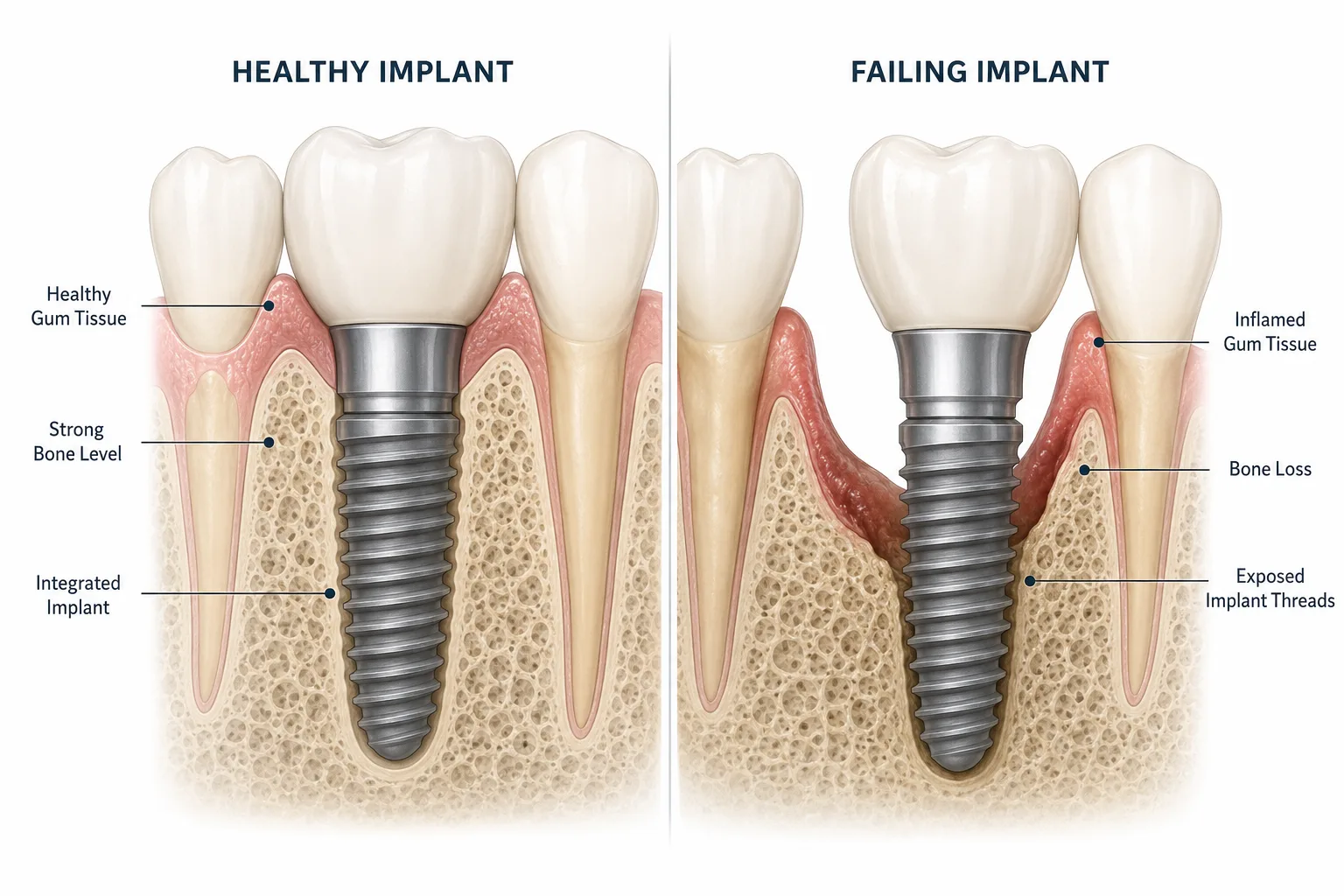
It helps to separate two ideas that often get blurred: survival and success. An implant has survived if it is still in the mouth and not mobile. It is a success if it has done that and the bone and gum around it are healthy, with no ongoing inflammation. An implant can technically survive while quietly underperforming — stable for now, but with bone loss building underneath. That distinction is why a good clinic tracks more than whether the implant is “still there.”
Failure in the strict sense is a breakdown of osseointegration — the implant does not fuse, or stops staying fused, with the jawbone it was meant to bond with. On the long-term numbers this is uncommon: across the 20-year meta-analysis, survival was 92% in prospective studies (n=237 implants) and 88% in retrospective studies (n=1,440).1 The authors’ own conclusion is worth quoting in spirit rather than in slogans: the results are reliable, and follow-up care is what keeps them that way — it shouldn’t stop after the implant is placed.1
When osseointegration truly breaks down, removal and a fresh start is usually cleaner than trying to rescue a post that never integrated. But caught early, many problems can be managed and the implant kept. Timing, as you’ll see, is the theme this whole article keeps returning to.
Early Failure vs Late Failure
Failures tend to cluster in two windows, and the causes differ in each.
- Early failure (first weeks to months), usually before or during osseointegration, traces back mostly to planning and surgery: poor angulation or positioning, bone density that was too low and wasn’t addressed first, infection soon after the procedure, not enough initial stability, or over-preparation of the implant site.
- Late failure (months or years later), after the implant has integrated and been working, traces back mostly to maintenance and biology: peri-implantitis, a misaligned bite or grinding, leftover cement below the gumline, poor hygiene, smoking, alcohol, uncontrolled health conditions, or a mechanical problem like a loose screw or chipped crown.
The pattern is worth remembering: early failures are mostly about planning and surgery; late failures are mostly about maintenance and biology. Both are addressable — just at different stages, and by different people. The first is the clinic’s job; the second is a partnership.
Warning Signs to Catch It Early
The single most important sign is movement — a healthy implant should feel as solid as bone, so any looseness of the implant or crown is often the first indication that integration is breaking down. Beyond that, see your dentist promptly if you notice:
- Persistent or returning pain around the implant, especially when biting or chewing.
- Swelling, redness or bleeding of the gum that lasts beyond the first couple of weeks, or any pus.
- Gum recession exposing the metal, a bad taste or smell, or the crown feeling lower than before.
- On an X-ray, visible loss of bone around the implant — the clearest objective sign your dentist will look for.
Mild swelling and soreness in the first few days is normal healing, not failure — here’s the realistic week-by-week recovery timeline so you can tell ordinary healing from something that needs a look.
The Main Causes, in Plain Terms
Most failures come down to one or more of the following — and notice how many are within your or your dentist’s control.
- Peri-implantitis — the leading driver of late failure. A systematic review of 57 studies put its prevalence at 19.5% of patients and 12.5% of implants.2 Daily cleaning and regular check-ups are the main defence; here’s how peri-implantitis is treated.
- Smoking — one of the biggest single risks. Pooling 292 publications and more than 150,000 implants, failure risk in smokers came out at roughly 2.4 times that of non-smokers, with about 0.58 mm more marginal bone loss, because smoking impairs blood supply and bone healing.3
- Alcohol — heavy drinking, particularly during the healing phase, can interfere with bone metabolism and osseointegration, so limiting alcohol while the implant integrates is sensible.
- Diabetes — across 89 publications, implants in diabetic patients failed more often than in non-diabetic patients (odds ratio 1.78), and the difference was larger in type 1 than in type 2 diabetes.4 The clinical point isn’t to rule anyone out — it’s that your diabetes needs to be discussed and well managed before surgery is planned.
- Certain medications — some drugs affect bone metabolism. A 2024 meta-analysis of 11 studies found a history of antidepressant use was associated with roughly 2.4 times the risk of implant failure,5 and bone-thinning medications used for osteoporosis can also be relevant. Always give your dentist your full medication list.
- Bite overload & grinding (bruxism) — excessive force loosens the bond over time; a night guard often protects the implant.
- Insufficient bone at placement and poor oral hygiene — both avoidable. Where the bone is thin, it’s rebuilt first with a bone graft or, in the upper jaw, a sinus lift, rather than placing the implant and hoping.
Can a Failing Implant Be Saved?
Frequently, yes — if it’s caught early. Where the problem is infection, a thorough professional cleaning around the implant, sometimes with antibiotics or laser treatment, can settle peri-implant inflammation and stabilise the implant. Where the issue is the bite, an adjustment or a night guard relieves the overload. A loose screw or a chipped crown is usually a simple repair, because the restoration is removable.
If osseointegration has genuinely broken down, the cleaner route is to remove the implant, let the site heal — often with a bone graft to rebuild lost support — and place a fresh implant once the area is ready. The second implant does well when the original cause has been identified and corrected, which is the part that matters: replacing the implant without diagnosing why the first one failed simply repeats the experiment. Where several teeth are involved, the plan may shift to a fixed bridge on four implants — see All-on-4.
How Failure Is Prevented
Prevention maps neatly onto the two failure windows.
- Before surgery: plan from a 3D (CBCT) scan, treat any gum infection first, rebuild bone where it’s thin, review medications and health conditions, and place the implant with good primary stability.
- After surgery: clean around the implant daily, don’t smoke, limit alcohol while you heal, protect the bite if you grind, keep diabetes well controlled, and attend your check-ups so any early change is caught and reversed.
Put simply, the assessment beforehand and the aftercare afterwards matter every bit as much as the surgery itself — which is exactly why they shouldn’t be an afterthought. If you’d like the other side of the same coin, here’s how long implants last and what extends their life.
Frequently asked questions
What are the first signs of dental implant failure?
How often do dental implants fail?
Does smoking affect dental implants?
Can I have implants if I have diabetes or take medication?
Can a failed dental implant be replaced?
Can dental implants fail after 10 years?
How DentSpa Plans Against Failure
Because most failures are preventable, every dental implant in Turkey at DentSpa is planned from a 3D scan, with your health and medications reviewed, bone rebuilt where it’s needed, and aftercare and remote support built into the plan — the precise things that stop both early and late failure.
Volume matters here too, because implant outcomes track how often a team handles the situation in front of them. That’s one number you don’t have to take our word for: the manufacturer publishes it. Straumann’s own certificate-verification page records the implants DentSpa placed over a full year, and you can check it in a few seconds — see the Straumann Achievement Award and how to verify it.
The rest is the sort of thing you can look up yourself: DentSpa holds the Certification for Excellence in Medical Travel Patient Experience from Global Healthcare Accreditation, which assesses exactly the parts of treatment abroad that a clinical inspection doesn’t — information before you travel, care coordination and the handover of aftercare.6 The clinic was named best dental clinic in Europe in the odontology category at the European Awards in Medicine, is licensed by the Turkish Ministry of Health, certified to ISO 9001 and ISO 10002, and a member of the Turkish Dental Association. Over 50,000 international patients have been treated at the Şişli clinic — how they found it is in the verified Trustpilot and Google reviews.
Book a free consultation to have your case assessed from a 3D scan before anything is decided.
Sources
- 1. How far can we go? A 20-year meta-analysis of dental implant survival rates. Clinical Oral Investigations, 2024. pmc.ncbi.nlm.nih.gov/articles/PMC11416373
- 2. What is the prevalence of peri-implantitis? A systematic review and meta-analysis (57 studies; 19.53% at patient level). pmc.ncbi.nlm.nih.gov/articles/PMC9583568
- 3. Smoking and Dental Implants: A Systematic Review and Meta-Analysis (292 publications; OR 2.402). pmc.ncbi.nlm.nih.gov/articles/PMC8780868
- 4. Diabetes Mellitus and Dental Implants: A Systematic Review and Meta-Analysis (89 publications; OR 1.777). pmc.ncbi.nlm.nih.gov/articles/PMC9105616
- 5. The Effect of Antidepressants on Dental Implant Failure: A Systematic Review and Meta-analysis (risk ratio 2.44). pubmed.ncbi.nlm.nih.gov/38498803
- 6. Global Healthcare Accreditation — DentSpa Strengthens Global Trust in Turkey’s Dental Services with GHA Certification, 16 July 2026.















 70%
70%