Losing several teeth can feel like the end of the world. It isn’t.
All-on-Six replaces a full arch with six titanium implants placed into the jawbone, carrying a fixed bridge that stays in your mouth — so eating and smiling stop being something you plan around.
One thing to say up front, because it shapes everything below: All-on-6 is not a better version of All-on-4. They are two answers to different amounts of bone. Six implants are an advantage where the bone can host them properly — and six placed into inadequate bone is a worse plan than four placed into good bone. Which one suits you is decided by a 3D scan, not by budget.
This guide covers what All-on-Six involves, who it suits, how the treatment runs, and what recovery actually looks like.
What is an All-on-Six Dental Implant?
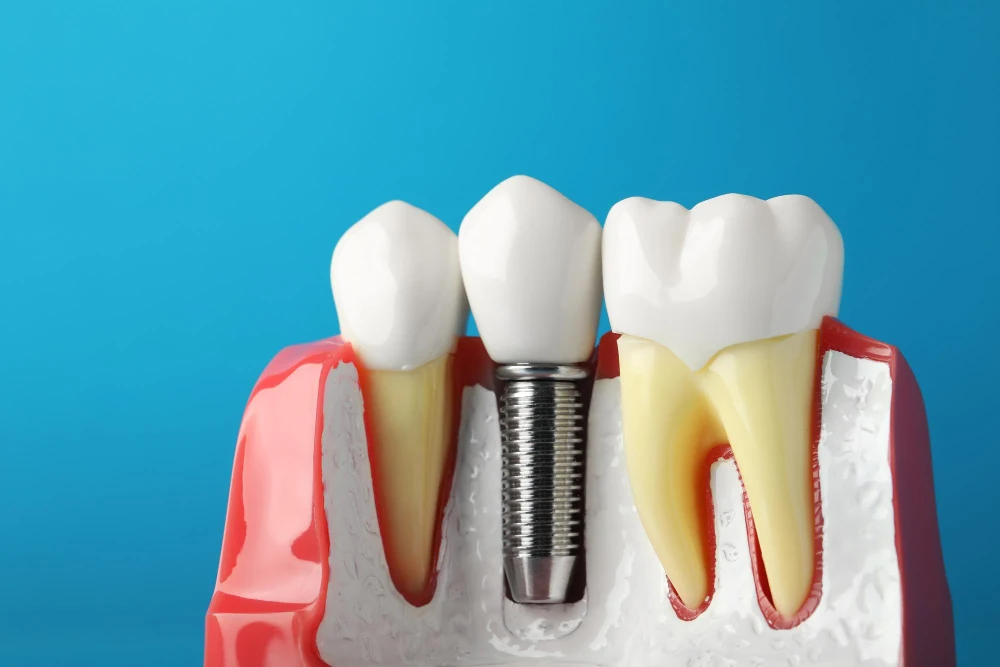
All-on-Six restores a full arch for someone who has lost most or all of the teeth in one jaw. Rather than replacing each tooth individually, six small titanium implants are placed into the jawbone.
They work as artificial roots, supporting an entire row of teeth. You usually receive a temporary prosthesis after surgery; once healing is complete, the permanent bridge is fitted.
There is also a bone argument. When teeth are missing, the ridge loses the loading it used to get from chewing and gradually resorbs — bone loss in the jaw covers why. Implants restore that loading in the treated area, which is what slows the change under the bridge.
Dr Madina Gulverdiyeva, who specialises in implantology and prosthodontics at DentSpa with over fifteen years of experience, puts it simply: “Most people hear ‘titanium posts’ and think it sounds scary. But really, once they heal, you’ll forget they’re even there.”
What Six Implants Give You
- Load spread across six anchors. Chewing force is distributed across more fixation points, so each implant carries less of it — an advantage where the bite is heavy or where grinding is part of the picture.
- Support along the length of the arch. Intermediate implants reduce the unsupported span of the bridge between anchor points.
- A long evidence base. A longitudinal study of full-arch cases — 561 patients and 2,364 implants followed for 3 to 17 years — reported implant survival of 97.4% in the upper jaw and 98.9% in the lower,1 and a meta-analysis put implant survival generally at around 94.6% at 20 years.2
- A fixed result. No adhesives, no removing it at night, and a bridge shaped to your face, gum line and smile.
- Cleaning like natural teeth, with the addition of cleaning under the bridge daily.
Those survival figures are population data across implant treatment rather than a promise about your case. What moves an individual result is bite design, hygiene and regular maintenance — set out in what determines implant lifespan and why implants fail.
As Dr Madina adds: “When the jawbone stays active, your face keeps its shape.”
What the Procedure Looks Like
- Consultation. Often held online first — you share photographs and ask your questions before travelling.
- Planning. Radiographs and a 3D CBCT scan of the jaw. This assesses bone volume and density at each site, checks where the nerve and sinus sit, reviews your health history, and establishes whether six implants are the right number for the bone you have — see how much bone implants actually need.
- Implant placement. The area is numbed with local anaesthetic. Any teeth that need removing are extracted, and six implants are placed at the planned positions.
- Temporary teeth. You may be given a temporary prosthesis. Where it is not fixed to the implants, it is there for appearance and not for chewing — biting on it too early puts load on healing implants. Whether you have one, and of what type, depends on your case.
- Healing and integration. The implants fuse with the bone — osseointegration — which typically takes in the region of three to six months, confirmed by imaging rather than by the calendar. Healing after dental surgery covers what helps.
- Permanent bridge. Once integration is confirmed, the temporary is removed and the definitive bridge is fitted.
At DentSpa the final restoration is often a Malo Bridge — a custom-made full-arch prosthesis designed for use with All-on-4 and All-on-6. How long any bridge lasts depends on the bite, hygiene and maintenance rather than on the product alone.
All-on-4 or All-on-6? Indication, Not Ranking
There is no universal answer, and anyone who gives you one without looking at a scan is guessing.
All-on-4 uses four implants, typically two vertical at the front and two angled at the back. That angulation is deliberate: it engages the bone still available at the front of the jaw and avoids the sinus and nerve, which is why All-on-4 often works without grafting where six implants would need it. That is a design advantage, not a compromise.
All-on-6 adds two more fixation points and shortens the unsupported spans of the bridge — genuinely useful where there is enough bone height and width at six sites, and where the bite is heavy.
| Feature | All-on-6 | All-on-4 |
|---|---|---|
| Implants per arch | 6 | 4 |
| Load distribution | Spread across six points, shorter spans between them | Spread across four, using angled posterior placement |
| Bone required | Adequate height and width at six sites | Adequate anterior bone; limited posterior bone workable |
| Grafting | Sometimes needed to reach six viable sites | Often avoided by design |
| Typically chosen when | Six viable sites available, heavy bite or grinding | Front bone good, back bone limited, grafting to be avoided |
| Cost | Higher — two more implants and more surgical time | Lower, as a consequence of the design rather than the standard |
Read the table across the rows, not down a ranking. The bone decides the protocol, and the protocol decides the cost — not the other way round. The full four-way comparison, including All-on-8 and zygomatic implants, is in our guide to full-arch implant rehabilitation.
All-on-Six Dental Implant Cost
Cost depends on the country, the clinic, the implant system and bridge material, whether grafting or a sinus lift is needed, and how many visits the plan requires.
Treat any figure you find online as an approximate range rather than a quote. A full-arch case is priced from the scan and the plan, and yours is confirmed in writing after an assessment — with the number of visits alongside it. Current ranges are set out in implant prices in Istanbul and dental treatment prices in Turkey.
Turkey is lower than the UK, US and much of Europe, and it is worth being precise about why: the difference comes from the local cost base — staffing, premises and laboratory work — not from fewer implants, cheaper components or a shortened protocol. Many clinics also coordinate transport and accommodation alongside treatment, which removes costs you would otherwise arrange separately.
When you compare quotes, compare the whole plan: implants, abutments, the final bridge, any grafting, and the number of trips. A per-implant price without the bridge is not the real number in any country. More on how the journey is organised in dental tourism in Turkey.
Am I a Candidate for All-on-Six Implants?
You may be a good candidate if you:
- have lost most or all of the teeth in one jaw
- have healthy gums and reasonable general health
- have enough bone at six separate sites — the point the scan settles
- want a fixed result rather than something removable
The plan may change if you:
- smoke heavily — this affects healing and integration, and is worth discussing early
- have a condition such as uncontrolled diabetes, which is usually a sequencing question rather than a refusal
- have insufficient bone at some sites — in which case grafting, a sinus lift, or a four-implant design may be the better route
- have untreated gum disease, which is treated first since the same tissues have to hold the implants
Dr Madina: “To be sure that you’re a good fit for an all-on-six implant, you should always speak with your dentist. They’ll carry out necessary scans and gauge your health history.” If you have been told elsewhere that you have too little bone, that is rarely the end of it.
Recovery and Aftercare
Two different timelines get confused here, so worth separating them:
- Surgical recovery — soreness and swelling for the first several days, managed with cold compresses and the pain relief your dentist advises. This settles first.
- Integration — the months during which the implants fuse with the bone before the permanent bridge is fitted. You feel fine long before this is finished, which is exactly why the temporary is not for chewing on.
To help it along: rest, soft foods early on, plenty of water, avoid smoking and alcohol, keep the mouth clean, and tell your dentist about anything that changes.
Once the permanent bridge is in, day-to-day care is close to natural teeth — with one addition that matters. The bridge cannot decay, but the bone and tissue holding the implants can still be lost to inflammation, which is the main cause of late implant problems. That means cleaning under the bridge daily with the aids you are shown, plus regular maintenance appointments.
Why Choose DentSpa
- Straumann implant systems — Swiss-manufactured, among the most extensively documented implant systems in the world.
- The number of implants chosen from a 3D scan, including the answer that four suits your bone better than six.
- PhD-level specialist dentists and oral and maxillofacial surgeons, with professors and associate professors involved in complex full-arch cases.
- Costs and the number of visits set out in writing before treatment begins.
- Full A–Z care from the online consultation through to aftercare.
DentSpa was named best dental clinic in Europe in the odontology category at the European Awards in Medicine,3 is licensed by the Turkish Ministry of Health, certified to ISO 9001 and ISO 10002, and a member of the Turkish Dental Association. For treatment planned from abroad it also holds the Certification for Excellence in Medical Travel Patient Experience from Global Healthcare Accreditation.4 Since the clinic was founded in Istanbul in 2018, more than 50,000 international patients have been treated — see cases in the smile gallery and read the verified reviews.
Book a free consultation or message us on WhatsApp. Send a scan if you have one, and you will get an assessment of how many implants your bone actually supports, the number of visits, and the cost in writing. If you are comparing clinics, the questions worth asking any of them are in how to find a dentist in Turkey.
Frequently asked questions
Is All-on-6 better than All-on-4?
How long does All-on-Six take from start to finish?
How long do All-on-Six implants last?
Can I eat normally with the temporary teeth?
Will I need a bone graft for six implants?
What does maintenance involve afterwards?
Does smoking rule me out?
Sources
- Longitudinal study of full-arch implant-supported rehabilitations — 561 patients, 2,364 implants, 3 to 17 years’ follow-up.
- Long-term survival of dental implants: systematic review and meta-analysis — survival at 20 years.
- The European Awards in Medicine — DentSpa Clinic — European Award in Medicine in Odontology
- Global Healthcare Accreditation — DentSpa Strengthens Global Trust in Turkey’s Dental Services with GHA Certification









 70%
70%