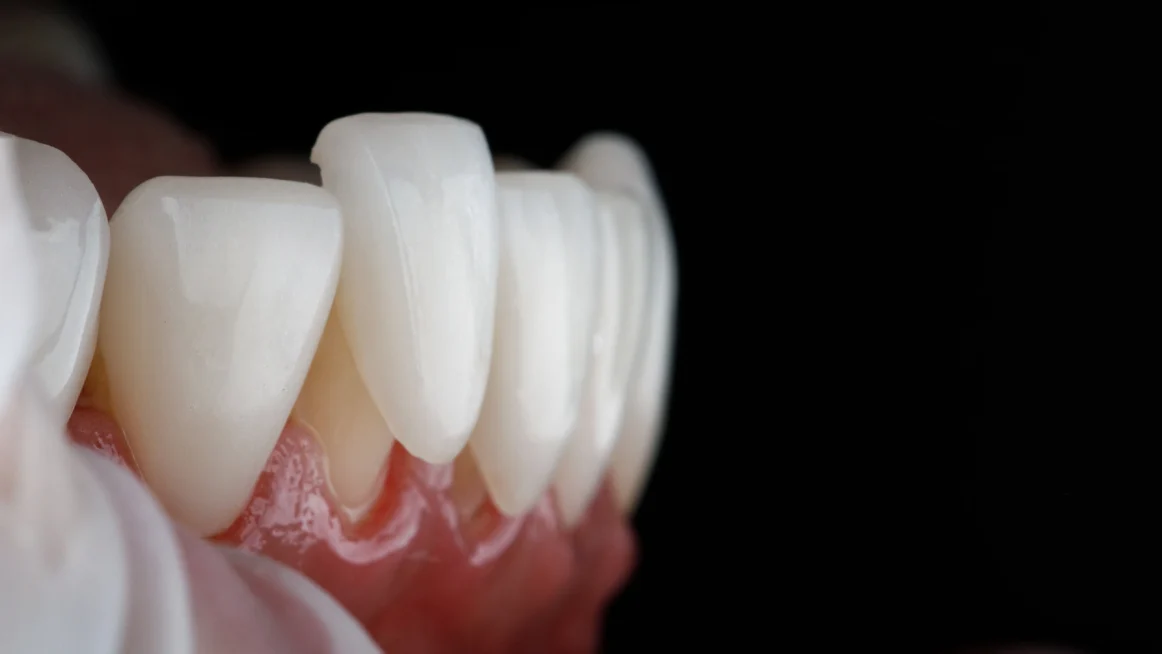
Do you grind your teeth at night? Many people do, and most have no idea until a dentist points out the worn enamel. Bruxism — the involuntary grinding or clenching of teeth — affects somewhere between 8% and 31% of adults, and because it most often happens during sleep, a large share of those people never notice it themselves (1). That matters if you are planning dental veneers at DentSpa or implants, because grinding is a real factor in how long that work lasts. The honest answer to the question of bruxism causing veneer damage, and to what teeth grinding means for dental implants, is yes: left unmanaged, grinding can crack veneers and compromise implants. But it is not a barrier. With the right planning and protection, both treatments remain entirely possible. DentSpa assesses every international patient for bruxism as part of treatment planning, and builds custom nightguard guidance into the plan from the start.
What Is Bruxism (and How Do You Know If You Have It)?
Bruxism is the involuntary grinding or clenching of the teeth. It comes in two forms: awake bruxism, which happens during the day and is often linked to concentration or stress, and sleep bruxism, which happens at night. Sleep bruxism is the more common of the two and far harder to catch on your own, simply because you are asleep when it happens.
The signs are usually there if you know what to look for:
- Morning jaw pain or soreness
- Headaches around the temples
- Flattened, chipped, or worn-down teeth
- Clicking or popping in the jaw joint (TMJ)
- A sleep partner who hears grinding sounds in the night
The causes vary. Stress and anxiety are common triggers, as are sleep disorders such as sleep apnoea, a misaligned bite, and certain medications including some SSRIs. Many of these parafunctional habits go undiagnosed for years.
This is exactly why a great many patients arrive at DentSpa without realising they grind at all. DentSpa’s pre-treatment assessment is designed to identify bruxism before any cosmetic or restorative work begins, so the treatment plan accounts for it rather than discovering it later.
How Bruxism Affects Veneers
Porcelain veneers are thin ceramic shells. They are strong in normal use, but they are also somewhat brittle, and the repeated lateral forces of grinding are very different from the forces of ordinary chewing. Grinding and clenching generate sustained, sideways loads that ceramic was never designed to absorb, which is what puts veneers at risk in bruxers.
The specific risks are:
- Fractures and chips, particularly along the veneer edges
- Debonding, where the veneer works loose from the tooth
- Accelerated wear, leaving veneers looking dull or uneven over time
The clinical evidence backs this up. A University of Valencia study that followed 323 porcelain laminate veneers found that the majority of fractures and debonding incidents occurred in patients with bruxism, and that wearing an occlusal splint reduced the risk of fracture (2). In other words, grinding clearly raises the failure rate, and protection clearly lowers it.
The key point is that bruxism does not disqualify you from veneers. It changes how they should be planned. For patients who grind, DentSpa recommends zirconia veneers, which are stronger and more fracture-resistant than standard porcelain, and provides a custom nightguard as part of the treatment plan. The same expertise sits behind a full Hollywood Smile at DentSpa, where material choice and bite protection are planned together.
Considering veneers but worried about grinding? Book a free online consultation with DentSpa — our specialists assess bruxism as part of every treatment plan. Book a Free Consultation →
How Bruxism Affects Dental Implants
Implants behave differently from veneers, and the reason is biological. A natural tooth sits in a periodontal ligament, a thin layer of tissue that absorbs and cushions the force of biting. A dental implant has none of that. It fuses directly to the jawbone in a process called osseointegration, which means there is no built-in shock absorber. Every gram of grinding force passes straight into the implant post, the crown, and the surrounding bone.
That creates two critical risk windows. The first is during healing. Grinding while the implant is still integrating can cause micro-movements that interfere with osseointegration, raising the risk that the implant never fuses properly. The second is long-term. Even after an implant has fully integrated, chronic grinding can accelerate bone loss around it (a contributor to peri-implantitis), loosen the crown or abutment screw, and over time threaten the implant itself.
The data here is striking. A 2025 systematic review and meta-analysis published in the MDPI Dentistry Journal, drawing on fifteen studies, found that bruxism carried a pooled odds ratio of 4.68 for implant failure — meaning bruxers face roughly 4.68 times the risk when protective measures are not in place (3). A separate 2024 meta-analysis covering 27 studies and more than 12,000 implants reached the same conclusion: implants placed in probable bruxers fail significantly more often than in non-bruxers (4). Alongside outright failure, bruxers also see more crown fractures, abutment screw loosening, and faster bone resorption.
Once again, though, bruxism is a risk factor, not a disqualifying one. With proper management — a nightguard, bite adjustment, and the right crown material — patients who grind can still be excellent implant candidates. DentSpa screens all implant patients for bruxism using bite analysis and full clinical assessment, and custom nightguards are recommended for every bruxer receiving dental implants at DentSpa, factored into the plan from day one.
Can You Still Get Veneers or Implants If You Grind?
Yes. Bruxism is not a disqualifying condition — it is a manageable risk factor. The whole difference lies in identifying it before treatment begins and building protection into the plan rather than reacting to problems afterwards.
For veneers, that means selecting the appropriate material (zirconia for severe grinders), fitting a custom nightguard, and adjusting the bite where needed. For implants, the treatment plan accounts for the extra grinding load, may use stronger crown materials and more strategic implant placement, and treats a nightguard as essential after the procedure.
DentSpa’s approach is to give every international patient a full bruxism assessment as part of the pre-treatment evaluation. The team identifies grinding patterns from wear marks, bite analysis, and patient history — often picking it up even when patients have no idea they grind. Custom nightguards are included in treatment plans for bruxers at no surprise cost, which reflects DentSpa’s focus on how the work holds up over years, not just how it looks on the day.
Get a free online bruxism and smile assessment — send DentSpa your photos or X-rays and receive a personalised treatment plan before you travel. Start My Free Assessment →
Why Choose DentSpa for Treatment as a Bruxer
DentSpa has treated over 50,000 international patients from more than 50 countries, and a great many of them grind their teeth. That volume matters, because it means the clinical team has seen the full range of cases rather than only the straightforward ones.
A few things set DentSpa apart for patients who grind. The full pre-treatment assessment combines bite analysis, wear-pattern evaluation, and patient history to detect bruxism before patients are even aware of it. On materials, DentSpa uses CE-certified and FDA-compliant products, and for bruxers the team recommends zirconia veneers for their superior fracture resistance, along with zirconia-based crowns on implants. Custom nightguards are fabricated on-site from digital impressions and included as standard for bruxism patients. Aftercare continues once you are home, with the team reachable via WhatsApp and treatment records shareable with your local dentist. And because this is Istanbul, the full package — bruxism assessment and nightguard included — typically costs a fraction of equivalent private care in the UK or North America, with no compromise in clinical standard. Patient experiences across more than 2,500 DentSpa patient reviews reflect that consistency.
Frequently asked questions
Can I get veneers if I grind my teeth?
Will grinding break my veneers?
Can I have dental implants if I grind my teeth?
How does DentSpa check for bruxism?
What type of nightguard is recommended after implants or veneers?
Does teeth grinding affect All-on-4 or All-on-6 implants?
Conclusion
Bruxism is common, frequently undetected, and a genuine risk factor for both veneers and implants — but it is manageable. The combination of the right material, a properly adjusted bite, and a custom nightguard keeps veneers and implants a viable option for the vast majority of people who grind. Every patient who comes to DentSpa in Istanbul receives a comprehensive bruxism assessment as standard, because protecting the result over the years ahead matters as much as how the smile looks on the day it is finished.
Planning veneers or implants abroad? Start with a free consultation at DentSpa. Our specialists will assess your bite, check for bruxism, and build a personalised treatment plan — before you book your flight. Book Free Consultation →
Sources
Manfredini D, Winocur E, Guarda-Nardini L, Paesani D, Lobbezoo F — Epidemiology of Bruxism in Adults: A Systematic Review of the Literature (Journal of Oral & Facial Pain and Headache) — https://pubmed.ncbi.nlm.nih.gov/23630682/ — 2013
Granell-Ruíz M, et al. — Influence of bruxism on survival of porcelain laminate veneers (Medicina Oral, Patología Oral y Cirugía Bucal / National Library of Medicine) — https://pmc.ncbi.nlm.nih.gov/articles/PMC4192563/ — 2014
Ionfrida JA, Stiller HL, Kämmerer PW, Walter C — Dental Implant Failure Risk in Patients with Bruxism — A Systematic Review and Meta-Analysis of the Literature (Dentistry Journal, MDPI / National Library of Medicine) — https://pmc.ncbi.nlm.nih.gov/articles/PMC11763436/ — 2025
Häggman-Henrikson B, Ali D, Aljamal M, Chrcanovic BR — Bruxism and dental implants: A systematic review and meta-analysis (Journal of Oral Rehabilitation) — https://pubmed.ncbi.nlm.nih.gov/37589382/ — 2024















 70%
70%