

Table of content
Table of content
When someone asks “why do my teeth hurt when I eat sweets?”, the answer is usually that sugar has found a gap in the tooth’s armor. Most often that gap is a cavity [1][2]. It can also be worn enamel, a gum that’s crept back off the root, or a filling lifting at the edge [3]. All fixable.
Why do my teeth hurt when I eat sweets? What’s going on inside
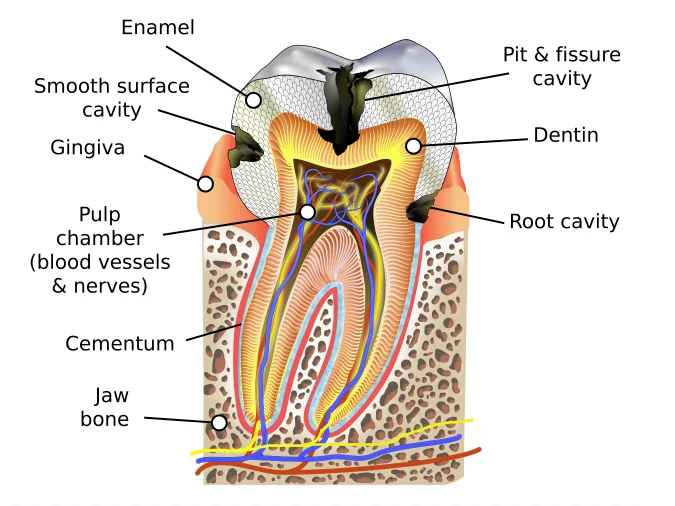
A tooth is a bit like a house with good insulation. Enamel covers the part you can see. Down below the gum, the root has its own thinner covering, called cementum. And under both of those sits dentin, which is shot through with microscopic tubes leading in toward the nerve [3].
Keep the insulation whole and sugar barely registers. Wear a patch away, though, or let decay eat through it, and those little tubes are left open to whatever you put in your mouth, sweet or hot or cold [3].
What you actually feel is the nerve reacting to fluid sloshing around inside the tubes [4]. People who get tooth pain eating sweets often describe it as a quick electric zing, there and gone again before they’ve finished swallowing.
Odd as it sounds, that zing is useful information for your dentist. If you’d like to see the full list of suspects before your appointment, this article on the common causes of tooth sensitivity has it.
The most common causes
A cavity
This goes first on the list because it’s the one that gets worse if ignored. Early decay is often silent. By the time it speaks up, the classic complaint is a sharp pain with anything hot, cold or sweet [1], and NIDCR lists sensitivity to sweets as a sign that decay is moving deeper [2]. The repair depends on how far it’s got, which this guide to cavity treatment lays out stage by stage.
Worn enamel
Enamel doesn’t grow back, and it thins out over the decades. Thinner enamel puts the dentin closer to the surface [3]. That can leave teeth reacting to heat and cold as well as sugar [3]. Fluoride can toughen up what’s left, and there’s more on that in this piece on strengthening your enamel.
An exposed root from receding gums
Roots were never meant to see daylight. There’s no enamel on them, so when the gum slides back, the exposed surface is much more sensitive [3]. Bacteria can then reach the root and start decay there, which NIDCR notes is common in older adults with receding gums [2]. Noticed your teeth looking a little longer near the gum line? This article on root tooth decay is a good next read.
A cracked or leaking filling
No filling is forever, and many need replacing eventually [5]. Worn fillings can leave a tooth sensitive [3], and a loose or broken one is on the NHS’s list of toothache causes [6]. All it takes is a hairline gap at the edge for sugar to seep underneath. A crack in the tooth itself lets it in just as easily [3][6].
No cavities, but teeth hurt when eating sweets?
This one confuses a lot of people. You were told everything looked fine, and yet a spoonful of something sugary still makes you flinch.
Most of the time it’s one of the culprits above that isn’t a cavity at all. Thinned enamel, a root that’s lost its gum cover, the worn rim of an old filling [3].
Then there’s timing. When was “no cavities” actually checked? Decay can begin quietly in the months between visits, and early on it usually doesn’t hurt [1].
A tooth sensitive to sugar with no visible hole can also be decay at its very first stage, when the enamel is losing minerals but hasn’t broken. Here’s the encouraging bit: at that point it can still be stopped, even reversed, with fluoride [7]. No drilling.
Why do back teeth hurt with sweets more often?
Run your tongue over a molar. All those bumps and grooves? Food and bacteria settle into them and stay put, because toothbrush bristles simply can’t reach the bottom [7]. It’s no accident that most cavities in children and teenagers start in the molars [7]. The tight spots where back teeth touch are another hiding place for decay, out of sight of the mirror.
Molars also do the heavy lifting when you chew, year after year. That’s a lot of force, and over time it can crack a tooth or grind down a filling. Either one can turn a single back tooth into the one that complains whenever you have something sweet [3][6].
If it’s the same tooth every time, take that seriously.
Tooth hurts when eating sweets after a filling
Had a filling recently and now it’s twinging? You’re in good company. A review of composite fillings in back teeth found patients often report some sensitivity afterwards, mild for some and sharper for others, usually with nothing actually wrong with the filling [4]. The cause traces back to that same fluid movement in the dentin [4]. Give it a little time, and if it isn’t calming down, ask your dentist to check the bite and the seal.
An old filling is another story. When a tooth that’s been quiet for years suddenly starts reacting to sugar, think wear, a crack, or an edge that’s come loose [3][6]. This guide to when a filling needs replacing covers what to look out for, and catching a leak early keeps the repair small.
How a dentist fixes tooth sensitivity to sugar
Everything hinges on the cause, so the first appointment is mostly detective work: an exam, and quite often an X-ray.
Caught very early, before there’s a hole, decay can sometimes be reversed with a fluoride varnish or a prescription mouthwash [1]. If a cavity has already formed, the dentist clears out the decay and rebuilds the tooth, these days usually with a composite filling [5].
Worn enamel and exposed roots call for a different toolkit. That might be a desensitizing toothpaste, a fluoride gel painted on in the clinic, a layer of bonding over the sore spot, or a gum graft to cover a bare root [3]. Leaking fillings get repaired or swapped out, and a tooth that’s badly broken down may need a crown or an inlay [3].
Root canal treatment sits at the far end. It’s for sensitivity that’s severe and won’t respond to anything else, or for a tooth whose nerve has become infected [3][8]. There’s more detail in this guide to treatments for sensitive teeth.
What you can do at home until your appointment
Think of this as damage control. It won’t fix the cause, but it can make the next few days easier.
Swap your usual toothpaste for a desensitizing one. It needs several uses before it really kicks in, so stick with it [3]. Brush morning and night with fluoride toothpaste, and when you’re done, spit but don’t rinse; that way the fluoride stays on your teeth [1]. A soft brush helps. So does leaving the floss alone right around the sore tooth for now [6].
For an ache, ibuprofen or acetaminophen (paracetamol) can take the edge off. Stick to the dose on the label, and if you’re unsure which one is right for you, a pharmacist can tell you [6]. Beyond that, go easy on whatever triggers it until the tooth has been looked at.
When to see a dentist soon
A tooth that keeps flinching at sugar needs a check-up regardless. Some signs push it up the queue, though. The NHS says to see a dentist if toothache lasts longer than two days or doesn’t respond to painkillers, and also if it comes with a fever, pain on biting, red gums, a bad taste, or a swollen cheek or jaw [6].
Pain that hangs around long after the sweet is gone, or that starts all by itself, can mean the nerve is involved. When a tooth is infected, root canal treatment removes the infection and seals the tooth [8].
One situation can’t wait at all. If swelling spreads up toward your eye or down into your neck, or makes it hard to breathe, swallow or talk, go straight to the emergency room or call 911 [6].
Treatment at DentSpa in Istanbul
At DentSpa, we work out the cause first. That means starting from the clinical findings: which tooth hurts, what sets it off, what the X-rays show, and the state of your gums and any old fillings. Then we listen to what you want. Some patients just want the pain gone. Some want to protect a tooth that’s been patched more than once. Others would rather deal with every sensitive tooth in a single plan.
From there, your dentist explains why one approach fits you and why another doesn’t, such as why bonding may suit a sensitive root better than a filling, or why an old filling is better replaced than repaired. Quality is never reduced to reach a price.
Treatment at DentSpa costs up to 70% less than private prices in the US. The difference comes from local staff and laboratory costs in Istanbul. It doesn’t come from doing less work or using different materials.
Stop guessing and get it checked
That jolt you get from sugar is your tooth’s way of saying something has gotten in. Find out what it is now and the fix is usually small. Book a free consultation with the DentSpa team. A dentist will go over your findings with you, ask what you’d like, and explain the treatment that suits your tooth.
Frequently asked questions
Why do my teeth hurt when I eat something sweet?
Why do my back teeth hurt when I eat sweets?
How do you fix tooth sensitivity to sugar?
What is the 3-3-3 rule for toothache?
How do I fix tooth sensitivity?
What does a sugar tooth feel like?
Sources
- NHS. Tooth decay. https://www.nhs.uk/conditions/tooth-decay/
- National Institute of Dental and Craniofacial Research (NIDCR). Tooth Decay. https://www.nidcr.nih.gov/health-info/tooth-decay
- American Dental Association, MouthHealthy. Sensitive Teeth. https://www.mouthhealthy.org/all-topics-a-z/sensitive-teeth
- Sabbagh J, Fahd JC, McConnell RJ. Post-operative Sensitivity and Posterior Composite Resin Restorations: A Review. Dent Update. 2018;45(3):207–213. https://dental-update.co.uk/content/restorative-dentistry/post-operative-sensitivity-and-posterior-composite-resin-restorations-a-review
- National Institute of Dental and Craniofacial Research (NIDCR). Dental Fillings. https://www.nidcr.nih.gov/health-info/dental-fillings
- NHS. Toothache. https://www.nhs.uk/conditions/toothache/
- National Institute of Dental and Craniofacial Research (NIDCR). The Tooth Decay Process: How to Reverse It and Avoid a Cavity. https://www.nidcr.nih.gov/health-info/tooth-decay/more-info/tooth-decay-process
- NHS. Root canal treatment. https://www.nhs.uk/tests-and-treatments/root-canal-treatment/














 70%


