
Table of content
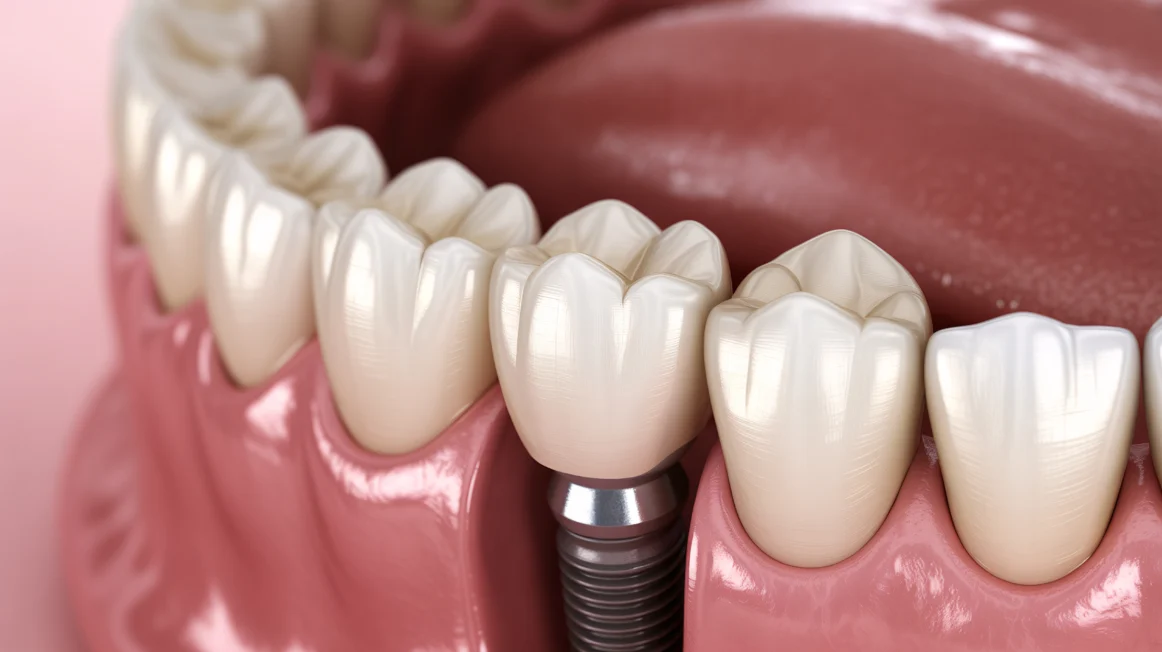
Implants are a serious investment, so the first question almost everyone asks is fair: how long will they last?
The honest answer has two halves. The averages are genuinely good — modern implants survive at around 96% after ten years, and roughly four out of five are still working at twenty. [1][2] But “average” isn’t “guaranteed.” A specific implant lasting a decade, two decades, or a lifetime depends on factors, some in your control and some not.
This guide breaks down what those factors are, why bone health sits at the centre of all of them, what maintenance actually moves the needle, and where the regenerative therapies you’ve read about really stand today.
So how long, realistically?
By design, implants are built to last a long time — typically quoted at anywhere from 10 to 25 years, and often longer. The data backs the optimism: a 2019 systematic review put ten-year survival at roughly 96% at the implant level, and a 2024 meta-analysis looking out to twenty years found about four in five implants still functioning. [1][2]
What those numbers don’t tell you is which group you’ll land in. The implant itself is rarely the weak point — titanium and zirconia are durable and biocompatible. What varies is everything around it: the bone holding it, the gum sealing it, and the habits maintaining it.
What actually determines implant lifespan
Bone quality and quantity
This is the foundation, literally. An implant needs solid, dense bone with enough volume to hold it firmly. If the surrounding bone is thin, soft, or insufficient, the implant has less to grip and is more vulnerable over time. Bone health isn’t a one-time check at placement either — it’s something that matters across the implant’s whole life.
Daily oral hygiene
An artificial tooth is not exempt from cleaning. Brushing twice a day, flossing regularly, and avoiding tobacco do more for implant longevity than almost anything else you control. Neglect lets bacteria settle around the implant, and that’s the start of the inflammation that ends implants early.
Smoking
Smoking works against implants in a specific, mechanical way. It reduces blood flow to the gums and jawbone, which weakens bone quality and slows healing. A poorly healing site struggles to integrate the implant and is more prone to peri-implantitis — the leading cause of late failure, strongly linked to smoking in the research. [3] Of all the risk factors, this is one of the most controllable.
Systemic health
Conditions like poorly controlled diabetes, lupus, rheumatoid arthritis, and other autoimmune disorders affect healing and bone, directly and indirectly. They don’t rule out implants, but they need to be managed before placement and monitored after.
Why bone health is the centre of it all
A useful way to think about it: an implant needs healthy bone the way a house needs foundation. Without enough surrounding jawbone, an implant can’t stay stable over the long term, full stop.
Before bone is considered suitable for a standard implant, it generally needs to meet three conditions:
| Requirement | Typical guide |
|---|---|
| Height | Around 8–10 mm, to accommodate the implant length |
| Density | Sturdy enough to support the titanium post |
| Width | Around 4–6 mm, to fully encase the implant |
Fall short on these and placing an implant anyway invites two predictable problems.
Poor osseointegration. Osseointegration is the structural fusion between implant and bone, and it’s the whole basis of stability. Without adequate bone, that fusion is weak or doesn’t happen — the implant shifts under load and eventually fails.
Structural weakness. Low bone density and volume leave vulnerabilities around the implant where bacteria collect more easily, raising the risk of peri-implantitis and failure.
This is exactly why, when bone is lacking, bone grafting and sinus lifts are done first. They’re not upsells — they build the foundation that makes a long-lasting implant possible.
Can regenerative therapies extend implant lifespan?
Regenerative approaches — exosomes, mesenchymal stem cells, platelet-rich plasma (PRP) — come up constantly in implant longevity conversations, and the underlying biology is real and interesting. Two mechanisms get the attention:
Supporting bone remodelling. Bone is in constant turnover between cells that build it (osteoblasts) and cells that break it down (osteoclasts). When that balance tips towards breakdown, an implant loses support. Regenerative therapies aim to nudge the balance back towards bone formation, which in theory improves long-term stability.
Reducing chronic inflammation. Chronic inflammation is what tends to kick off peri-implantitis. Brushing and flossing reduce it to a point, but they don’t switch off the cells producing the inflammatory signals. Exosomes — cell-free bioactive vesicles — are being studied precisely because they can target those signalling pathways.
Now the honest part. The strongest current evidence for these therapies in bone and periodontal regeneration shows real promise but is still mostly early-stage: reviews of human trials report a clinical benefit in some settings yet conclude there isn’t enough evidence to say which technique is best, and they frame these therapies as an adjunct to grafting rather than a replacement for it. [4] Much of the supporting data, particularly for exosomes, still comes from laboratory and preclinical work.
So as it stands: a credible research direction, not an established, widely available way to make your implant last longer. If a clinic offers these therapies, ask what evidence supports the specific claim and whether they’re regulated where you’re treated. For now, the things that reliably extend implant life are unglamorous and proven — good bone, clean habits, and regular monitoring.
The maintenance that actually keeps implants long-term
Longevity is less about any single intervention and more about consistency. Three habits do most of the work.
Professional cleanings. There are spots around an implant a toothbrush simply can’t reach, and bacteria settling there drive inflammation over time. Routine professional cleaning clears those areas and is one of the clearest protectors of implant life.
Bone-level monitoring. Periodic check-ups with X-rays catch problems — bone loss, early inflammation — before they advance. Steady monitoring confirms the implant stays properly supported and lowers the risk of long-term complications.
Early treatment of inflammation. Peri-implantitis doesn’t appear overnight. It starts as mild inflammation and worsens slowly until it threatens the implant. Caught and treated early, the damage stays limited. Caught late, it often doesn’t.
If you grind your teeth, a night guard belongs on this list too — unmanaged grinding puts heavy, repeated load on implants and the bone around them.
Why patients choose DentSpa for long-lasting implants
DentSpa’s implant work is built around the things that actually determine lifespan: bone foundation and precise planning. The clinic uses 3D CBCT imaging and iTero scanning to assess bone and plan placement exactly, and the surgical team covers the full range — single tooth implants, implants for multiple teeth, All-on-4 and All-on-6, and the foundation procedures behind them, bone grafting and sinus lifts.
Longevity also depends on what happens after you leave, which is why aftercare continues remotely once you’re home, with records that can be shared with your local dentist for ongoing monitoring. You can see real outcomes in the smile gallery and read about the clinical team before deciding.
If you’re planning implants — or want an existing one assessed — start with an evaluation of your bone and risk factors. Book a free consultation and send recent X-rays or a scan, and you’ll get a clear, realistic picture before committing to anything.
Frequently asked questions
How long do dental implants last?
Can implants last a lifetime?
Why do some implants fail years later?
Can bone loss shorten implant lifespan?
Can regenerative therapies support long-term stability?
How often should implants be checked and cleaned?
What are the warning signs an implant may not last?
Sources
- Howe MS, Keys W, Richards D. Long-term (10-year) dental implant survival: A systematic review and sensitivity meta-analysis. Journal of Dentistry. 2019. (Pooled 10-year implant-level survival of approximately 96.4%.) https://pubmed.ncbi.nlm.nih.gov/30904559/
- How far can we go? A 20-year meta-analysis of dental implant survival rates. Clinical Oral Investigations. 2024. (Consolidates 20-year survival data, reflecting roughly four out of five implants still functioning.) https://link.springer.com/article/10.1007/s00784-024-05929-3
- Galarraga-Vinueza ME, et al. Prevalence, incidence, systemic, behavioral, and patient-related risk factors and indicators for peri-implant diseases: An AO/AAP systematic review and meta-analysis. Journal of Periodontology. 2025. (Patient-level peri-implantitis prevalence ~21%; periodontitis, diabetes, smoking, and alcohol identified as risk indicators.) https://aap.onlinelibrary.wiley.com/doi/10.1002/JPER.24-0154
- Cell-Based Therapies for Alveolar Bone and Periodontal Regeneration: A Concise Review. Stem Cells Translational Medicine. 2019;8:1286–1295. (Reports clinical benefit in some settings but insufficient evidence to identify the best technique, and frames mesenchymal stem cells as an adjunct to grafting rather than a standalone treatment.) https://www.ncbi.nlm.nih.gov/pmc/articles/PMC6877771/















 70%
70%