
Table of content
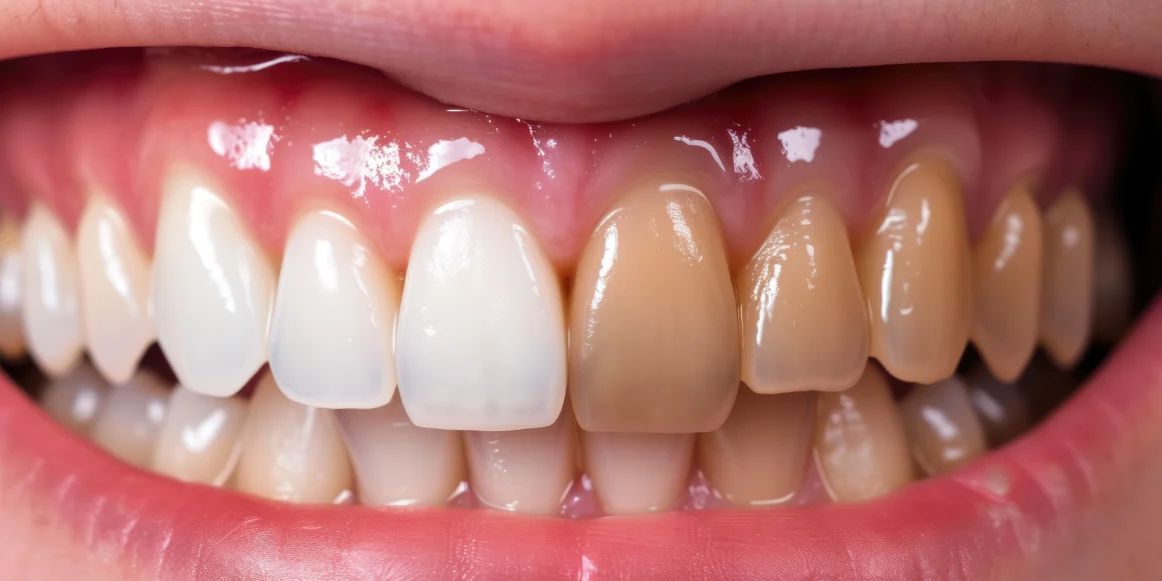
Most brown stains on teeth are surface staining from coffee, tea, red wine, tobacco or hardened tartar — and those come off with a professional clean. But a brown spot can also be early tooth decay, and the NHS lists “white, brown or black spots on your tooth” among the signs of it.1 Telling the two apart is the first thing to do, and there is a check you can run yourself.
That distinction is why the same advice doesn’t work for everyone. This guide covers how to tell a stain from decay, where brown discolouration comes from, and which treatment actually matches which cause — starting with the least invasive one, not the most.
Is It a Stain, or Is It Decay?
Run your tongue or a fingernail over it. That single action tells you more than any photograph.
| More likely a stain | Worth checking for decay | |
|---|---|---|
| Surface | Smooth, level with the rest of the tooth | Rough, pitted, catches a fingernail |
| Where | Along the gum line, between teeth, on the flat front surfaces | In a groove on a back tooth, or right at the contact point between two teeth |
| Sensitivity | None | A sharp twinge with hot, cold or sweet |
| Change | Builds gradually, matching your habits | Appeared and then kept getting darker or bigger |
This is worth doing rather than worth worrying about, and here is why: the NHS states that a dentist can prescribe fluoride treatments such as mouthwash or varnish to reverse early tooth decay.1 Caught at the spot stage, there may be nothing to drill at all. That window is the reason to look now rather than in a year.
If it does turn out to be decay, our guide to fixing tooth decay covers what happens at each stage — and how much of it is reversible.
Why Brown Stains Appear on Teeth
Enamel is the hardest tissue in the human body, but it isn’t a sealed surface. It has microscopic porosity, and pigments from what you drink settle into it and stay.
Under the enamel sits dentine, which is naturally more yellow-brown. Enamel thins with age and with acid wear, and as it does, more of that dentine shows through. This is why teeth can darken even when your brushing has never changed — you are seeing more of the layer underneath, not more dirt on top. What keeps enamel in good condition is covered in our guide to looking after tooth enamel.
The usual contributors:
- Coffee, tea, red wine and cola — the pigments in all of them bind readily to enamel.
- Plaque and tartar, particularly along the gum line, which absorb colour and hold it against the tooth.
- Tobacco, which produces a characteristic deep brown that is stubborn to shift.
- Acid wear from fizzy drinks, citrus or reflux, thinning the enamel.
- Old fillings that have discoloured at the edges, or amalgam greying the tooth around it — the subject of our guide to replacing amalgam fillings.
- Past trauma to a tooth, or certain medications and high fluoride exposure during childhood, while the tooth was still forming.
Extrinsic vs Intrinsic Stains — and Why It Matters
Extrinsic stains sit on the outside of the enamel. Food and drink pigments, tobacco, plaque and tartar. These show up along the gum line and between teeth, where a brush doesn’t reach cleanly, and they are the ones a professional clean removes outright.
Intrinsic stains are within the tooth itself — thinner enamel letting darker dentine through, changes from trauma, or colour laid down while the tooth was developing. A brush will never reach these, and neither will a whitening toothpaste.
One correction worth making, because it is widely misstated: whitening is not limited to surface stains. The American Dental Association states plainly that whitening treatments can be effective on both extrinsic and intrinsic staining.2 Deep intrinsic discolouration responds less predictably and may need more than whitening, but “it’s internal, so whitening won’t help” is not accurate.
Brown Stains Around the Gum Line
This is the most common location, and there is a mechanical reason for it: the gum line is the hardest place to clean well, so plaque sits there longest and hardens into tartar. Tartar is porous and grips pigment, so the band darkens faster than the rest of the tooth. Once it has hardened, brushing will not remove it — that requires scaling, which is what a hygienist appointment is for. Our guide to scaling and root planing explains what that involves.
Two other things produce brown at the gum line, and they matter because the treatment differs:
- Decay at the neck of the tooth, where enamel is thinnest. This one looks like a stain until you feel that it is soft or rough — which is exactly why the check at the top of this page is the place to start.
- Receding gums exposing root surface, which is dentine rather than enamel and is naturally darker and more porous. Nothing has gone wrong with the enamel; you are seeing a different tissue.
A brown line that appeared quickly, or that keeps coming back within weeks of a clean, is worth having examined — not because it is dangerous, but because the reason it returns that fast is usually fixable once it is named.
How to Get Rid of Brown Stains on Teeth
These are in order. Almost nobody needs to start at the bottom of the list, and a plan that opens with veneers has skipped several steps.
1. Professional cleaning — the first step for most people
Scaling and polishing removes tartar, the surface staining held in it, and the buildup between teeth and along the gum line. For extrinsic staining, this is the treatment, not a preliminary to one.
People routinely find their teeth look several shades better afterwards without any whitening at all — because a good proportion of what they were seeing was tartar, not tooth. The difference between cleaning and whitening, and which one your case needs, is set out in our comparison of teeth cleaning vs teeth whitening.
2. Professional whitening
Where the tooth is clean and the colour is still darker than you want, whitening lightens the tooth itself. Peroxide breaks down the pigment molecules held within the enamel and dentine, rather than scrubbing anything off.
Two things the ADA is explicit about, and both change what you should expect:2
- Only natural teeth whiten. Fillings, crowns and veneers do not change colour. If you have a white filling in a front tooth, whitening the teeth around it will make it stand out — which is a reason to sequence the work, not a reason to avoid whitening.
- Temporary tooth sensitivity and gum irritation are the most common side effects, and they are temporary. This is why concentration and contact time are chosen for your enamel rather than set to maximum.
How in-practice whitening works appointment by appointment is covered in our guide to Zoom teeth whitening.
3. Microabrasion
For discrete brown or white marks sitting in the outermost enamel — developmental spots, mild fluorosis — a very thin surface layer is removed with a fine abrasive and acid, and the mark goes with it. It is often combined with whitening afterwards to even out the shade, and it is far more conservative than covering the tooth.
4. Fillings, where the cause is decay or an old restoration
If the brown area is decay, or the edge of a filling that has stained or begun to leak, no amount of whitening will address it. The tooth is restored with composite filling material matched to the surrounding shade, which fixes both the appearance and the underlying problem in one step.
5. Veneers or crowns — when the colour is beyond whitening
Where discolouration is deep, uneven, or comes with a tooth that also needs its shape or strength addressed, a restoration covers it. Veneers face the front of the tooth; crowns cover it entirely.
Which of the two suits a given tooth is a question of what is left of it rather than a question of quality — the line between them is set out in our guide to veneers vs crowns. And if whitening is on the table at all, it happens before this stage, so the ceramic can be matched to the lighter shade rather than to the old one.
Home Care: What Helps, and What Doesn’t
Worth doing:
- Brush twice daily with fluoride toothpaste, and clean between the teeth every day — that is where gum-line staining starts.
- Rinse with water after coffee, tea or wine, rather than brushing immediately — enamel is softened straight after anything acidic.
- Use a whitening toothpaste as maintenance for surface stain, not as a treatment for a spot.
- Keep routine check-ups, which is how the ones you cannot see get caught.
Not worth doing — and this is not an opinion. The ADA reviewed the popular home remedies: a strawberry and baking-soda mixture produced no measurable whitening, and a charcoal-and-salt mixture was found to be abrasive and ineffective, leaving teeth with a yellow cast that the authors attributed to enamel being removed during brushing.2
The mechanism there is worth understanding, because it explains why abrasive methods backfire: removing enamel exposes more of the yellow-brown dentine underneath. Scrubbing harder to remove a stain can leave the tooth looking darker than when you started. If you have been using strips, our guide to whitening strips covers what they realistically achieve.
Treating Brown Stains at DentSpa
This is a topic where the diagnosis does most of the work. The same brown mark can be tartar, decay, a leaking filling edge, exposed root or a developmental change — and those are five different treatments. So the appointment starts with examination and radiographs, not with a shade guide.
What follows from that is a plan that starts at the least invasive option that will actually work for your cause. Cleaning before whitening, whitening before covering anything. Nothing is prepared for a veneer that a clean and a shade change would have solved — and if that is what your case needs, that is what you will be told.
- Independent recognition. DentSpa was named best dental clinic in Europe in the odontology category at the European Awards in Medicine.3
- Accreditation that covers the whole journey. DentSpa holds the Certification for Excellence in Medical Travel Patient Experience from Global Healthcare Accreditation,4 which assesses information before you travel, care coordination and the handover of aftercare once you are home.
- Regulatory basics. Licensed by the Turkish Ministry of Health, certified to ISO 9001 and ISO 10002, and a member of the Turkish Dental Association. The clinic is in the Şişli district of Istanbul.
- Real patient voices. Read the verified Trustpilot and Google reviews and see results on Instagram.
If you are weighing up treatment abroad, how it is planned end to end is covered in our guide to dental tourism in Turkey, and the questions worth asking any clinic are in how to find a dentist in Turkey.
Keeping the Result
Stain returns at the rate your habits set. What extends a result is unglamorous and effective: cleaning between the teeth daily, rinsing after dark drinks, a straw for iced coffee, and a hygienist appointment at the interval your dentist suggests for you rather than a fixed one.
Where whitening was part of the plan, a short top-up every so often keeps the shade rather than repeating the full course. Your dentist will tell you what that looks like for your teeth.
Not sure whether yours is a stain or something that needs treating? Send DentSpa a few clear photos for a free, no-obligation assessment from our specialists. Book a free consultation or message us on WhatsApp.
Frequently asked questions
What causes brown stains on teeth?
How to get rid of brown spots on teeth?
Why do I have brown stains around my gum line?
Why do I suddenly have brown stains on my teeth?
Do brown spots on teeth go away?
Is professional whitening safe for enamel?
Is whitening toothpaste or a home kit enough?
Does whitening work on intrinsic stains?
Will whitening change the colour of my fillings or crowns?
Do baking soda or charcoal remove brown stains?
Sources
- NHS — Tooth decay
- American Dental Association — Oral Health Topics: Whitening
- The European Awards in Medicine — DentSpa Clinic — European Award in Medicine in Odontology
- Global Healthcare Accreditation — DentSpa Strengthens Global Trust in Turkey’s Dental Services with GHA Certification














 70%
70%