
Table of content
Table of content
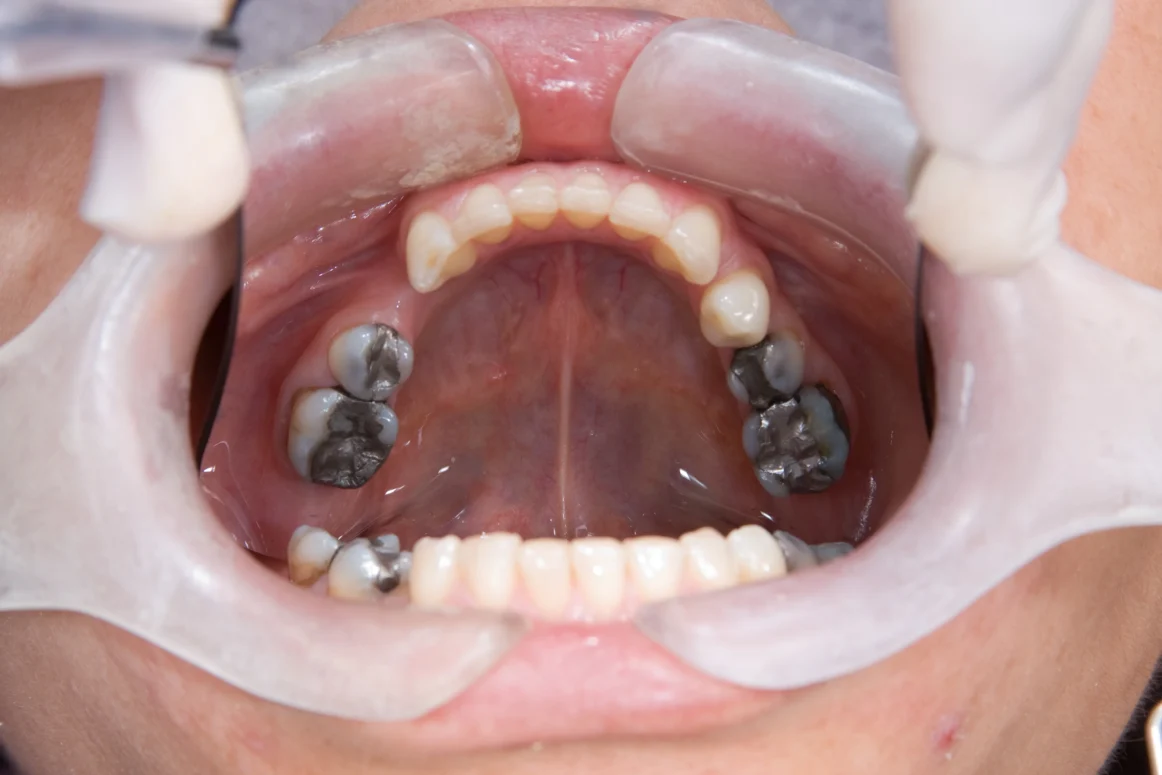
Amalgam fillings — the classic “silver” fillings — have done their job for years: strong, durable and used in hundreds of millions of patients for more than 150 years, as the US Food and Drug Administration puts it.1 But they leave a dark metallic shadow in an era of bright, natural smiles, and many patients now feel their old fillings no longer sit comfortably with the rest of their teeth.
One thing needs saying before anything else, because it decides who this article is actually for. The FDA does not recommend removing or replacing amalgam fillings that are in good condition, unless a health professional considers it medically necessary — because removing an intact filling means losing healthy tooth structure that did not need to be lost, and produces a temporary rise in mercury vapour during the removal itself.1
So the honest question is not “should everyone replace their amalgams?” It is whether yours has a reason to come out — decay underneath it, a crack, a worn or leaking margin, a documented sensitivity to the metals, or a considered aesthetic decision made with the trade-offs on the table. This guide covers how safe removal is done, what the realistic options are afterwards, and — just as importantly — when leaving a filling alone is the better dentistry.
What Amalgam Actually Is — and What the Regulators Say
Amalgam is a mixture of liquid mercury with a powdered alloy of silver, tin and copper. Two details are worth having straight, because a lot of what circulates online gets them wrong:
- It is roughly half mercury by weight — not a trace. The FDA states approximately 50% of dental amalgam is elemental mercury by weight, and that the mercury is what binds the alloy particles into a solid, durable filling.1
- It is not the same mercury as in fish. Amalgam contains elemental mercury, which releases a vapour absorbed by the lungs; fish contains methylmercury, absorbed through the digestive tract. The FDA is explicit that the body handles these forms differently.1
On safety in the general population, the position of both the American Dental Association2 and the FDA is that the majority of evidence does not show exposure to mercury from amalgam leading to negative health effects in most people.1 The FDA does, however, identify groups for whom it encourages non-amalgam materials when a new filling is needed: pregnant women and their developing fetuses, women planning pregnancy, nursing women and their infants, children under six, people with pre-existing neurological disease, people with impaired kidney function, and anyone with a known sensitivity to mercury, silver, copper or tin.1
Choosing a material is not the same question as removing one
Note what that FDA guidance is about: which material to use for a new filling, not whether to dig out an old one. The FDA states that intact amalgam fillings should not be removed for the purpose of preventing disease in anyone — including pregnant and nursing patients and children — unless a health professional considers it medically necessary.1 Modern dentistry has largely moved away from placing new amalgam, driven by aesthetics, adhesive technique and international agreements on mercury use. Moving away from placing it is a different question from removing what is already there and working.
Why People Replace Silver Fillings With Modern Materials
When patients consider replacing their silver fillings, they usually have one of three goals in mind. Working out which one matters most to you is the first step, because they lead to different conversations.
- “I want to improve how my smile looks.”
Metal fillings are easy to spot when you laugh or when a photograph is taken from the wrong angle. Grey patches sit awkwardly against a Hollywood smile or new veneer work, and this is a perfectly legitimate reason to replace one — as long as it is understood as a cosmetic choice with a cost in tooth structure, rather than a health necessity. - “I want my fillings to look like teeth.”
Modern composite fillings are shade-matched closely enough that most people cannot see where the tooth ends and the filling begins. If you want restorative work to blend rather than announce itself, this is the material for it. - “I would rather not have mercury in my mouth.”
Dental bodies still regard amalgam as safe for most people, and some patients simply feel better with mercury-free materials. That preference is respected here. What we will not do is tell you it is a medical necessity when the regulators say otherwise — and for anyone in the FDA’s higher-risk groups, that preference is most relevant to future fillings rather than a reason to remove intact ones.
The fourth reason — and clinically the strongest
There is a fourth reason, and clinically it outranks the other three: the filling itself has failed. Old amalgams crack, wear flat, and open up at the margin so that decay creeps in underneath — which is often invisible until it shows on a radiograph. That situation needs treatment on its own merits, whatever your view on mercury. Our guide to when a filling needs replacing covers the signs.
What Happens During Amalgam Filling Removal?
Because drilling an amalgam generates heat and fine particles, the removal itself is the moment of highest vapour release — which is precisely why technique matters, and why the FDA mentions that temporary increase in its guidance.1
A careful removal protocol usually includes:
- A rubber dam to isolate the tooth from the rest of the mouth
- High-volume suction close to the tooth to capture particles and vapour
- Copious water spray to keep the filling cool, since heat is what drives vapour off
- Sectioning the filling into large pieces and lifting them out, rather than grinding the whole thing to dust — fewer cut surfaces means less vapour and less debris
- Room ventilation and protective equipment for both patient and clinical team
The purpose of all of it is the same: keep exposure during the procedure as low as reasonably achievable, and keep the debris out of your mouth. The other half of good technique is conservation — removing the filling and any decay beneath it while keeping every millimetre of sound tooth that can be kept, because that tooth structure is what the new restoration will be bonded to.
Possible Side Effects of Removing Amalgam Fillings
When performed by a trained dentist, the side effects of amalgam removal are usually mild and short-term:
- Mild sensitivity, particularly to cold, as the tooth settles
- Slight gum irritation where the dam or matrix sat
- A temporary metallic taste
- Light soreness from the drilling vibration
These usually resolve within a few days, and serious complications are rare where proper technique is used.
There is one consequence that is not a side effect but a certainty, and it deserves plain language: every replacement makes the cavity slightly larger. The old filling comes out along with a thin margin of tooth around it, so a tooth that has been filled and refilled several times has progressively less of itself left — which is the reason the FDA frames removal of an intact filling as an unnecessary loss of healthy tooth structure.1 On a heavily filled tooth this is what eventually turns a filling into an onlay or a crown. It is not a reason never to replace a filling. It is a reason to have a reason.
What Are Your Options After Removal?
Once the filling is out, the choice of replacement depends on how much tooth is left and where the tooth sits in your bite.
- Composite filling (tooth-coloured)
The most common choice. Bonded directly, shade-matched, and done in a single visit — suited to small and moderate cavities. - Porcelain inlay or onlay
Made in the laboratory and bonded in, for cavities too wide for a direct filling to support reliably. It rebuilds the chewing surface while keeping more tooth than a full crown would — the comparison is set out in our guide to inlays, onlays and crowns. - Crown
For a tooth that is cracked or so heavily filled that the remaining walls need full coverage to survive normal biting. - A planned sequence
Where several old amalgams are involved, they are usually staged rather than done all at once, so the bite can be checked as it changes.
Which of these applies to a given tooth is a structural judgement made from the tooth and the radiograph, not from a preference stated in advance. Where the decay underneath has reached further than expected, the plan changes accordingly — see how tooth decay is treated at each stage.
Am I a Candidate for Amalgam Filling Removal?
There is usually a clear case for replacement if:
- Your amalgam is cracked, worn, leaking at the margin, or no longer sealing
- There is decay underneath or alongside it
- The tooth around it has cracked or is flexing
- You have a documented allergy or sensitivity to mercury, silver, copper or tin1
- The filling has left a grey shadow through the tooth, and it is a front-of-mouth aesthetic concern
- The tooth is being restored anyway as part of planned veneer or crown work, so the filling is coming out regardless
It is usually better to leave the filling alone if:
- The filling is intact, sealed and causing no problem. This is the FDA’s position rather than ours, and it is the most important line on this page: an intact amalgam should not be removed to prevent disease unless a health professional judges it medically necessary.1
- You are pregnant or breastfeeding. The FDA’s guidance for these groups is to prefer non-amalgam materials for new fillings — and specifically not to remove intact ones, which would raise exposure rather than reduce it.1
- You have uncontrolled medical conditions that make elective treatment inadvisable for now
- The tooth is so heavily restored that removal would risk what remains, and monitoring is the safer plan
An assessment exists to tell you which of those two lists you are on. If the answer is “leave it alone and review it”, that is a legitimate outcome of a consultation, and you should expect to be told so.
Book a free online consultation — a specialist will look at your fillings and tell you honestly whether any of them need replacing.
What to Expect After Removal
Where replacement is the right call, most patients notice the difference the same day and get on with normal eating.
- A tooth-coloured surface that blends with the surrounding enamel
- No more grey shadow through the tooth in photographs
- A properly sealed margin, which is the part that matters clinically
- Sensitivity that settles over the following days
How long the new restoration lasts depends less on the material than on what happens around it. The FDA makes the same point: durability depends on many factors besides the filling material, and diet, oral hygiene and regular check-ups are what keep both teeth and fillings going.1 A composite in a mouth that grinds heavily and skips cleaning will not outlast the amalgam it replaced.
Why Many Patients Choose Turkey for This Work
Turkey has become a common destination for restorative and cosmetic dentistry because of:
- Clinics equipped for rubber-dam isolation, high-volume suction and adhesive restorative work as routine
- Experienced restorative and cosmetic dentists with high case volume
- The same CE-marked composites and ceramics used in UK and European practices
- Appointment availability without long waits
- Travel support — airport pickup, hotel coordination, translation
Costs are lower than in the US, UK and much of Europe, and it is worth being precise about why: the difference comes from the local cost base — laboratory work, staffing and premises — rather than from different materials or fewer appointments. Any figure you read online should be treated as an approximate range rather than a quote; what a case actually costs depends on how many teeth are involved and whether each needs a filling, an onlay or a crown, and it is confirmed in writing after an assessment. The wider picture is in our guides to dental treatment prices in Turkey and dental tourism in Turkey.
One practical note for anyone travelling: replacing several old amalgams is restorative work, not a two-day cosmetic appointment. Ask for the treatment plan and the number of visits before you book flights. Many patients do combine it with cosmetic work such as bonding, veneers or crowns — but the sequence should be planned, not improvised on arrival.
Why Choose DentSpa for Removing Amalgam Fillings?
At DentSpa you benefit from:
- PhD-level specialist dentists, with professors and associate professors supervising complex restorative cases.
- Isolation, suction and cooling protocols applied as standard during removal, so exposure during the procedure is kept as low as reasonably achievable.
- A conservative approach to preparation — keeping sound tooth structure is treated as part of the result, not an afterthought.
- High-quality composite and porcelain materials, and clinical facilities equipped for adhesive restorative work.
- An assessment that will tell you if a filling is better left alone — because a recommendation you can trust has to include that answer.
- Full A–Z care from your online consultation through to follow-up.
You don’t have to take our word for the standard. DentSpa was named best dental clinic in Europe in the odontology category at the European Awards in Medicine,3 is licensed by the Turkish Ministry of Health, certified to ISO 9001 and ISO 10002, and a member of the Turkish Dental Association. For treatment planned from abroad it also holds the Certification for Excellence in Medical Travel Patient Experience from Global Healthcare Accreditation.4 More than 50,000 international patients have been treated since the clinic was founded in Istanbul in 2018 — see real cases in the smile gallery and read the verified reviews.
Next Steps
If your old fillings bother you — whether because of how they look, or because one has started to feel rough, sharp or sensitive — the useful next step is to find out which of them actually need attention and which are fine as they are.
Book a free consultation or message us on WhatsApp. You will get an assessment of each filling and a plan — including, where it applies, the recommendation to leave one alone.
Frequently asked questions
Should I have my amalgam fillings removed?
Are amalgam fillings dangerous?
How much mercury is in an amalgam filling?
Is amalgam removal safe? What protects me during it?
Can I have amalgam fillings removed while pregnant or breastfeeding?
Does replacing a filling weaken the tooth?
What will replace the amalgam?
How long will the new filling last?
Sources
- U.S. Food and Drug Administration — Dental Amalgam Fillings
- American Dental Association — Oral Health Topics: Dental Amalgam
- The European Awards in Medicine — DentSpa Clinic — European Award in Medicine in Odontology
- Global Healthcare Accreditation — DentSpa Strengthens Global Trust in Turkey’s Dental Services with GHA Certification
















 70%
70%