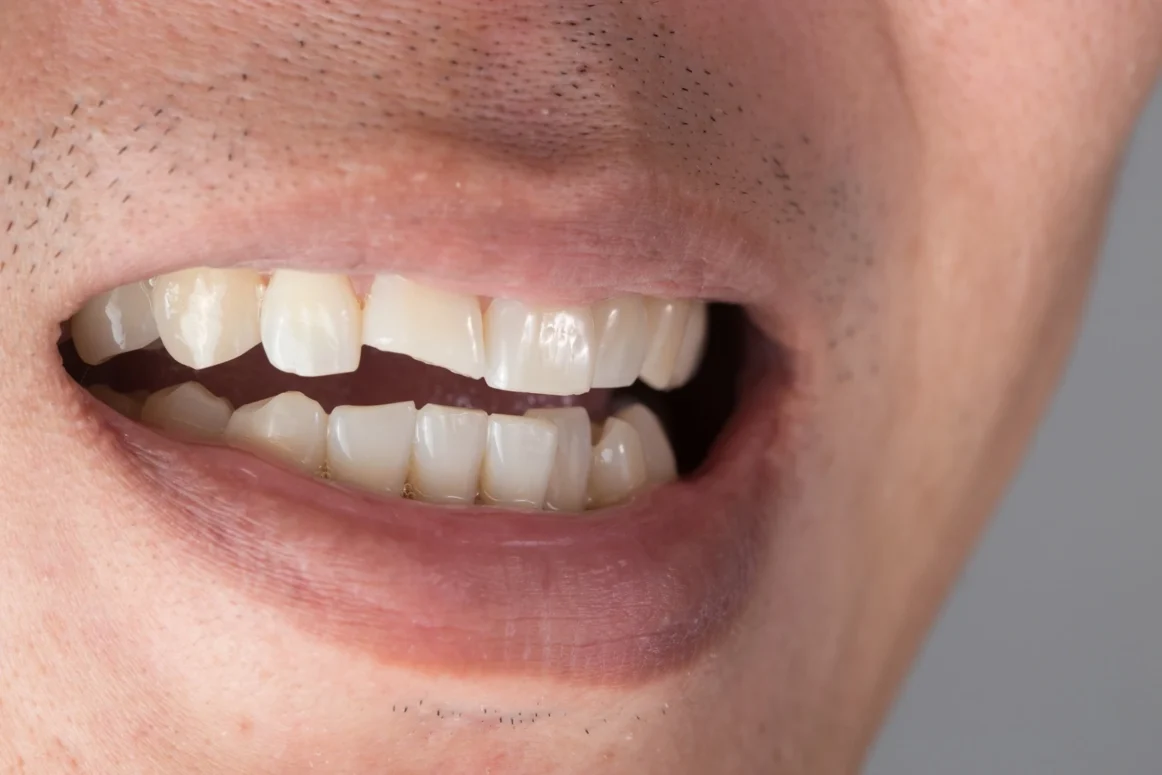
A chipped front tooth is usually repaired in a single appointment. The four routes are reattaching the broken piece, composite bonding, a veneer or a crown — chosen by how much tooth is missing, not by preference. Most chips are cosmetic, but a few need same-day attention, and the difference is easy to recognise.
If it has just happened: find the fragment and keep it in milk. Reattaching your own piece of tooth is a real treatment — and a published review calls fragment reattachment “the treatment of choice when the fragment is available and well stored.”1 Most people throw the piece away without knowing that.
What to Do in the First Hour
- Find the fragment and keep it wet. Milk is the practical choice — the review above notes that milk keeps fragments hydrated and that fragments stored in it retain better fracture resistance than dry ones.1 Saliva works if nothing else is available. Do not let it dry out, and do not scrub it clean.
- Rinse your mouth with warm water and check for other sharp edges.
- Cover a sharp edge with a piece of sugar-free chewing gum or dental wax if it is cutting your lip or tongue.
- Avoid biting on that tooth and skip anything very hot or cold until it has been looked at.
- Call a dentist. Even a cosmetic chip is easier to treat before the edge starts to wear unevenly against the opposing tooth.
When it needs same-day attention
Most chips are not urgent. These are:
- A pink or red dot in the middle of the broken surface, or bleeding from the tooth itself rather than the gum. That is the pulp — the nerve — exposed, and it needs covering quickly to give the tooth its best chance of staying alive.
- The tooth is loose, has moved, or feels different when you bite. That is an injury to the ligament and the bone around the root, not just to the crown of the tooth.
- Strong, spontaneous pain, or pain that lingers for more than a few seconds after something cold.
- Facial swelling or a bad taste, which points to infection rather than a fracture — covered in our guide to dental infection treatment.
None of those is common after a small chip. They are listed so you can rule them out in ten seconds and stop wondering.
How Deep Is the Chip? Three Levels
Everything about the treatment follows from this, and you can usually tell which one you have.
| Depth | What you notice | Usual treatment |
|---|---|---|
| Enamel only | A rough or sharp edge, no sensitivity at all | Smoothing, or bonding for appearance |
| Into the dentine | The exposed area looks slightly yellower; twinges with cold or air | Bonding, reattachment, or a veneer |
| Into the pulp | A pink or red point in the middle; bleeding; lasting pain | Nerve treatment first, then the restoration |
The reason a dentist checks even a chip that doesn’t hurt is that a fracture line can run deeper than the missing piece suggests, and a tooth can lose its nerve quietly months after an impact. Whether that has happened, and what can be done about it, is set out in our guide to whether a dead tooth can be saved.
The Four Ways to Fix It
These are listed from the most conservative to the most extensive. The right one is the least invasive option that will hold — which for most chips is one of the first two.
1. Reattaching your own fragment
If you have the piece and it has been kept moist, it can often be bonded back on. Modern adhesives make this reliable, and the review cited above describes it as the treatment of choice when the fragment is available and well stored.1
The appeal is obvious once you think about it: the colour, translucency and surface texture match perfectly, because it is your tooth. No shade guide gets closer. It is a single appointment, and it removes essentially no additional tooth.
This is the option most often lost simply because nobody knew to keep the piece.
2. Composite bonding
Composite bonding rebuilds the missing corner directly in the mouth. Tooth-coloured resin is layered and shaped by hand, set with a curing light, then contoured and polished. One visit, local anaesthetic often not needed, and little or no drilling.
What the evidence says about how it holds up is worth having, because it is more encouraging and more specific than “a few years.” A systematic review of 17 studies covering 1,821 anterior composite restorations followed for at least three years found annual failure rates between 0% and 4.1%. The most common reason for failure was fracture — and where restorations had been placed for aesthetic reasons, the failures were more often about colour, shape or surface staining than about anything breaking.2
Which is a useful thing to know in advance: when bonding on a front tooth eventually needs attention, it is usually because it has stained or dulled rather than because it has failed. That is a polish or a refresh, not a rescue.
3. A veneer
A porcelain veneer is a thin ceramic shell covering the front of the tooth, made in a laboratory and bonded on. It suits a larger chip, or a tooth where the colour and shape need addressing as well as the missing corner.
Ceramic holds its colour where composite gradually does not, and the published survival is strong: a systematic review of roughly 6,500 porcelain laminate veneers estimated 95.5% survival at ten years.3 It takes two visits and some preparation of the enamel — how much, and why the amount matters, is covered in our guide to laminate veneers.
Choosing between this and bonding is the most common decision on this page, and it comes down to how much tooth is missing and how long you want the colour to hold. Our comparison of composite bonding vs veneers takes it apart properly.
4. A crown
Where a large part of the tooth has broken away, a crack runs into the body of the tooth, or the tooth has had root canal treatment, a crown covers the whole tooth and holds what is left together.
A systematic review of single crowns on natural teeth put estimated five-year survival at 96.6% for lithium-disilicate glass ceramic, 94.7% for metal-ceramic and 92.1% for zirconia.4
A crown is not a worse outcome than a veneer, and it is not an upsell — it is what a tooth that has lost structure actually needs. The line between the two is a question of what remains, not of quality, and it is set out in veneers vs crowns. Where the chip came from grinding rather than an accident, that has to be addressed too, or the same edge chips again: see how bruxism affects veneers and implants.
Cost to Fix a Chipped Front Tooth
Please read this before the table. Every figure below is an approximate market range drawn from published price information for each country — not a DentSpa quote, and not a price list. What you pay depends on the material, how much tooth is missing, whether nerve treatment is needed first, and the exchange rate on the day. Your own cost is confirmed in writing after a consultation, once someone has looked at the tooth.
| Treatment (one front tooth) | UK | US | Turkey |
|---|---|---|---|
| Composite bonding | £150–£400 | $300–$600 | €50–€150 |
| Porcelain veneer | £700–£1,200 | $1,000–$2,500 | €130–€300 |
| Ceramic crown | £600–£1,100 | $800–$3,000 | €100–€300 |
Approximate market ranges for 2026, not quotes. Currencies are shown as each market prices them; converted figures will differ with the exchange rate.
Comparing these numbers straight across is the mistake to avoid. The cheapest treatment and the cheapest outcome are not the same thing. Bonding costs least today; ceramic holds its colour for longer. One chipped corner on an otherwise sound tooth is a bonding case whatever the price list says, and a tooth that has lost half its edge is not — the depth decides, not the budget.
Two guides on our own site go into the home-market side in more detail: veneer costs in the UK and what a dental crown costs.
The gap between the columns is not a difference in what is used. The cost base in Turkey is lower — laboratory work, clinical staffing and premises — while the composites and ceramics are the same CE-marked products from the same international manufacturers, and the number of appointments does not shrink.
Does It Hurt, and How Long Does It Take?
For a small chip treated with bonding or reattachment, anaesthetic is often not needed at all — the enamel being worked on has no nerve supply. You feel pressure, the polishing, and cold water. One appointment, and you leave with the tooth complete.
Veneers and crowns involve preparing the tooth, so local anaesthetic is used and you feel nothing during it. Both take two appointments with a laboratory stage in between, and you wear a temporary meanwhile — you are never sent away with a visible gap.
Where the nerve is involved, that is treated first and the appearance is dealt with afterwards. It adds a stage; it does not change the eventual result.
Fixing a Chipped Front Tooth at DentSpa
A front tooth is the one restoration nobody can hide, so the appointment starts with examination and a radiograph rather than with a shade guide. How deep the fracture runs, whether the nerve is still healthy, what the bite is doing to that edge — those answers decide the treatment, and they cannot be read from a photograph.
What follows is the least invasive option that will hold. If you have kept the fragment, bring it. If bonding will do the job, you are not offered a veneer.
What you can check before you commit
- Independent recognition. DentSpa was named best dental clinic in Europe in the odontology category at the European Awards in Medicine.5
- Accreditation covering the whole journey. DentSpa holds the Certification for Excellence in Medical Travel Patient Experience from Global Healthcare Accreditation,6 which assesses the information you get before travelling, care coordination, and aftercare once you are home.
- Regulatory basics. Licensed by the Turkish Ministry of Health, certified to ISO 9001 and ISO 10002, and a member of the Turkish Dental Association. The clinic is in the Şişli district of Istanbul.
- A written plan naming the material and the teeth before you travel.
- Real patient voices. Read the verified Trustpilot and Google reviews and see results on Instagram.
If you are considering treatment abroad, the planning end to end is set out in our guide to dental tourism in Turkey, and the questions worth asking any clinic are in how to find a dentist in Turkey.
Want to know which of the four your chip needs? Send DentSpa a clear photo for a free, no-obligation assessment from our specialists. Book a free consultation or message us on WhatsApp.
Frequently asked questions
Can a chipped front tooth be fixed?
Should I keep the broken piece of tooth?
Is a chipped front tooth an emergency?
How much does it cost to fix a chipped front tooth?
How long does composite bonding last on a front tooth?
Bonding or veneer for a chipped tooth?
Will it look natural?
Does fixing a chipped tooth hurt?
Can a chipped tooth get worse if I leave it?
Can a chipped front tooth be fixed in one trip abroad?
Sources
- Reattachment of Fractured Tooth: A Comprehensive Review. Cureus, 2024.
- Demarco FF, Collares K, Coelho-de-Souza FH, et al. — Anterior composite restorations: A systematic review on long-term survival and reasons for failure. Dental Materials 2015.
- Alenezi A, Alsweed M, Alsidrani S, Chrcanovic BR — Long-term survival and complication rates of porcelain laminate veneers in clinical studies: a systematic review. Journal of Clinical Medicine 2021;10(5):1074.
- Sailer I, Makarov NA, Thoma DS, Zwahlen M, Pjetursson BE — All-ceramic or metal-ceramic tooth-supported fixed dental prostheses? Part I: Single crowns. Dental Materials 2015;31(6):603–623.
- The European Awards in Medicine — DentSpa Clinic — European Award in Medicine in Odontology
- Global Healthcare Accreditation — DentSpa Strengthens Global Trust in Turkey’s Dental Services with GHA Certification















 70%
70%