When you lose some or all of your teeth, your eating and drinking habits are not the only thing affected — your confidence takes a knock too. Many people stop smiling in photographs long before they stop chewing comfortably.
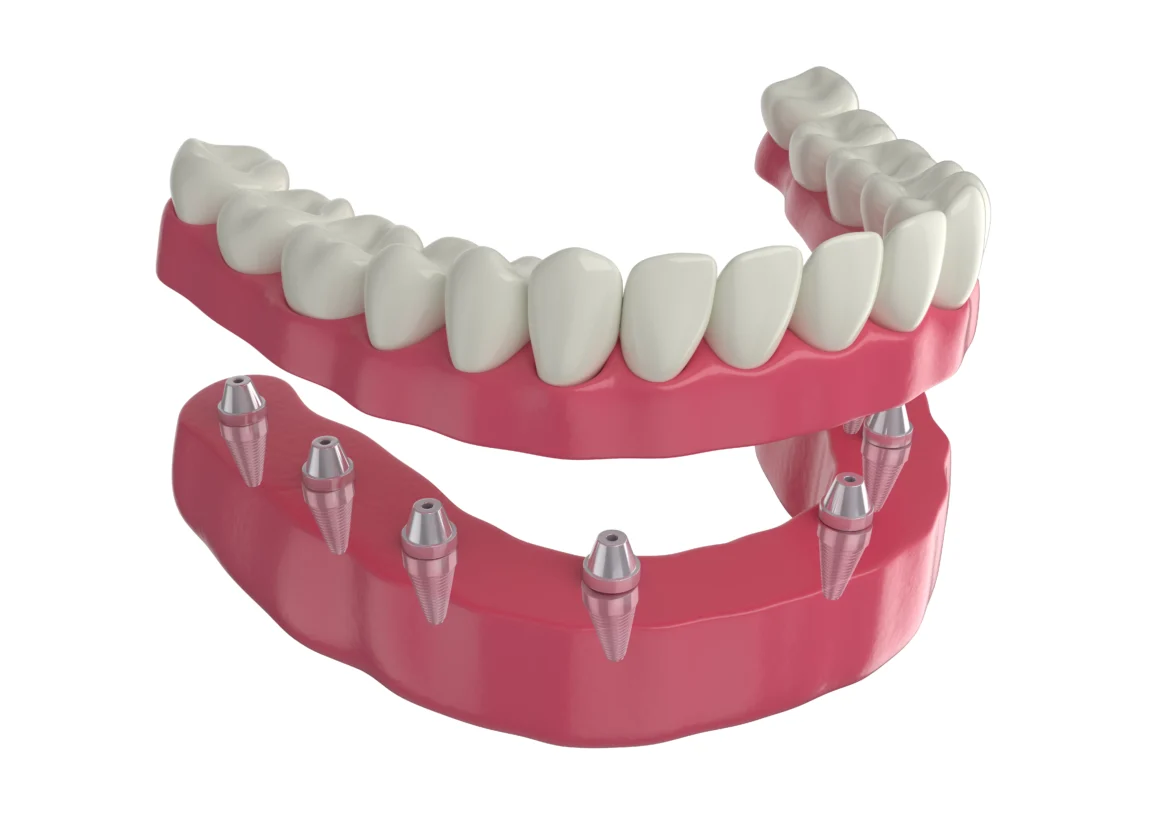
Traditional dentures restore chewing to a degree, but they rest on the gum and move. All-on-8 offers a fixed alternative: eight titanium implants placed into the jawbone to support a full fixed arch of teeth, upper or lower.
One thing to say at the outset, because it decides everything that follows: more implants is not automatically better. All-on-4, All-on-6 and All-on-8 are not three grades of the same treatment — they are three answers to different amounts of bone and different bite demands. This guide covers what All-on-8 involves, who it actually suits, and how it compares.
Understanding All-on-8 dental implants
All-on-8 restores a full arch for someone who has lost most or all of the teeth in that jaw. It involves the surgical placement of eight titanium implants into the upper or lower jawbone — or both — at eight separate sites.
Because the bridge is fixed to the implants, the teeth do not shift the way a removable denture does, and the biting forces are spread across more anchor points. That is the practical benefit: stability and comfort when chewing.
All-on-8 is not suitable for every patient. It is generally considered for:
- Patients needing full-mouth reconstruction after losing most of their teeth to decay, gum disease or trauma.
- Patients with heavy bite forces or bruxism, where spreading the load across more implants is an advantage.
- Patients who have enough bone height and width at eight separate sites to take the implants without extensive grafting — which is the real gatekeeper, and the reason many people are better served by All-on-4 or All-on-6.
Whether you have that bone is decided from a 3D scan rather than a photograph — see how much bone you actually need for implants.
Benefits of All-on-8 dental implants
- Load spread across eight anchors. More fixation points mean each implant carries less force, which is an advantage where the bite is heavy or where grinding is part of the picture.
- Force distribution closer to a natural arch. Eight points around the arch distribute chewing forces more evenly than four.
- Long-term durability with proper maintenance. Implant treatment is well documented over decades: a meta-analysis put dental implant survival at around 94.6% at 20 years,1 and a longitudinal study of full-arch cases followed for 3 to 17 years reported implant-level survival of 97.4% in the upper jaw and 98.9% in the lower.2
- Titanium is biocompatible. The implants themselves are titanium, a material used in orthopaedic and dental surgery for decades precisely because bone integrates with it and it rarely provokes a reaction. The visible bridge on top is ceramic or acrylic depending on the plan — that is a separate choice from the implant material.
Those survival figures are population data across implant treatment generally rather than a promise about your case. What moves an individual result is bite design, hygiene and regular maintenance — set out in what determines implant lifespan and why implants fail.
What you should expect during the procedure
If you are preparing for All-on-8, here is what typically happens.
Initial consultation
Also called the oral evaluation. Your dentist uses conventional and digital radiographs together with 3D CBCT imaging to assess the remaining teeth, the sinuses and the bone structure of the jaw. You also discuss what you want the finished smile to look like.
Treatment planning
Based on the scans, a plan is built for your case. It establishes whether you need a bone graft or a sinus lift first, whether any remaining teeth need extracting, and — importantly — whether eight implants are genuinely the right number for the bone you have.
Pre-surgery preparation
Your dentist reviews your medical history and current health to reduce the risk of complications before or after surgery, and gives you preoperative instructions. Where remaining teeth on the arch are not restorable, they are extracted at this stage.
The day of surgery
- The area is fully numbed with local anaesthetic, so you feel pressure rather than pain. Sedation is available if you would prefer it.
- Eight small openings are made in the gum tissue at the positions set out in your plan.
- Eight titanium implants are placed into the jawbone at the planned angles and depths.
- Connector pieces — abutments — are attached to the implants.
- The sites are closed and a temporary fixed bridge is attached, so you do not leave without teeth.
Whether teeth can be fitted the same day depends on the stability achieved when the implants are seated — explained in immediate vs delayed implant placement.
The healing phase
Healing time varies with bone quality, the number of implants and your general health. As a planning window rather than a promise, osseointegration — the implants fusing with the bone — generally takes three to six months before the definitive bridge is made.
Readiness is confirmed by imaging rather than by the calendar, which is why the follow-up appointments during this period matter. You wear the temporary bridge throughout, and most of what is happening is invisible. What helps in the early days is in our guide to healing after dental surgery.
Final prosthetic placement
Once imaging confirms the implants have integrated, the definitive bridge is made in the laboratory. The temporary is removed, and the permanent bridge is fitted, checked against your bite and adjusted.
All-on-4 vs All-on-6 vs All-on-8: Indication, Not Ranking
It is tempting to read this table as good, better, best. It isn’t. All three restore a full arch, and the right one is the one your bone and your bite allow — a well-planned All-on-4 in the right case outperforms an All-on-8 forced into bone that cannot support eight implants.
| Factor | All-on-4 | All-on-6 | All-on-8 |
|---|---|---|---|
| Implants per arch | 4 | 6 | 8 |
| Bone requirement | Works with less available bone, often avoiding grafting | Needs moderate bone volume | Needs sufficient bone height and width at eight sites |
| Force distribution | Adequate for most arches | More points of support | Most points of support |
| Surgical complexity | Least complex | Moderate | Most involved |
| Healing | Generally shortest | Moderate | Generally longest |
| Cost level | Lowest | Mid-range | Highest |
| Maintenance | Daily cleaning + professional maintenance | Daily cleaning + professional maintenance | Daily cleaning + professional maintenance |
| Typically chosen when | Bone is limited, or grafting is to be avoided | A middle ground on bone and load | Bone is plentiful and the bite is heavy |
The honest summary: eight implants are chosen because the case calls for them, not because more is better. If a clinic recommends All-on-8 without a scan showing you have the bone for it, that is worth asking about. The full-arch options are compared in more detail in our guide to full-arch implant rehabilitation, and the costs across markets in full mouth implants abroad.
Book your All-on-8 consultation with DentSpa
Full-arch implant treatment changes daily life — eating, speaking and smiling without thinking about your teeth. It is also a significant piece of surgery, which is why the planning matters more than the marketing.
DentSpa was founded in Istanbul in 2018 and has treated more than 50,000 international patients since. The clinic is built around a spa-like environment, because treatment that feels calmer is treatment people actually complete.
What you can check before you commit
- Verifiable implant volume. Straumann publishes and verifies on its own website the number of its implants placed at DentSpa over a full year — more than a thousand. It is a manufacturer’s record rather than a claim of ours: see the Straumann Achievement Award and the verification page itself.3
- Independent recognition. DentSpa was named best dental clinic in Europe in the odontology category at the European Awards in Medicine,4 and is licensed by the Turkish Ministry of Health, certified to ISO 9001 and ISO 10002, and a member of the Turkish Dental Association.
- Senior surgical team. Implant cases are led by PhD-level specialists, professors and associate professors, internationally trained and multilingual, from the first contact to the postoperative reviews.
- Aftercare assessed independently. DentSpa holds the Certification for Excellence in Medical Travel Patient Experience from Global Healthcare Accreditation,5 which matters here because a full-arch case has a second stage months after you fly home.
- Real patient voices. Read the verified Trustpilot and Google reviews and see cases in the smile gallery.
Whether you need All-on-4, All-on-6 or All-on-8 is decided from your scan, not from a price list — and if fewer implants will serve you better, that is what you will be told. Book a free consultation or message us on WhatsApp. If you are still comparing clinics, the questions worth asking any of them are in how to find a dentist in Turkey.
Frequently asked questions
Is All-on-8 better than All-on-4 or All-on-6?
Who is a candidate for All-on-8?
What are All-on-8 implants made of?
How long does All-on-8 take from start to finish?
Does All-on-8 surgery hurt?
How long do full-arch implants last?
Do I need a bone graft for All-on-8?
Sources
- Dental implant long-term survival — 20-year meta-analysis (~94.6%), 2024. pmc.ncbi.nlm.nih.gov/articles/PMC11416373
- The All-on-four concept for fixed full-arch rehabilitation of the edentulous maxilla and mandible — longitudinal study, 3–17 year follow-up, 561 cases / 2,364 implants. International Journal of Implant Dentistry, 2023. pmc.ncbi.nlm.nih.gov/articles/PMC10632321
- Straumann — Certificate verification: DentSpa
- The European Awards in Medicine — DentSpa Clinic — European Award in Medicine in Odontology
- Global Healthcare Accreditation — DentSpa Strengthens Global Trust in Turkey’s Dental Services with GHA Certification









 70%
70%