Table of content
Neither approach is better. On the pooled evidence they perform the same. A 2023 systematic review and meta-analysis of ten studies found 97.4% survival for implants placed immediately into a fresh extraction socket and 97.5% for implants placed after healing — a difference that was not statistically significant.1
So the question is not which is safer in general. It is which one your socket, your bone and your bite allow — a decision made from the examination, not from the calendar. This guide sets out what each approach involves, what has to be true for immediate placement to be an option, and what the evidence actually says.
What Implant Placement Timing Means
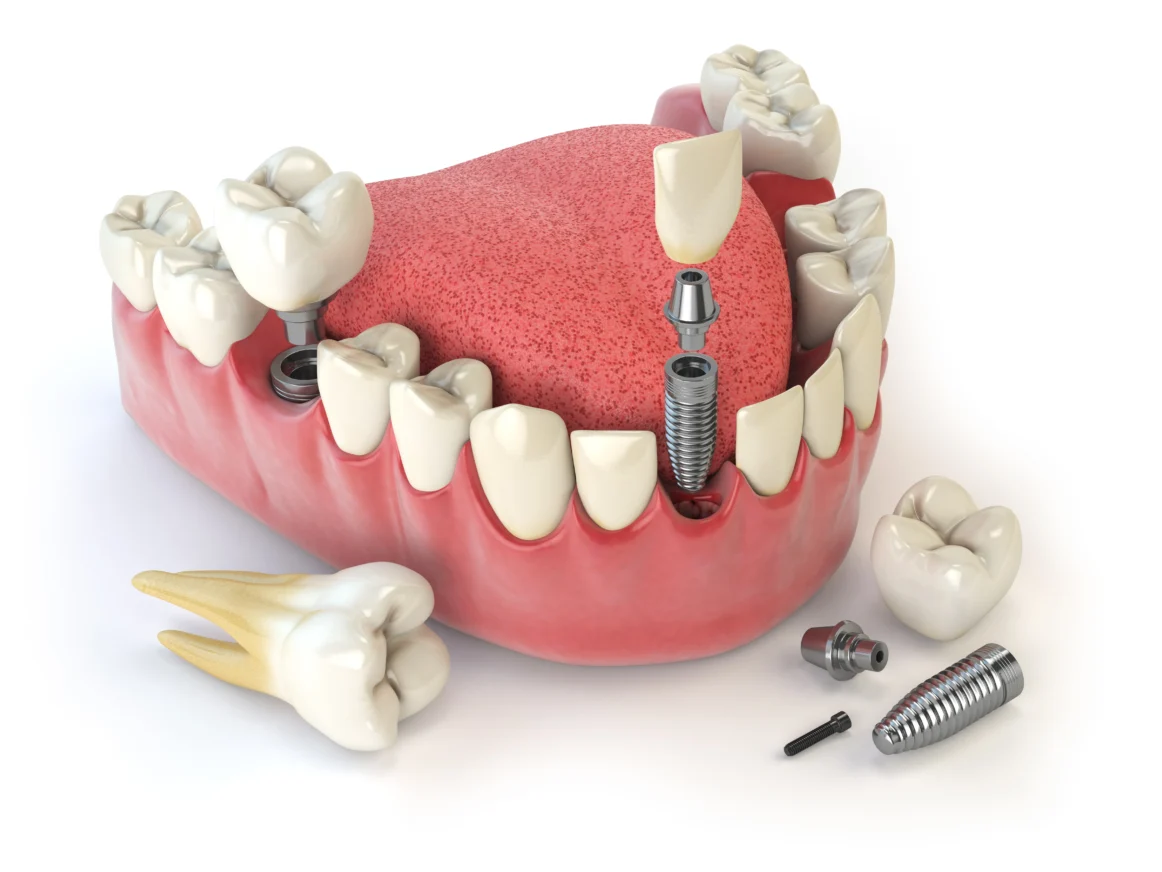
A dental implant is a titanium or zirconia fixture placed into the jawbone to carry a crown. What changes between the two protocols is when that fixture goes in relative to the extraction:
- Immediate placement — the implant is inserted into the socket at the same appointment as the extraction.
- Delayed placement — the socket is allowed to heal first, typically over several weeks to a few months, and the implant follows.
One clarification worth making early, because it causes more disappointment than anything else on this page: “immediate placement” is not the same as “same-day permanent tooth.” Where a tooth is fitted at the same appointment it is normally a temporary crown. The definitive crown comes later, once the implant has integrated with the bone.
What the Evidence Actually Shows
This is the section most pages on this topic get wrong, so it is worth quoting precisely.
The 2023 review pooled ten studies — six randomised controlled trials and four comparative studies — covering 341 implants placed immediately and 359 placed after healing. 332 of the immediate implants survived (97.4%) and 350 of the delayed ones (97.5%). The meta-analysis found no significant difference between the two protocols: risk ratio 0.99, 95% CI 0.96–1.02, p = 0.45.1
The same paper does note that slightly more failures occurred in the immediate group, with survival in some individual studies falling between 90% and 95% while the delayed studies stayed above 95%.1 That spread is real — but it is the range across studies, not the pooled result, and it should not be read as a ranking.
Here is why the distinction matters. These protocols are not assigned at random in practice. Immediate placement is chosen when conditions are favourable and avoided when they are not — so any raw comparison outside a randomised trial is partly measuring which cases each protocol was given, rather than the protocol itself. That is also why the randomised evidence, where the assignment is random, shows them level.
The practical conclusion is a reassuring one: whichever your case calls for, the published survival is excellent. What determines your result is whether the protocol matches your biology — which is what the rest of this page is about.
Immediate Placement: What Has to Be True
The implant goes into the socket the moment the tooth comes out. Done in the right case it shortens the overall treatment, removes a surgical stage, and helps hold the shape of the bone and gum — which matters most on a front tooth, where the contour is what makes the result look natural.
It is an option when all of the following hold:
- No active infection at the site.
- Intact socket walls — particularly the thin outer plate of bone, which decides whether the gum contour holds.
- Enough bone beyond the socket for the implant to engage, usually below or beside it.
- Primary stability achieved at placement. This is the decisive one — the implant has to be mechanically firm the moment it is seated, and that is measured during surgery rather than predicted beforehand.
- Healthy gum tissue and controlled general risk factors.
That fourth point is the reason a surgeon can plan immediate placement and change to delayed on the day. It is not indecision. An implant placed without primary stability is one of the recognised routes to early failure, as set out in our guide to why implants fail. A surgeon who tells you the staged route is now necessary is doing the harder thing, not the slower one.
Delayed Placement: What It Buys You
Delayed placement lets the socket heal before the implant goes in. It is the route chosen when the site needs to be rebuilt or settled first, and it is the standard approach where any of these apply:
- Active infection or an abscess at the extraction site.
- A damaged or missing socket wall, or bone loss around the tooth being removed.
- A need for bone grafting or a sinus lift before the implant can be anchored.
- Gum disease that has to be treated and stabilised first.
- Heavy bite forces or grinding, or medical conditions that slow healing.
What is being bought with that time is a site that behaves like an untouched one — and there is good evidence it works. A systematic review following patients for at least ten years compared implants placed in grafted sites against implants in native bone and found similar survival between the two, with reported rates from 91.6% to 100%.2
“Significant bone loss” covers a wide range, so if your dentist has raised it, it is worth knowing how much bone you actually need for an implant — the type and severity decide whether a small graft is enough or a larger rebuild comes first. And if the answer is that there is not enough, that situation has its own routes.
The waiting is also not dead time — it is bone maturing in stages, and most of it is invisible. How that lines up month by month is in our implant timeline with a bone graft.
Why the Extraction Itself Matters
Whichever protocol is used, an empty socket does not stay the shape it started. Measured across human studies, an untreated extraction site loses 29% to 63% of its ridge width and 11% to 22% of its height within the first six months.3
That single fact explains a lot of what happens at the extraction appointment. It is why a socket-preservation graft is often placed at the time of removal even when the implant is going to be delayed, and why the tooth is removed as atraumatically as possible rather than quickly. The bone you keep at that appointment is bone nobody has to rebuild later — the wider picture is in our guide to bone loss in the jaw and how it is rebuilt.
Side-by-Side Comparison
| Factor | Immediate placement | Delayed placement |
|---|---|---|
| Timing | Same appointment as extraction | After the socket has healed |
| Pooled survival | 97.4% | 97.5% (difference not significant) |
| Total treatment time | Shorter | Longer |
| Surgical stages | Fewer | More |
| With active infection | Not suitable | Suitable once resolved |
| Grafting | Sometimes avoided | Often planned in |
| Depends on | Primary stability on the day | A rebuilt, settled site |
| Who it suits | Selected cases | A broader range |
Read down the last two rows rather than the survival row. That is where the actual decision lives.
Cost: Compare Plans, Not Implants
Please read this before the table. The figures below are approximate market ranges drawn from published price information for each country — not a DentSpa quote, and not a price list. What you pay depends on the implant system, whether an extraction or graft is needed, whether a temporary crown is part of the plan, and the exchange rate on the day. Your own cost is confirmed in writing after an examination and a CBCT scan.
| Treatment | UK | US | Turkey |
|---|---|---|---|
| Single implant with abutment and crown | £2,000–£3,000 | $3,000–$6,000 | €400–€700 |
| Bone graft or socket preservation | £300–£1,200 | $400–$3,000 | €150–€500 |
| Sinus lift | £1,200–£3,000 | $1,500–$5,000 | €400–€1,000 |
Approximate market ranges for 2026, not quotes. Currencies are shown as each market prices them; converted figures will differ with the exchange rate.
The comparison that misleads people is implant against implant. Compare plan against plan. Immediate placement can remove a stage and cost less overall — or it can add graft material and a temporary crown and cost more. A quote is only meaningful once it names the implant system, whether the final crown is included, and whether grafting sits inside the figure or outside it. Full pricing detail is in our guide to dental implant prices in Istanbul.
The gap between the columns is not a difference in what is used. The cost base in Turkey is lower — laboratory work, staffing and premises — while the implant systems are the same CE-marked products from the same manufacturers, and the number of appointments does not shrink.
How the Decision Is Made at DentSpa
Implant cases are managed by our oral surgeons, including Dr Serdar Yılmaz, and planned before anything is scheduled:
- CBCT imaging and digital impressions taken at the clinic — bone volume and density in three dimensions, and the position of the nerve canal and sinus. What that scan shows and why it is used is covered in our guide to CBCT scans for dental implants.
- Soft tissue and gum assessment, since gum health has to be stable before an implant is placed.
- Bite and load evaluation, including whether you grind.
- Risk factor screening — smoking and uncontrolled diabetes both change the plan, and both are in why implants fail.
The protocol follows from that, and it is explained to you with the reason attached — including the reason the other option was set aside. Where the plan has to change on the day because primary stability is not there, you are told why rather than discovering it later.
What you can check before you commit
- Verifiable implant volume. Straumann publishes and verifies on its own website the number of its implants placed at DentSpa over a full year — more than a thousand. It is a manufacturer’s record rather than a claim of ours: see the Straumann Achievement Award and the verification page itself.4
- Independent recognition. DentSpa was named best dental clinic in Europe in the odontology category at the European Awards in Medicine.5
- Accreditation covering the whole journey. The Certification for Excellence in Medical Travel Patient Experience from Global Healthcare Accreditation6 — which matters here because implant treatment has a follow-up stage months after you fly home.
- Regulatory basics. Licensed by the Turkish Ministry of Health, certified to ISO 9001 and ISO 10002, and a member of the Turkish Dental Association. DentSpa was founded in Istanbul in 2018 and has treated over 50,000 international patients since.7
- Real patient voices. Read the verified Trustpilot and Google reviews and see results on Instagram.
How treatment abroad is planned end to end is in our guide to dental tourism in Turkey, and the questions worth asking any clinic are in how to find a dentist in Turkey.
Want to know which protocol your case allows? Send DentSpa your radiographs or CBCT scan for a free, no-obligation assessment from our surgeons. Book a free consultation or message us on WhatsApp.
Frequently asked questions
Is immediate or delayed implant placement better?
Does immediate placement mean I leave with a permanent tooth?
Who is not suitable for immediate implant placement?
Why did my surgeon change to delayed placement on the day?
How long does delayed placement take?
Do implants in grafted bone last as long?
Which is cheaper, immediate or delayed placement?
What happens to the bone if I just leave the gap?
Can immediate placement be done if the tooth is infected?
Can implant treatment be completed in one trip abroad?
Sources
- Differences in Dental Implant Survival between Immediate vs. Delayed Placement — A Systematic Review and Meta-Analysis. Dentistry Journal 2023;11(9):218.
- Gurbanov V, et al. — Survival of dental implants placed in grafted versus non-grafted sites: a systematic review with at least 10 years of follow-up, 2024.
- Tan WL, Wong TL, Wong MC, Lang NP — A systematic review of post-extractional alveolar hard and soft tissue dimensional changes in humans. Clinical Oral Implants Research 2012;23(Suppl 5):1–21.
- Straumann — Certificate verification: DentSpa
- The European Awards in Medicine — DentSpa Clinic — European Award in Medicine in Odontology
- Global Healthcare Accreditation — DentSpa Strengthens Global Trust in Turkey’s Dental Services with GHA Certification
- DentSpa — About DentSpa (founded 2018; 50,000+ international patients; Ministry of Health, ISO and Turkish Dental Association)











 70%
70%