
A root canal can fail — and it can happen months or even years after a treatment that seemed to go perfectly. The American Association of Endodontists puts it plainly: a treated tooth can heal improperly and become painful or diseased long after the appointment.1
The important part is what comes next. A failed root canal almost never means the tooth is finished. There are three realistic paths — retreating the canal, surgery at the root tip, or replacing the tooth — and in most cases the first two are tried before anyone talks about extraction.
This page covers the signs that a root canal hasn’t held, why it happens, how the three options compare, and what the published success rates actually say about each one.
Signs of a failed root canal
Some are obvious and some aren’t. The pattern that matters is a treated tooth behaving differently from the way it settled after treatment.
- Pain or tenderness when you bite on that tooth, weeks or months after everything had calmed down.
- A dull ache that comes and goes — often the earliest sign, and the easiest one to talk yourself out of.
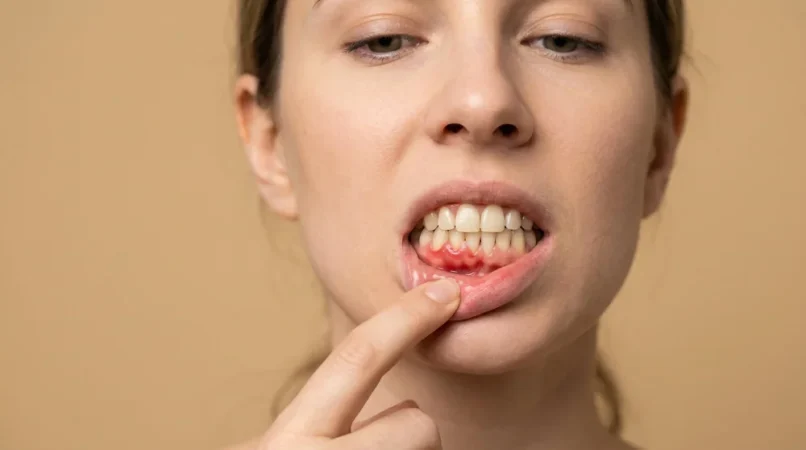
- Swelling or tenderness in the gum near the root, sometimes only when you press on it.
- A small bump on the gum that appears, drains and disappears — a sinus tract, and one of the clearest signals there is.
- A dark shadow on an X-ray around the root tip. This one is often found at a routine check-up with no symptoms at all.
A tooth can also fail quietly, with no pain whatsoever, which is exactly why a periapical X-ray matters more than how the tooth feels. If you’re currently dealing with discomfort, our guide to managing tooth pain covers the short term — but a treated tooth that’s aching needs a look at the root, not just pain relief.
Why root canals fail
It usually isn’t because something was done badly. The AAE groups the causes into two families.1
Something in the original treatment. Narrow or curved canals that weren’t treated the first time; complicated canal anatomy that went undetected; a crown or restoration placed too long after the root canal; or a restoration that didn’t keep saliva out of the inside of the tooth.1
Something new, years later. Fresh decay exposing the root canal filling to bacteria; a loose, cracked or broken crown or filling letting infection back in; or a fracture in the tooth.1 A tooth that was treated perfectly can still be jeopardised this way.
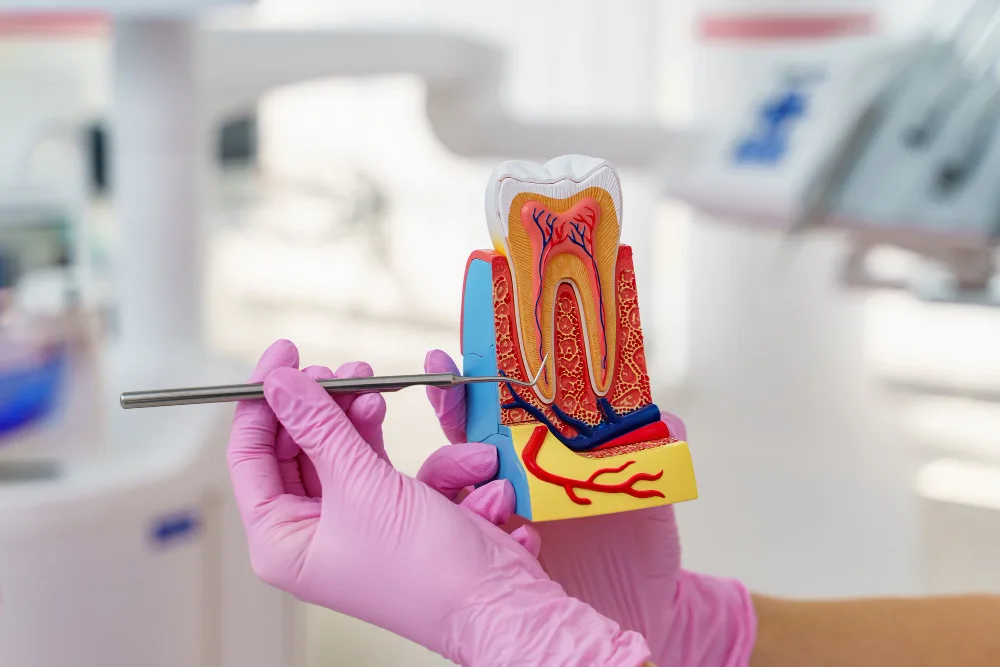
There’s also the anatomy itself. At the very tip of the root, tiny branches spread out like a delta at a river mouth. These branches are too small and too complex for a root canal file to clean reliably, and bacteria can persist there even after a treatment that looked completely successful. Over time that hidden bacterial load can produce a new infection, a cyst, or an abscess around the root tip — which is why one of the three options below treats the root tip from outside the tooth rather than from within.
How soon can a root canal fail?
There’s no fixed window. The AAE describes teeth becoming painful or diseased months or even years after treatment,1 and a long-term study of root-end surgery followed teeth for up to thirteen years precisely because problems at the root tip develop on that kind of timescale.2
Practically, this means two things. A root canal from a decade ago is not automatically in the clear — and a tooth that starts aching years later is not a strange case, it’s a recognised pattern with a name and a treatment.
Your three options, compared
| Option | What it does | When it’s the right call |
|---|---|---|
| Retreatment (non-surgical) | The tooth is reopened, the old filling material removed, the canals re-examined for extra canals or new infection, then cleaned, reshaped and refilled1 | Tried first in most cases — it treats the whole canal system rather than just the tip, and works well when the canals are still accessible |
| Apicoectomy (root-end surgery) | The root tip and the infected tissue around it are removed surgically, and the root end is sealed from below | When retreatment isn’t realistic: blocked or calcified canals, a crown and post that would have to be dismantled, or a problem confined to the root tip |
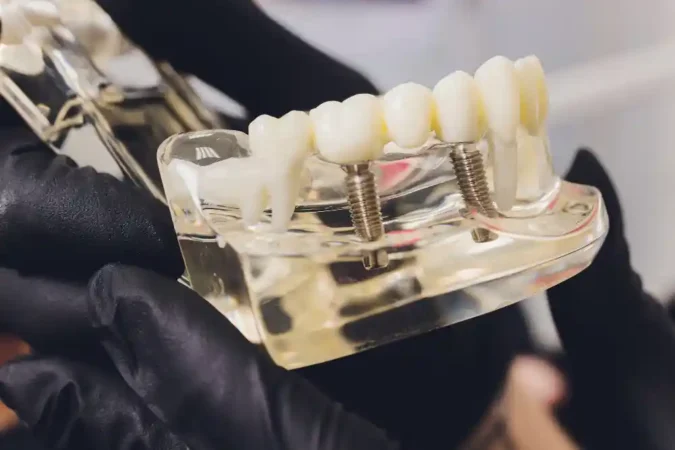
| Extraction + implant or bridge | The tooth is removed and replaced | Last resort — a vertical root fracture, or bone loss around most of the root, where neither option above can hold |
Retreatment first, surgery second, extraction last is the usual order — but the tooth decides, not the sequence. A tooth carrying a well-fitting crown and post is often a better candidate for surgery than for having the whole restoration taken apart. Our full guide to apicoectomy — the procedure, recovery and cost covers the surgical route in detail, and root canal versus extraction covers the last one.
What the success rates say
If the surgical route is on the table, one number matters more than any other — and it isn’t the one most pages quote.
A meta-analysis of 21 longitudinal studies compared traditional root-end surgery with endodontic microsurgery, the same operation performed under a surgical operating microscope.3
- Traditional root-end surgery: 59% pooled success across 12 studies (925 teeth).3
- Endodontic microsurgery: 94% pooled success across 9 studies (699 teeth).3
The difference was statistically significant, and the authors concluded that microsurgical technique is what produces predictably high success rates.3 The AAE makes the same point in plainer language: digital imaging and operating microscopes are what allow these procedures to be done quickly, comfortably and successfully.4
Over the longer term, a clinical study followed 73 patients with 87 post-restored teeth through apical microsurgery for up to thirteen years.2 Radiological healing was 97.6% at 1.5–5 years and 75.8% at 10–13 years, with smokers doing significantly worse at the longer interval.2 Two caveats worth knowing: “success” there means healthy bone healing on an X-ray with no pain or swelling, not a permanent guarantee — and the ten-year figure counts healing among the teeth still present, roughly four in five of the originals.2
So the question to ask any clinic isn’t “do you treat failed root canals”. It’s “do you work under a microscope, and do you take a CBCT first”. Those two answers separate a 94% procedure from a 59% one.
What happens at the assessment
Nothing is decided from symptoms alone. A proper assessment of a suspected failed root canal involves three things, and you’re entitled to all three before agreeing to anything.
- Current imaging. A periapical X-ray at minimum, and a 3D CBCT scan where the anatomy is complex — it shows the root tip, the surrounding bone and the nearby nerves in a way a flat image can’t.
- An assessment of the existing restoration. Whether the crown or post can stay determines whether retreatment is even practical, and that single point often decides the whole plan.
- A written plan naming the option and the reason. Retreatment or surgery, and why that one rather than the other. If the reason isn’t given, ask for it.
A tooth that turns out not to be saveable is worth knowing about early too — our guide on whether a dead tooth can be saved covers that side, and tooth infection treatment covers what’s done when there’s active infection to settle first.
What it costs
On the NHS, root canal treatment and oral surgery procedures both sit in Band 2, currently £76.60 in England, and if you need several treatments from the same band you pay the band charge once.5 The practical issue is access rather than price: the NHS notes that more complex root canal work is often referred on to another service.5
Privately in the UK, retreatment and root-end surgery both cost meaningfully more than a first-time root canal, because both take specialist time, a microscope and usually 3D imaging. Our page on root canal treatment cost in the UK sets out the NHS and private picture in full.
In Turkey, the same work with the same equipment costs considerably less, and the reason is the local cost base in Istanbul rather than any difference in what’s done — rents, salaries and laboratory work are lower, while the imaging, the instruments and the specialist’s time are the same line items. Our dental treatment prices in Turkey page compares treatment by treatment.
Any figures referenced are indicative market observations at the date of publication, not a quote, an offer, or a pricing commitment by DentSpa. Your own cost depends on the tooth, the number of canals or root tips involved, and whether additional imaging or grafting is needed — and is only confirmed after your scans are reviewed and a written quote is issued.
Treating a failed root canal at DentSpa
Patients arrive with this exact problem often enough that it has its own pathway. What’s worth checking — here or anywhere else:
- Microsurgical technique as standard, because of the 59%-versus-94% gap above.3
- 3D CBCT before any decision — you can see the imaging setup on our facilities page and the team on our specialists page.
- Accreditation you can verify yourself. DentSpa appears on the public Global Healthcare Accreditation register6 — the detail is in our article on being a GHA-certified dental clinic in Turkey.
- Recognition from outside the clinic — the title of best dental clinic in Europe in odontology, awarded by The European Awards in Medicine,7 and the Straumann Achievement Award.
- Follow-up after you fly home, through our after-treatment team — which matters here, because the X-ray that confirms the result is taken months later, not days.
If you’re weighing this up as part of fixing earlier dental work more broadly, or considering root canal treatment in Turkey, those pages cover the wider journey. And keep a local dentist for routine checks wherever you’re treated — remote follow-up complements care close to home, it doesn’t replace it.
If a treated tooth has been aching on and off, or a dentist has told you the infection hasn’t cleared, the useful next step is an assessment with current imaging. Send your X-rays or CBCT scan through our free online consultation and one of our endodontic specialists will tell you honestly which of the three options fits your tooth — including if the answer is that no treatment is needed yet.
Frequently asked questions
What are the signs of a failed root canal?
Can a root canal fail years later?
Why do root canals fail?
Can a failed root canal be fixed?
What is root canal retreatment?
Retreatment or apicoectomy — which is better?
How successful is treatment for a failed root canal?
Does a failed root canal always mean losing the tooth?
Is treating a failed root canal covered by the NHS?
What should I bring to an assessment?
Sources
- American Association of Endodontists — Endodontic Retreatment. aae.org
- Kqiku L, Städtler P, Ebeleseder K, et al. Long-term follow-up for apical microsurgery of teeth with core and post restorations. Journal of Endodontics. 2020. pubmed.ncbi.nlm.nih.gov/31862177
- Setzer FC, Shah SB, Kohli MR, Karabucak B, Kim S. Outcome of endodontic surgery: a meta-analysis of the literature — part 1: comparison of traditional root-end surgery and endodontic microsurgery. Journal of Endodontics. 2010;36(11):1757–1765. pubmed.ncbi.nlm.nih.gov/20951283
- American Association of Endodontists — Endodontic Surgery. aae.org
- NHS — How much NHS dental treatment costs. nhs.uk
- Global Healthcare Accreditation — accredited and certified organizations register. globalhealthcareaccreditation.com
- The European Awards in Medicine — DentSpa Clinic, European Award in Medicine in Odontology. theeuropeanawards.eu













 70%
70%