Table of content
Table of content
An apicoectomy is a small piece of surgery with a big job: saving a tooth that a root canal couldn’t quite finish saving. It removes infected tissue from the very tip of a tooth’s root and seals that root end, so the tooth can stay in your mouth instead of coming out. Most people return to normal daily activities the next day1. It isn’t guaranteed to work for every tooth, but in the hands of an experienced specialist, it works far more often than it fails.
Below, we’ll explain what the procedure involves, when it’s the right call versus retreating the root canal or removing the tooth altogether, what recovery feels like, what it costs, and why so many UK patients now have it done in Turkey rather than at home.
What Is an Apicoectomy?
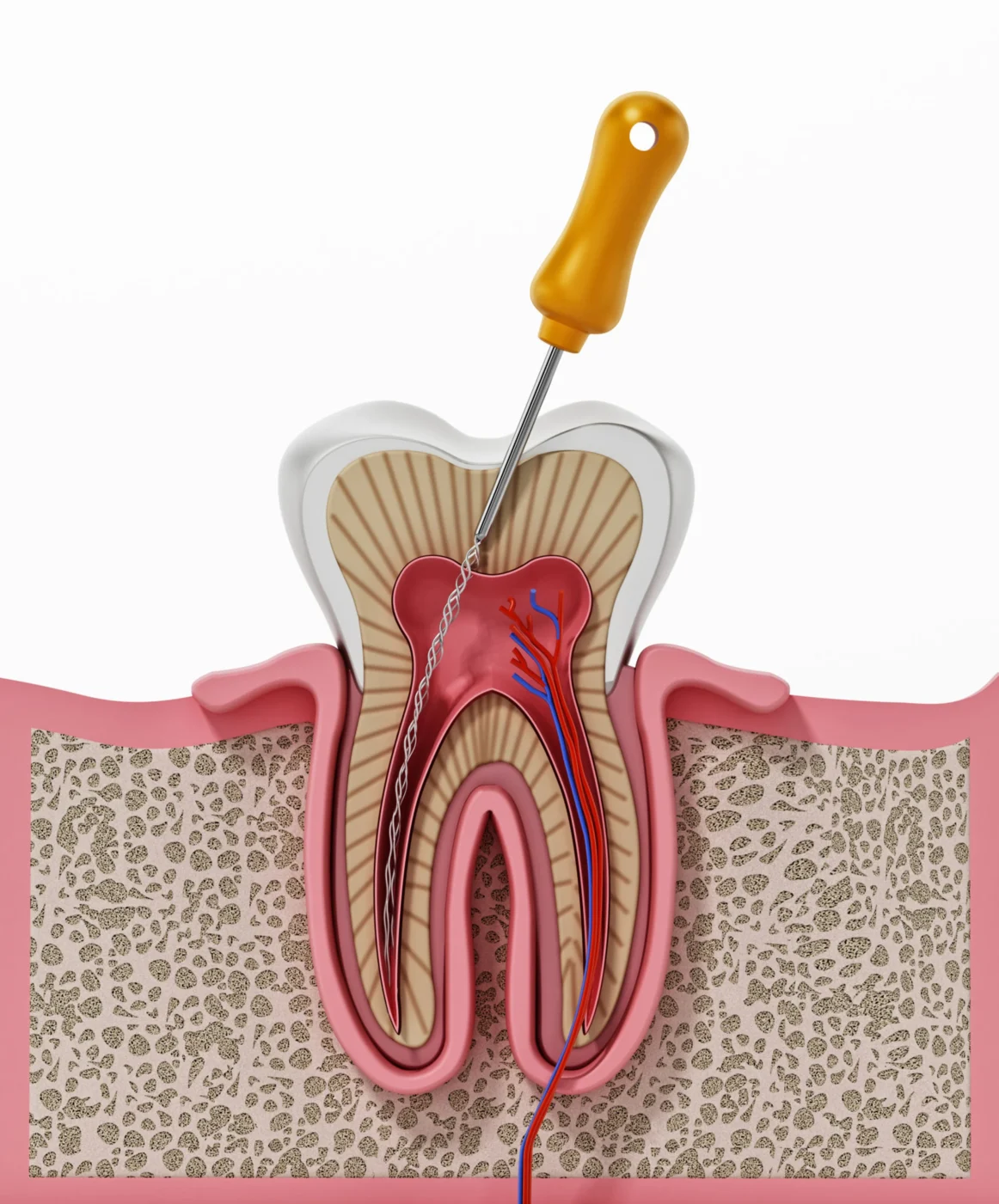
A root canal treats the inside of a tooth, cleaning out the canal system and sealing the space from within. Most of the time, that’s the end of the story. An apicoectomy is different: it’s minor surgery that treats the very tip of the root from the outside, through the gum, rather than from inside the tooth. In the UK you’ll also see it spelled apicectomy (without the “o”) — the same procedure either way. You’ll sometimes see it called a surgical root canal too, a fair description, since it’s the surgical counterpart used when the standard procedure hasn’t fully resolved a problem at the root tip. The crown of the tooth, and everything visible when you smile, is untouched throughout.
When Do You Actually Need One?
An apicoectomy is almost always the next step after something else hasn’t worked, or isn’t likely to. The most common reasons include a persistent infection or cyst at the root tip that hasn’t cleared despite a properly completed root canal; canals too curved or calcified to clean fully from inside the tooth; a fracture at the very root tip that non-surgical retreatment can’t reach; and a crown or post that would otherwise need removing and remaking just to retreat the canal from above.
This procedure is typically carried out by an endodontist, a dentist with additional specialist training in root canal systems and the surgery around them, because of the precision the root tip demands1. At DentSpa, this work sits with the dedicated endodontic team, not with one generalist handling every case that walks through the door.
Apicoectomy vs Retreatment vs Extraction
This is the question most patients are actually trying to answer. When a root canal hasn’t healed properly, three realistic paths exist, and the right one depends on the tooth and what’s already inside it.
Non-surgical retreatment reopens the tooth, removes the old filling material, recleans the canal, and reseals it. It’s worth ruling out first, since it treats the whole canal system rather than just the tip, and works well when canals are still accessible.
Apicoectomy comes in when retreatment isn’t realistic; blocked canals, a crown that would need replacing, or a problem specifically at the root tip beyond a file’s reach. It treats that localised issue surgically while leaving the rest of the tooth alone.
Extraction, followed by an implant or bridge, is the option of last resort, considered when a tooth’s structure is too compromised for either option above; extensive decay, a vertical fracture, or advanced bone loss. Weighing up root canal vs extraction in cases like these comes down to how much healthy tooth structure remains. The goal, where achievable, is always to save the natural tooth, since nothing artificial replicates one perfectly. But when a tooth genuinely can’t be saved, a well-planned implant is a strong outcome in its own right.
There’s no single “best” option; only the one that fits your specific tooth, a judgment your endodontist makes from your scans.
How Is an Apicoectomy Performed?
The procedure is more straightforward than the name suggests, done under local anaesthetic in a single visit lasting thirty to ninety minutes depending on the tooth and root anatomy1,2:
- Anaesthetic numbs the area fully before anything else happens.
- Accessing the root: a small opening is made in the gum tissue to reach the root tip and surrounding bone.
- Removing the infected tissue, along with a few millimetres of the root tip itself.
- Sealing the root end with a biocompatible filling material to prevent reinfection.
- Closing up: the gum is repositioned and closed with a few stitches, usually removed within a week.
Modern endodontic microsurgery uses a surgical microscope and micro-instruments throughout, which makes a measurable difference to how well the procedure works.
Does It Hurt, and What Does Recovery Look Like?
The surgery itself doesn’t hurt; you’re numb the whole time. After is a different story, though nothing dramatic. Some swelling, some tenderness, a few days of it, roughly what you’d feel after a tooth gets pulled. Painkillers from the pharmacy sort it out. Most people are back to normal the next morning.1,2
Gum tissue heals fast, a week or two and it’s done. Bone is slower. It’s still quietly knitting itself back together months later, which is why your dentist won’t rush you in for an X-ray; there’s nothing to see yet. Six months, then twelve, is the usual rhythm for checking. In between, just don’t push it: soft food, nothing scalding, brush around the area gently rather than avoiding it altogether, take what’s been prescribed properly instead of stopping the second it feels better, and lay off intense exercise for a bit. And actually turn up to the follow-up. Feeling fine isn’t the same as being healed. That’s kind of the whole point of the X-ray.
How Successful Is an Apicoectomy?
This is where technique matters enormously. Older, traditional root-end surgery, performed with the naked eye or simple loupes, had a pooled success rate of around 59% across the published literature. Endodontic microsurgery, using a surgical operating microscope, ultrasonic micro-instruments, and modern sealing materials, raised that figure to roughly 94% in the same body of research3. In plain terms, the equipment and technique your endodontist uses changes the odds substantially.
It’s worth being honest about what “success” means here, too. Most outcome studies define it as healthy bone healing on follow-up X-rays combined with the absence of pain or swelling, tracked over one to several years. Results vary by tooth position, root anatomy, and prior bone loss, so “high” isn’t the same as “guaranteed,” and no responsible clinician will promise a 100% outcome before reviewing your scans.
Can an Apicoectomy Fail, or Be Done Twice?
Most apicoectomies heal exactly as expected; that’s what the 94% success rate reflects.3
For the small number that don’t, your endodontist isn’t starting from scratch: they’ll usually spot it early, at the routine six or twelve-month X-ray, well before it ever becomes painful or urgent.
If healing hasn’t gone to plan, you still have good options. A second apicoectomy on the same tooth is often possible, especially if the first procedure used older techniques and a repeat with modern microsurgery is likely to do better. In cases with a root fracture or more significant bone loss, your endodontist may suggest extraction and replacement instead; not as a failure of the original treatment, but simply the more reliable path forward for that particular tooth. Either way, this is something your endodontist will walk you through with your X-rays in hand, not something to lose sleep over in advance.
Apicoectomy Cost: UK vs Turkey
Apicoectomy treatment is genuinely expensive, largely because it requires specialist training, a surgical microscope, and dedicated operating time. Costs climb further on molars, which have more complex roots than front teeth, and on cases involving larger cysts or previous failed treatments.
In the UK, private apicoectomy treatment typically costs between £700 and £1,500 per tooth, depending on which tooth is involved and how complex the surgery is.4 At DentSpa in Istanbul, the same procedure is performed by specialist endodontists using the same surgical microscope and biocompatible materials used in UK clinics, at a cost that reflects Turkey’s lower operating costs, sometimes up to 70% less cost, rather than any difference in the standard of care. Because pricing depends on the tooth, the number of root tips involved, and whether additional imaging or grafting is needed, the only reliable way to know your own cost is a personalised quote based on your CBCT scan; which is exactly what our free consultation gives you.
It’s also why DentSpa patients keep mentioning the same thing in their reviews: the clinical work and the experience around it both holding up under scrutiny. One patient who came to DentSpa specifically to fix a poorly performed root canal described first-class service at every step, from the airport pickup through to the dentist’s chair; exactly the follow-through that matters most when you’re trusting a clinic abroad with a procedure this precise.
If you’re weighing up whether root-end surgery is right for your tooth, the clearest next step is a free consultation, where one of our endodontists reviews your X-rays or CBCT scan and tells you honestly whether an apicoectomy, retreatment, or another option fits your case. You can book one through our team on WhatsApp whenever suits you.
Turkey’s Place in Dental Tourism, and Why It Matters for Surgical Cases
Istanbul has become one of the world’s busiest hubs for dental treatment, and not by accident. Specialist clinical teams, technology that often matches or exceeds smaller UK practices, and pricing that reflects a different cost base rather than a different standard of care, draw hundreds of thousands of patients from the UK, Europe, and North America each year. For something as precise as root-end surgery, the gap between a clinic set up for surgical endodontics and one that isn’t shows up directly in outcomes.
DentSpa was named Best Dental Odontology Clinic in Europe 2024, with the award recognising digital dentistry, complex case outcomes, and international patient care rather than volume alone. For an apicoectomy, that technology is directly relevant: 3D CT and CBCT imaging map the root tip, bone, and nerve pathways before surgery, the planning detail that separates a predictable outcome from a guess. Our endodontic specialists carry out this surgery routinely, supported by a dedicated medical advisor team that explains every step of the plan beforehand, and an after-care department that follows up on healing long after you’ve flown home.
Ready to Find Out If Root-End Surgery Is Right for You?
If you’ve been told you might need an apicoectomy, or you’re trying to work out why a previous root canal hasn’t settled down, the clearest next step is a free, no-obligation consultation. Send your X-rays or recent scans to our team on WhatsApp, and one of DentSpa’s endodontic specialists will talk you through what’s actually going on with your tooth, and which option genuinely fits your case.
Frequently asked questions
Does an apicoectomy hurt?
Can an apicoectomy fail?
Can an apicoectomy be done twice?
How long does recovery take?
Apicoectomy vs extraction; which is better?
How do you pronounce apicoectomy?
Sources
- American Association of Endodontists. Apicoectomy — Endodontic Surgery Explained. https://www.aae.org/patients/root-canal-treatment/endodontic-treatment-options/endodontic-surgery/endodontic-surgery-explained/apicoectomy/
- American Association of Endodontists — Endodontic Surgery — https://www.aae.org/patients/root-canal-treatment/endodontic-treatment-options/endodontic-surgery/
- Setzer FC, Shah SB, Kohli MR, Karabucak B, Kim S. Outcome of endodontic surgery: a meta-analysis of the literature — part 1: comparison of traditional root-end surgery and endodontic microsurgery. Journal of Endodontics. 2010;36(11):1757–1765. https://pubmed.ncbi.nlm.nih.gov/20951283/
- Arcendo Endodontics. Apicoectomy Cost Guide — Finchley Central, London. https://www.endodontics.org.uk/blog/how-much-does-apicoectomy-cost-in-finchley-central/













 70%
70%