
Table of content
Table of content
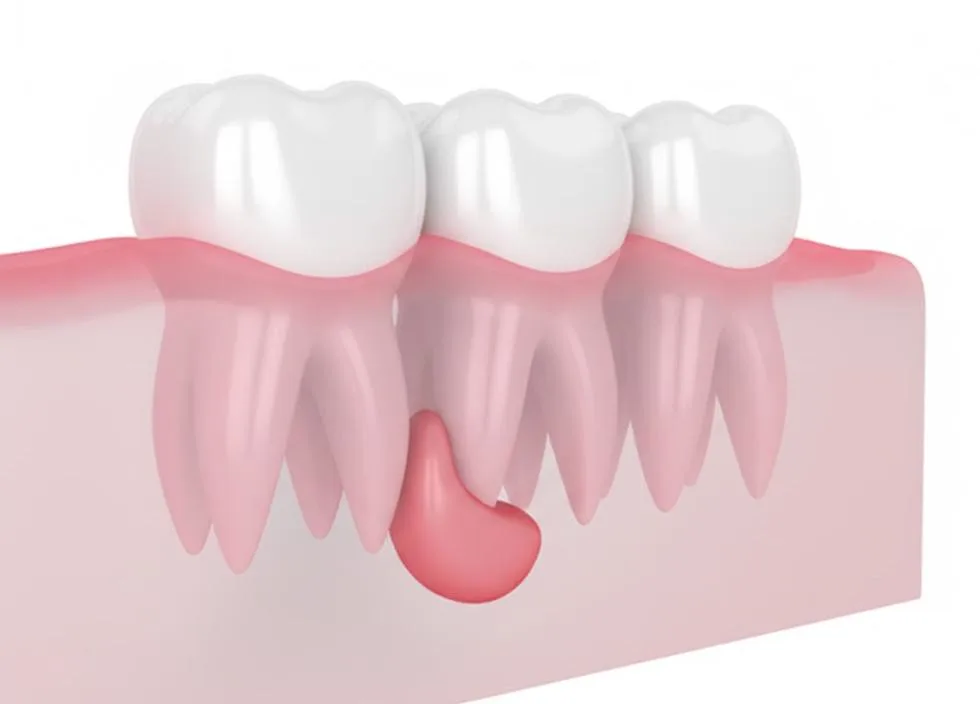
A dental cyst is a closed, fluid-filled sac that forms in the jawbone or the soft tissue of the mouth. The great majority are benign, grow slowly, and cause no pain — which is why most are found by chance on a routine X-ray rather than because something hurt. They are treated because they don’t resolve on their own, not because they are an emergency.
If you have just been told you have one, that is the sentence worth holding on to. This guide explains what a dental cyst is, the main types, how one is diagnosed, and what the published outcomes of each treatment actually look like.
What Is a Dental Cyst?
A dental cyst is a sac lined with its own layer of tissue, filled with fluid or soft material. Most arise from cells left over from tooth development — the same cells that built your teeth in the first place — which is why these are grouped as odontogenic cysts.
A cyst is not an infection in itself. It is usually the body’s response to a long-standing irritation: it walls the area off rather than resolving it, and the sac slowly enlarges from there.
They form in three broad places:
- At the tip of a tooth root, where a tooth’s nerve has died.
- Around an unerupted tooth, most often a wisdom tooth that never came through.
- In soft tissue — the lip, the inside of the cheek, the floor of the mouth, or near a salivary gland.
Because they enlarge over months and years rather than days, people commonly live with one for a long time without knowing. That is normal, and it is not a sign that anything has been missed.
The Main Types of Dental Cyst
The type matters, because it determines both the cause and the treatment. A multicentre study of 372 odontogenic cysts across three tertiary hospitals gives a clear picture of how common each one is: the apical radicular cyst accounted for half of all cases, followed by the dentigerous cyst at 29.3% and the odontogenic keratocyst at 14.2%.1
Periapical (radicular) cyst — the most common
This forms at the tip of a root when the nerve inside a tooth has died — from deep decay, a knock to the tooth, or an infection that persisted after earlier root canal treatment.
It is the type most likely to resolve without surgery, because removing the cause — the infection inside the tooth — often lets the body clear the lesion itself. Whether the tooth is still savable is the first question, and our guide to whether a dead tooth can be saved covers how that is judged.
Dentigerous (follicular) cyst
This develops around the crown of a tooth that never erupted — most often a lower wisdom tooth. It is one of the reasons dentists keep an eye on impacted wisdom teeth on X-ray even when they cause no trouble.
Worth knowing: the NHS is explicit that an impacted wisdom tooth causing no problems is normally left alone and simply monitored at routine check-ups.2 Monitoring is a legitimate plan, not inaction. If the tooth is already causing symptoms, our guide to lower wisdom tooth pain covers what happens next.
Odontogenic keratocyst
Less common — 14.2% of cases in that series — and distinctive because of how it behaves. It tends to extend along the length of the jaw rather than balloon outwards, so it can reach a fair size before it changes the shape of anything.
It is also the type most likely to come back after removal, which is the whole reason it is identified by name rather than treated generically. Naming it correctly changes two things: how thoroughly the lining is removed, and how long you are followed up afterwards.
Mucocele (mucous cyst)
This one isn’t in the jawbone at all. It appears in soft tissue — usually the lower lip or inner cheek — when a small salivary duct is blocked or damaged, often by an accidental bite. It shows as a soft, bluish, painless swelling, and it is the type people most often notice themselves.
What Causes a Dental Cyst?
The common thread is a long-standing irritation the body walls off instead of clearing. In practice that means:
- A tooth whose nerve has died — through deep decay, a crack, or trauma. This is the single most frequent route, and it is why treating decay early matters more than it looks.
- Infection persisting after earlier root canal treatment, usually around the very tip of the root.
- An unerupted or impacted tooth, where the sac that once surrounded the developing crown fills with fluid.
- Long-standing gum disease around a tooth — covered in our guide to scaling and root planing.
- Leftover tooth-forming tissue in the jaw, which accounts for types with no infection behind them at all.
Note what is not on that list: nothing you did wrong. Several types have no preventable cause whatsoever.
Dental Cyst Symptoms
The honest answer for most people is: none. A cyst usually announces itself on an X-ray, not through how you feel.
When one has grown enough to be noticeable, what people report is:
- Pressure rather than pain — a dull fullness in the jaw, lip or cheek.
- A firm, painless swelling in the gum or over the jaw.
- A tooth that has shifted slightly or feels different when you bite.
- Repeated flare-ups in the same spot that settle and return.
- An altered sensation in the lip or chin, if the cyst sits close to a nerve.
Any swelling or change in the mouth is worth having looked at, even when it doesn’t hurt — precisely because absence of pain tells you very little here.
Dental Cyst vs Abscess: What’s the Difference?
They get confused constantly, and the distinction changes how urgently you need to act.
| Dental cyst | Dental abscess | |
|---|---|---|
| What it contains | Fluid or soft material | Pus, from an active infection |
| Pain | Often none | Usually intense |
| Speed | Months to years | Hours to days |
| Timing of care | Planned | Urgent |
The NHS describes a dental abscess as a build-up of pus caused by infection that needs urgent treatment and will not go away on its own.3 If you have severe pain, facial swelling, a bad taste and a high temperature, that is the abscess pattern and it needs same-day attention — our guide to dental infection treatment covers it.
A cyst can become infected, at which point it behaves like an abscess and is handled with the same urgency. Most of the time it doesn’t.
Is a Dental Cyst Dangerous?
In the sense most people mean when they ask: no. Odontogenic cysts are benign. They are not tumours, and they are not cancer.
What they do is take up space. A cyst that keeps enlarging gradually occupies bone that teeth and nerves are using, and bone doesn’t share well. That is the reason a cyst is treated rather than watched indefinitely — not because it is about to do something dramatic, but because it is easier to deal with at 8 mm than at 30 mm, and because the space it takes up doesn’t come back on its own.
So the accurate framing is neither alarm nor dismissal. It is: this has a definite treatment, the treatment works, and the sooner it happens the smaller the job. If your dentist found one on a routine X-ray and booked you an appointment rather than sending you to hospital, that is a proportionate response, and you can read it that way.
How a Dental Cyst Is Diagnosed
- Clinical examination — the teeth in the area are tested for vitality, because a dead nerve points straight at a radicular cyst.
- Radiographs — where most cysts are first seen, as a well-defined dark area on a routine X-ray.
- CBCT (3D) imaging — this is what turns “there is something there” into a plan. It gives the true size in three dimensions, the exact relationship to the nerve canal and the sinus, and how much bone is left around it.
- Histology — the removed lining is examined under a microscope. This confirms the type, and it is the only way to distinguish a keratocyst, which changes the follow-up plan.
That last step is worth asking about, because it is the difference between a cyst being removed and a cyst being identified. The plan for afterwards depends on it.
Dental Cyst Treatment Options
Treatment follows the cause, the size and where the cyst sits. There are four routes, and more cases than people expect are handled by the least invasive of them.
Root canal treatment — often enough on its own
Where the cyst has formed because a tooth’s nerve died, disinfecting the inside of that tooth removes the cause, and the body frequently clears the lesion itself.
This is more powerful than it sounds. A clinical review followed 42 teeth with large cyst-like periapical lesions measuring 7 to 18 mm, treated with root canal treatment alone and followed for two to ten years. Complete healing was observed in 73.8% of cases, with partial healing in a further 9.5%. The authors concluded that the size of the lesion “is not a major determining factor” in choosing between root canal treatment and surgery.4
In other words: a large lesion on your X-ray does not automatically mean an operation. Root canal treatment is often the first thing to try, and the tooth is usually kept.
Enucleation (cystectomy) — complete removal
The cyst and its entire lining are lifted out in one piece under local anaesthetic, and the lining is sent for histology. It is the most common approach overall — 52.8% of cases in that 372-case series1 — and it is the standard where the cyst is well defined and reachable.
Removing the lining completely is the part that matters, since it is the lining, not the fluid, that regrows. Where the cavity left behind is large, it may be filled with graft material to help the bone rebuild — the principle is the same as in our guide to rebuilding bone in the jaw.
Marsupialization — shrink first, remove later
For a large cyst sitting close to a nerve or the sinus, a window is made into it and kept open so it decompresses and gradually shrinks. Once it has, the remainder is removed in a much smaller operation.
It takes longer, and that is the point: it protects the nerve and preserves jawbone that removing the whole thing in one go would have cost. Being offered this route is a sign the plan is being built around your anatomy.
Apicoectomy — surgery at the root tip
Where a tooth has already had root canal treatment and the lesion persists, the very tip of the root is removed along with the surrounding tissue, and the end of the canal is sealed. It is the step that saves a tooth that would otherwise be extracted — set out in full in our guide to apicoectomy and its success rates.
Extraction is the last option, not the first, and it enters the conversation only when the tooth itself can no longer be restored. Where surgery involves the jaw more broadly, it falls under jaw surgery, and the wider picture is covered in our overview of oral and maxillofacial treatment in Turkey.
Does a Dental Cyst Come Back?
Usually not, and the numbers are worth having.
Across those 372 treated cysts, 13 recurred — around 3.5% overall. They were not evenly spread: one radicular cyst, four dentigerous cysts, and eight keratocysts.1 Almost two thirds of all recurrences came from the type that makes up one case in seven.
Which explains why the histology result matters so much, and why follow-up appointments are scheduled rather than optional. For most types, one properly performed removal is the end of it. For a keratocyst, you are followed with periodic imaging for a period afterwards — and that is a plan, not a warning.
Recovery and Prevention
After removal you can expect some swelling and soreness for a few days, settling with standard pain relief, and soft food for a short period. What helps healing along is set out in our guide to recovering faster after dental surgery.
Not every cyst is preventable — the ones arising from leftover tooth-forming tissue simply are not. But the most common type is, because it starts with a nerve dying:
- Treat decay while it is still small, before it reaches the nerve.
- Have a tooth checked after any knock, even if it settles down at the time.
- Keep gum health under control.
- Keep routine check-ups and the X-rays that come with them — which is how the silent ones get caught early.
Dental Cyst Treatment at DentSpa
A cyst is one of the cases where the treatment depends entirely on getting the cause right first — and where the right answer may be endodontic rather than surgical. That makes it a case for more than one pair of hands.
- Where the cause is inside the tooth — a dead nerve or a previous root canal that didn’t fully resolve — the case is managed by our endodontist, Dr Mehmet Kalcay.
- Where the cyst involves the bone or needs surgical removal, it is handled by our oral surgeons, Dr Serdar Yılmaz and Dr Şükran Baycan.
Nothing is scheduled from photographs. The plan is built from three-dimensional imaging taken at the clinic, so the size, the type and the relationship to the nerve and the sinus are known before a date is set — and so you are told which of the four routes above applies to you, and why the others don’t.
If You’re Considering Treatment Abroad
For a cyst, the questions that matter are diagnosis, surgical experience and what happens after you fly home. All three can be checked before you commit:
- Accreditation covering the journey, not just the chair. DentSpa holds the Certification for Excellence in Medical Travel Patient Experience from Global Healthcare Accreditation5 — which assesses exactly the things a clinical inspection doesn’t reach: information before you travel, care coordination, and the handover of aftercare once you’re home. For a condition with scheduled follow-up imaging, that is the relevant credential.
- Independent recognition. DentSpa was named best dental clinic in Europe in the odontology category at the European Awards in Medicine.6
- Regulatory basics. A Turkish Ministry of Health licence and an International Health Tourism Authorisation Certificate, required by Turkish law for any clinic treating foreign patients. DentSpa is also certified to ISO 9001 and ISO 10002 and is a member of the Turkish Dental Association.
- Your histology report and imaging in your hands when you leave, so any dentist anywhere can read the case and continue the follow-up.
- Real patient voices. Read the verified Trustpilot and Google reviews and see results on Instagram.
How treatment abroad is planned end to end is set out in our guide to dental tourism in Turkey, and the questions worth asking any clinic are in how to find a dentist in Turkey.
Been told you have a cyst and want a second opinion on the plan? Send DentSpa your X-ray or CBCT scan for a free, no-obligation assessment from our specialists. Book a free consultation or message us on WhatsApp.
Frequently asked questions
Is a tooth cyst dangerous?
Can a dental cyst heal on its own?
Is a dental cyst an emergency?
What is the difference between a dental cyst and an abscess?
Is dental cyst treatment painful?
Will I lose the tooth?
Do dental cysts come back after removal?
What is the most common type of dental cyst?
Do I need a CBCT scan for a dental cyst?
Can a cyst be treated during a trip abroad?
Sources
- Frequency and Demographic Profile of Odontogenic Cysts in Riyadh, Saudi Arabia — Retrospective Multicenter Study, 372 cases from three tertiary centres.
- NHS — Wisdom tooth removal
- NHS — Dental abscess
- Calışkan MK — Prognosis of large cyst-like periapical lesions following nonsurgical root canal treatment: a clinical review. International Endodontic Journal 2004;37(6):408–416.
- Global Healthcare Accreditation — DentSpa Strengthens Global Trust in Turkey’s Dental Services with GHA Certification
- The European Awards in Medicine — DentSpa Clinic — European Award in Medicine in Odontology
















 70%
70%