

Table of content
Table of content
Gum disease treatment starts with better cleaning at home and professional cleaning by a hygienist. More serious disease needs deep cleaning under the gums, and some cases need antibiotics or gum surgery, according to the NHS.1 With careful assessment and treatment, the European Federation of Periodontology says it is usually possible to halt the progress of the disease.2
How do you know you need gum disease treatment?
Bleeding is one of the clearest signs.
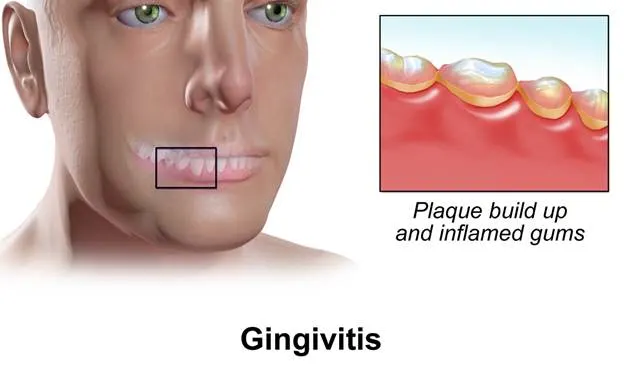
According to the NHS, gum disease can cause your gums to bleed when you brush your teeth, floss or eat hard foods. Your gums may also become swollen, red and sore. Bad breath is another reason to see a dentist.1 If you want to understand that symptom in more detail, our guide to what can cause bad breath and what to do about it explains where it fits into oral health.
Very sore and swollen gums need urgent attention. The NHS also advises seeking urgent dental attention if your teeth are becoming loose or falling out.1
The cause is straightforward: gum disease is caused by a build-up of plaque on your teeth.1 Treatment is therefore centred on removing bacterial deposits and improving the daily cleaning that helps stop them building up again.
What are the treatments for gum disease?
There is no single procedure that suits every stage of gum disease. The British Society of Periodontology divides treatment for periodontitis into four steps, moving from daily self-care through professional treatment and, where necessary, surgery, followed by ongoing maintenance.3
| Step | What it means for you |
| Step 1: Self-care and risk-factor control | You improve daily cleaning of your teeth and the spaces between them. Your dentist can also advise you about stopping smoking and other relevant risk factors.1 3 |
| Step 2: Non-surgical treatment | A hygienist cleans your teeth professionally. Where needed, deposits are removed from below the gum line and from the root surfaces. Some serious cases may also need antibiotics.1 2 |
| Step 3: Surgical therapy | If deeper gum pockets remain after non-surgical treatment, gum surgery may be needed. The NHS says some serious cases may require gum surgery or removal of some teeth.1 2 |
| Step 4: Supportive care and maintenance | Treatment does not simply finish after the initial cleaning. Follow-up appointments are usually scheduled every three to six months, with daily oral hygiene remaining essential.2 |
For patients who want a clearer explanation of the cleaning itself, our guide to tooth scaling and root planing in Istanbul explains what this non-surgical stage involves. If surgery is being discussed because the gum has receded, our guide to gum graft cost in the UK explains the two types of graft and what each one does.
The exact sequence depends on what your dentist finds. The important point is that how to treat gum disease is not simply a question of choosing one procedure. The plan starts with controlling plaque, then adds professional treatment when deposits cannot be removed through home care.
Does deep cleaning work?
Yes. Scaling and root planing can improve the attachment of the gum to the tooth.
A panel convened by the American Dental Association Council on Scientific Affairs found, with a moderate level of certainty, approximately a 0.5-millimetre average improvement in clinical attachment level following scaling and root planing.4
The result should be understood in context. Deep cleaning is one part of a wider treatment plan, not a replacement for daily cleaning. The European Federation of Periodontology says that, with careful professional assessment and treatment, it is usually possible to completely halt the progress of periodontitis, and that co-operating with oral-hygiene practices is essential for a successful outcome.2
The British Society of Periodontology also says that most cases of periodontal disease can be successfully treated by a dentist using these methods.5
Laser treatment is sometimes offered alongside deep cleaning. The same American Dental Association panel had a low level of certainty in the benefit of most non-surgical laser adjuncts.4
Can you treat gum disease at home?
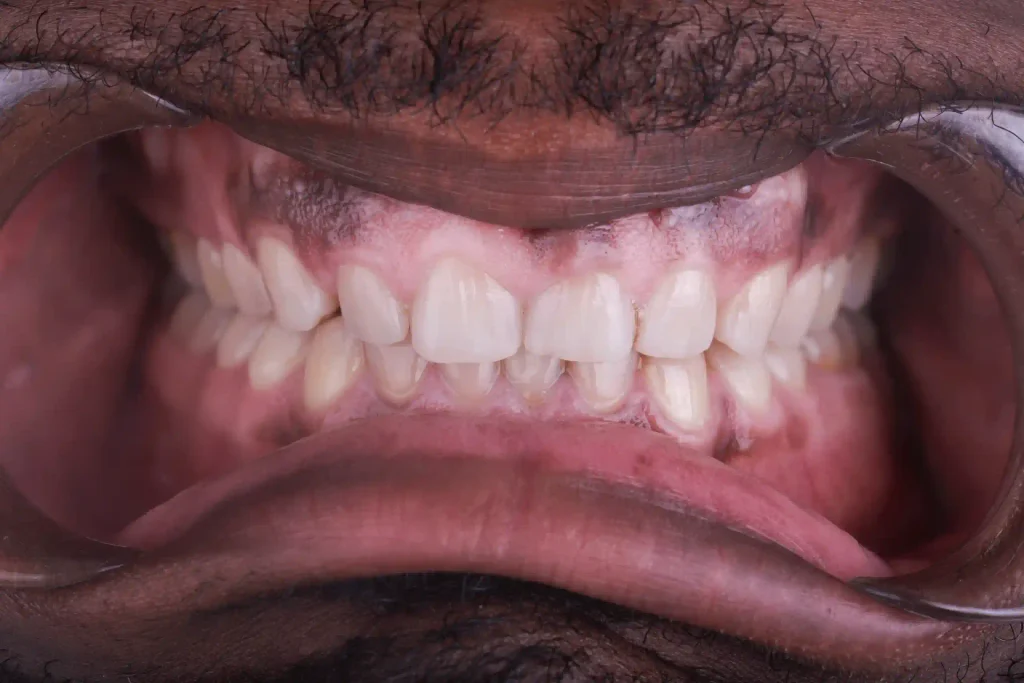
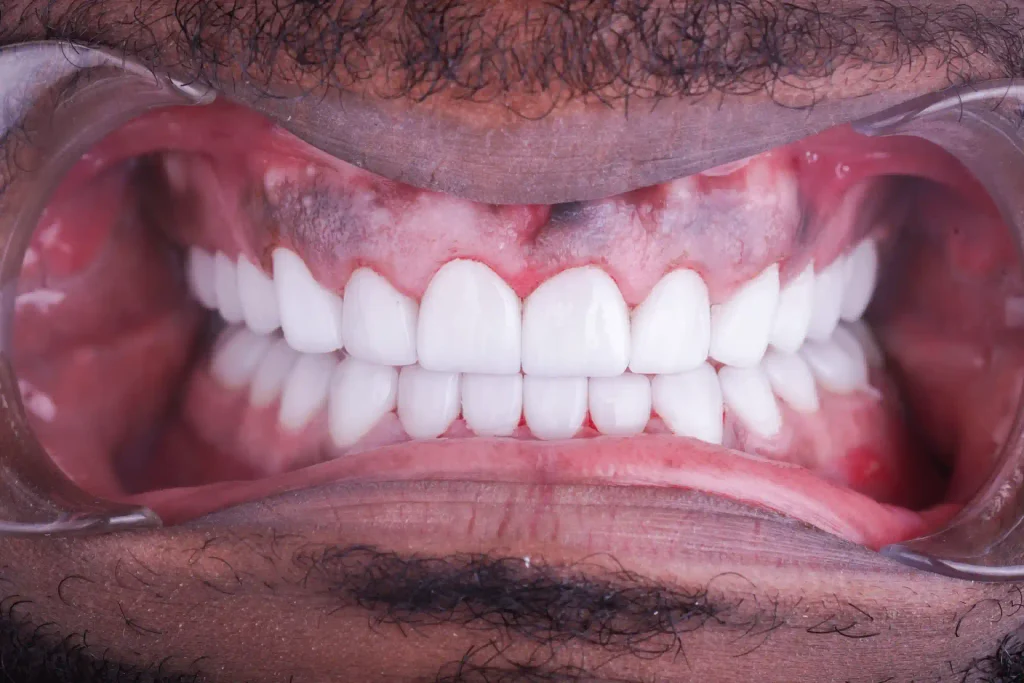
Home care is the first step in every treatment plan, and it is what helps maintain the result afterwards.2 3 It cannot, however, replace professional treatment when bacterial deposits have built up on root surfaces that you cannot reach yourself. The European Federation of Periodontology explains that professional treatment removes bacterial deposits and tartar from the root surfaces.2
The NHS recommends that you:1
- Brush your teeth with fluoride toothpaste at least twice a day.
- Clean between your teeth every day using floss or interdental brushes.
- Have regular dental check-ups.
- Do not use mouthwash straight after brushing.
- Do not smoke.
These habits matter even after professional treatment. Step 4 of the British Society of Periodontology guideline is supportive care and maintenance, which means continuing to look after the gums rather than considering treatment finished after one appointment.3
If you have been told that you have receding gums, our guide to receding gums and the issues they can raise gives you a separate explanation of that concern.
If you are asking whether lost gum tissue can come back, you can also read our guide to exosome therapy and gum regrowth to understand that specific question before discussing it with a dentist.
How much does gum disease treatment cost in the UK?
The gum disease treatment cost depends on whether you are receiving NHS treatment or paying privately, and on how extensive the treatment needs to be.
| Treatment | Cost |
| NHS Band 1 (England), including simple management of gum disease such as scaling when clinically needed | £27.90 |
| NHS Band 2 (England), including extensive management of gum disease | £76.60 |
| Private hygienist appointment, typical figure | £83 |
The NHS states that scaling is usually included in Band 1 at £27.90, while extensive treatment or complex gum problems may be charged as Band 2 at £76.60.6
For private treatment, research by myTribe Insurance found that a hygienist appointment typically costs £83, with most practices charging between £71 and £99.7
myTribe’s research does not price deep cleaning or gum surgery, and the NHS publishes its band charges only. For those treatments, the reliable figure is the one set out in your written treatment plan after assessment.
How long does gum disease treatment take?
Gum disease treatment is staged. The British Society of Periodontology guideline places a re-examination after the non-surgical treatment stage, before any further treatment is considered.3
The process therefore depends on what is found at assessment and how the gums respond to the initial treatment. It should not be treated as a single appointment with a fixed timetable.
The maintenance stage is also part of treatment. The European Federation of Periodontology says follow-up visits are usually scheduled every three to six months.2 Those appointments are not an optional extra after the real treatment has finished. They are Step 4, supportive care and maintenance, alongside continued oral hygiene at home.3
Why is gum disease treated before implants or veneers?
Gum health matters before restorative dental work because periodontal disease can affect the bone supporting the teeth.
The Association of Dental Implantology states that gum disease is a major cause of bone loss. It also says that the cause of gum problems needs to be understood and treated before implant treatment.8
That is why gum health is assessed before treatment involving implants, crowns or veneers at DentSpa. When gum disease is found during that assessment, it is treated before the restorative work rather than worked around.
For a broader explanation of why gum health matters before restorative treatment, read our guide to veneers, implants and gum disease. If you are specifically considering an implant, the tooth implant procedure guide explains the treatment itself.
At DentSpa in Şişli, Istanbul, periodontal treatment is carried out by specialists including Dr Damla Öztürk, a periodontology specialist with 10 years of experience. You can read Dr Damla Öztürk’s profile and see her education and presentations before deciding whether to arrange an assessment.
Bone levels are assessed using in-house panoramic X-ray and CBCT imaging. DentSpa is licensed by the Turkish Ministry of Health, certified to ISO 9001 and ISO 10002, and is a member of the Turkish Dental Association (TDB). The clinic’s licences and ISO certifications are explained here.
DentSpa also holds the Global Healthcare Accreditation (GHA) Certification for Excellence in Medical Travel Patient Experience. The certification covers the patient journey, including communication before treatment, coordination during treatment and follow-up afterwards.
That follow-up matters for international patients. Gum disease treatment is staged and leads into lifelong maintenance, so day-to-day care belongs with a dentist near home after you return from Istanbul. DentSpa continues follow-up from Istanbul after the patient goes home. You can read how GHA certification relates to the patient journey and follow-up before arranging treatment.
What should you do if you think you have gum disease?
Start with an assessment rather than choosing a treatment based on the name of a procedure.
A dentist can establish whether your gums show signs of disease and whether professional treatment is needed. From there, treatment can follow the staged approach: self-care, non-surgical treatment where needed, surgical therapy for cases that require it, and ongoing maintenance.3
For international patients considering restorative treatment at DentSpa, the same principle applies. The free consultation starts with the clinical findings and what you want to achieve. A dentist explains, in your own language, why one approach is recommended and why another is not. The aim is to make the treatment decision from the findings, rather than from a price.
If you are considering implants, crowns or veneers and want your gum health assessed first, contact DentSpa to arrange a consultation.
Frequently asked questions
What is the fastest way to cure gum disease?
What are the best treatments for gum disease?
Can you live a normal life with gum disease?
Is gum disease common at age 40?
How much does gum disease treatment cost?
Do I need antibiotics for gum disease?
Does laser gum disease treatment work?
Sources
- NHS — Gum disease — https://www.nhs.uk/conditions/gum-disease/
- European Federation of Periodontology — Gum disease: Treatment — https://www.efp.org/for-patients/gum-diseases/gum-disease-treatment/
- British Society of Periodontology — BSP UK Clinical Practice Guidelines for the Treatment of Periodontitis — https://www.bsperio.org.uk/professionals/bsp-uk-clinical-practice-guidelines-for-the-treatment-of-periodontitis
- Smiley CJ et al. — Systematic review and meta-analysis on the nonsurgical treatment of chronic periodontitis by means of scaling and root planing with or without adjuncts, Journal of the American Dental Association, 2015 — https://pubmed.ncbi.nlm.nih.gov/26113099/
- British Society of Periodontology — Patient FAQs — https://www.bsperio.org.uk/patients/faqs
- NHS — How much NHS dental treatment costs — https://www.nhs.uk/nhs-services/dentists/how-much-nhs-dental-treatment-costs/
- myTribe Insurance — How much does private dental treatment cost in the UK? (pricing research August 2026) — https://www.mytribeinsurance.co.uk/treatment/cost-of-private-dental-treatment-uk
- Association of Dental Implantology — Considering Dental Implants? A patient’s guide to dental implant treatment — https://consideringdentalimplants.co.uk/_userfiles/pages/files/consideringdentalimplants.pdf
















 70%
70%