Table of content
Table of content
On the NHS, root canal treatment costs £76.60 — a flat Band 2 charge that covers the whole course of treatment, whether it is a front tooth or a back molar.1 Privately, the same treatment runs from roughly £300 for a front tooth to £1,100 for a molar at a general practice, and higher again if a specialist does the work or you are being treated in central London.
That gap is the reason most people end up on a page like this. The NHS price looks manageable and the private quote does not, and somewhere in between sits the question nobody answered clearly: what are you actually paying for, and why does it change so much from one tooth to the next?
Here is the full picture — the NHS bands and the one rule about them that most price guides get wrong, private costs tooth by tooth, the crown that almost always follows, and what genuinely determines whether the treatment lasts.
How much does a root canal cost on the NHS?
Root canal treatment sits in Band 2, which costs £76.60 in England as of April 2026.1 That single charge covers every appointment needed to finish the treatment within that course, and root canal treatment usually takes two or more visits of an hour or two each.2
The three NHS bands work like this:
- Band 1 — £27.90. Examination, X-rays if clinically needed, a scale and polish, fluoride varnish.
- Band 2 — £76.60. Everything in Band 1, plus fillings, root canal treatment, extractions and other oral surgery.
- Band 3 — £332.10. Everything in Bands 1 and 2, plus crowns, bridges, dentures, inlays and onlays.
- Urgent treatment — £27.90. Includes emergency partial root canal treatment and draining an abscess, this stops the pain, but it is not the finished root canal.
Unlike private treatment, the NHS charge does not change with the tooth. A single-canal incisor and a four-canal molar cost the same £76.60, even though the molar may take three times as long in the chair.
The NHS band rule most price guides get wrong
Almost every article on this subject tells you that a root canal costs £76.60 and a crown costs £332.10, then adds them together to get £408.70. That is not how NHS charging works.
The NHS rule is explicit: if you need a mix of treatments from different bands, you pay only the cost of the highest band you are having.1 So a root canal followed by a crown, completed within the same course of treatment, costs £332.10 in total — not £408.70. And if you need several treatments from the same band, you pay that band charge once.
There is a second rule worth knowing. If you need further treatment within two months of finishing a course, and it falls into the same band or a lower one, there is no extra charge. Past two months, you pay again.1 If your dentist has told you the crown will follow in a few weeks, that timing is worth asking about directly.
Some people are entitled to free NHS dental treatment or help with the cost, and that is worth checking before assuming any of these figures apply to you.1
Private root canal cost in the UK, tooth by tooth
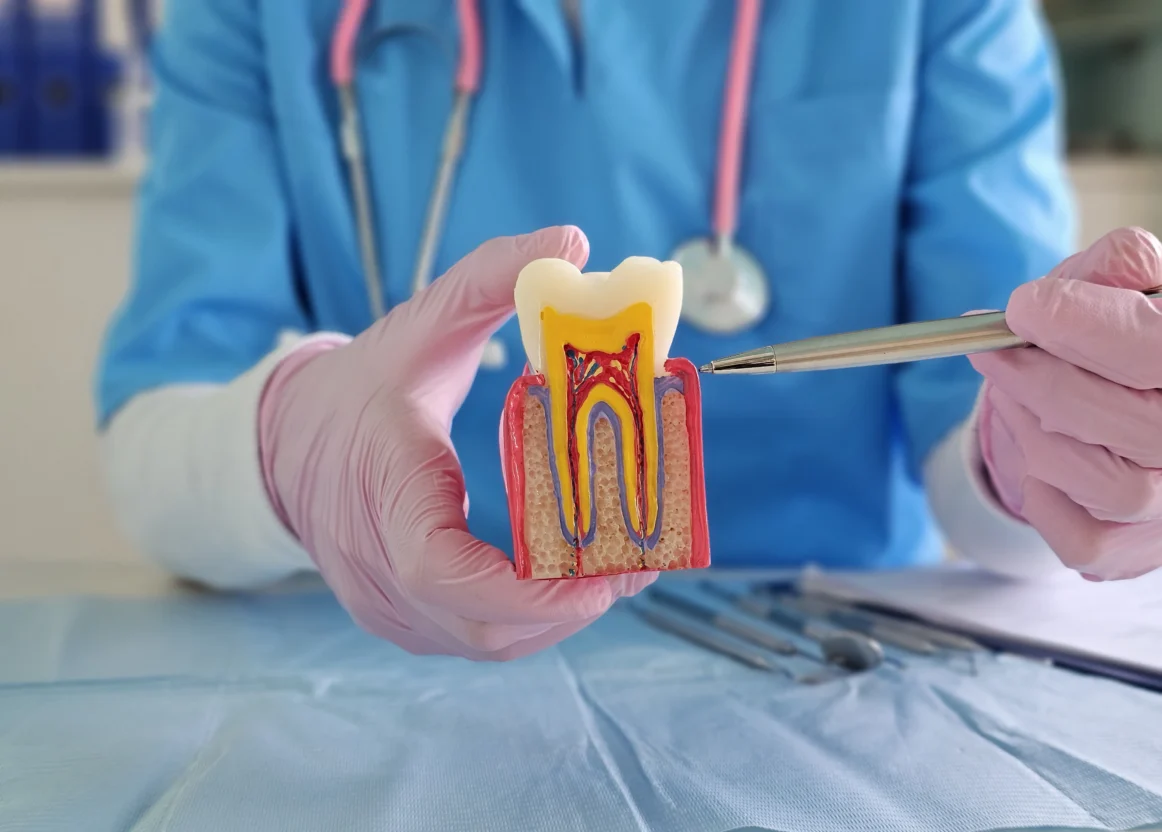
Privately, the price is driven almost entirely by one thing: how many canals are inside the tooth. Each canal has to be located, cleaned along its whole length, shaped and then sealed. Four canals is not four times the difficulty of one, but it is nothing like the same appointment either.
| Tooth | Canals | General dental practice | Specialist endodontist |
|---|---|---|---|
| Incisor or canine | 1 | £300 – £700 | £700 – £1,200 |
| Premolar | 1 – 2 | £400 – £800 | £800 – £1,300 |
| Molar | 3 – 4, occasionally more | £500 – £1,100 | £900 – £1,500 |
Front teeth are the straightforward end of the scale. One canal, good visibility, usually an hour. Premolars are the uncertain middle — the dentist often does not know whether there is one canal or two until the tooth is open, which is why the quote comes as a range rather than a figure.
Molars are where the money goes. Upper molars typically have three canals, lower molars two or three, and a meaningful minority have a fourth that is easy to miss. The anatomy branches and rejoins rather than running in straight lines, and a molar case can take anywhere from ninety minutes to three hours across more than one visit.
Location matters too, and so does the individual practice. Two dentists a few miles apart can quote very different figures for the same molar, and London practices sit consistently at the top of these ranges or above them. Treat any single number you read online — including the ones above — as a starting point for the conversation rather than a quote.
Why a specialist endodontist costs more
An endodontist is a dentist who has completed several additional years of training in root canal treatment alone. Your dentist may carry out the treatment themselves, or refer you to a specialist service if the case is more complex.2
Specialist fees sit well above general practice — commonly £700 to £1,200 for a front tooth and £900 to £1,500 for a molar, with complex molar cases in central London quoted beyond £2,000.
Whether that premium is worth paying depends on the tooth. On a single-canal front tooth the case for a specialist is weaker. On a molar with unclear anatomy, a previously failed treatment, a curved or calcified canal, or a tooth that matters structurally to the rest of your bite, the additional training and equipment change the odds meaningfully.
The cost almost nobody quotes upfront: the crown
A root-canalled tooth has had its centre removed. What is left is a shell — often already weakened by the decay or fracture that caused the problem — and on a back tooth, that shell is taking the full load of chewing. The NHS itself notes that a crown may be needed if the tooth was badly infected.2
This is not an upsell. It is the difference between a treated tooth and a treated tooth that survives. A long-running study of endodontically treated teeth found a strong association between placing a crown and the tooth still being there years later, once other clinical factors were controlled for.3 Restoring the tooth properly is treated by specialist bodies as part of the treatment, not as an optional extra afterwards.4
Privately, that adds £500 to £1,200. So the honest total for a private molar is not the £800 you were quoted for the root canal — it is roughly £1,000 to £2,300 by the time the tooth is properly finished, and more if a specialist is involved. If you want that second half of the bill broken down properly, our guide to what a dental crown costs in the UK on the NHS and privately covers the materials, the price differences and where the money actually goes.
What actually determines whether a root canal lasts
Price is the question people arrive with. Whether the treatment works is the question that matters more, and the two are not as closely related as you might assume.
The largest systematic review of first-time root canal treatment pooled success rates of roughly 68% to 85% when judged by strict radiographic healing, with higher figures when success is measured simply by the tooth staying functional and free of symptoms.5 The same body of research identified which factors actually move those numbers.6 They are clinical, they are well documented, and none of them is geographic.
Rubber dam isolation
A sheet of rubber isolates the tooth so that saliva and the bacteria in it never reach the open canal. It is the least glamorous item on this list and arguably the most important. A nationwide study of teeth receiving first-time root canal treatment found a significantly lower rate of eventual extraction where a rubber dam had been used.7 It takes a few extra minutes, which is exactly why rushed treatment skips it — anywhere in the world.
Magnification and imaging
A missed canal is one of the most common reasons a root canal fails, and you cannot clean what you never found. An operating microscope or loupes make the difference on the fourth canal in an upper molar. Where the anatomy is unclear, a 3D scan shows what a flat X-ray cannot — extra canals, unusual curvature, the true extent of infection at the root tip.
Instruments, sealing and follow-up
- Single-use files. Rotary files fatigue with each use. Reusing them is how instruments separate inside a canal.
- A canal filled to the right length. Under-filled leaves space for bacteria; over-filled irritates the tissue beyond the root.
- A sound coronal seal. A perfectly filled canal under a leaking temporary filling will reinfect. The permanent restoration is part of the outcome.
- Radiographic review. Healing at the root tip is judged over months, not on the day of treatment. A clinic that does not plan a follow-up X-ray has no way of knowing whether it worked.
These are the published quality standards for endodontic treatment in Europe, not one clinic’s opinion.8 Which makes them useful to you as a patient: you can ask any dentist, anywhere, which of these apply to your case and why. A practice that cannot give you a straight answer is telling you something. A practice that walks you through its protocol before you commit is telling you something too. You can see how we work through each of these steps on our root canal treatment page.
When a root canal fails: retreatment or extraction
Some root canals fail, sometimes years later. The tooth becomes tender again, or an X-ray taken for another reason shows infection persisting at the root tip. At that point there are three routes.
Retreatment means removing the old filling material, finding whatever was missed the first time, and doing it again through a tooth that has already been drilled and restored. It is more demanding than the original treatment and outcomes are less predictable, which is why it typically costs 30% to 50% more.6
Extraction is quicker and cheaper on the day, but it starts a second bill. A gap left unfilled lets the neighbouring teeth drift and the opposing tooth over-erupt, and replacing the tooth later with an implant or bridge costs more than saving it would have. We have set out that comparison in detail in our guide to choosing between a root canal and taking the tooth out.
Doing nothing is the option people take by default when the pain settles. Antibiotics are worth understanding here: they reduce inflammation in the tissue around the tooth, but they cannot reach dead tissue inside a canal with no blood supply. They buy time to arrange treatment. They do not fix the tooth.
Paying for it: insurance, finance and NHS access
UK dental insurance usually covers a proportion of root canal treatment, but two limits catch people out. Annual benefit caps are commonly in the region of £1,000 to £2,000, which a single molar root canal plus crown can exhaust on its own. And pre-existing conditions are excluded — the tooth that has been sensitive for eighteen months may not qualify as the sudden, unexpected problem the policy was written for.
Most private practices will split payment across treatment visits, and many offer interest-free finance over twelve months on larger amounts. Practice membership plans, typically £15 to £30 a month, cover check-ups and discount treatment, which changes the arithmetic if you know more work is coming.
Then there is the question underneath all of this. The NHS route exists and it is genuinely inexpensive — if you can get an appointment. Where an NHS place is not available and the private quote for a molar plus crown comes back in four figures, “which is cheaper” stops being the right question. The real one is what the tooth is worth keeping, and which options you actually have.
How UK costs compare with treatment in Turkey
Treatment in Turkey is substantially less expensive than private care in the UK, patients typically save up to 75% against UK private prices, and we have broken down how those figures work in our guide to dental treatment packages in Turkey and what they include. The difference is not a difference in materials or standards; it is the cost of running a clinic in Istanbul rather than in London.
That said, flying abroad for a single root canal on a front tooth rarely makes sense, the saving on one straightforward tooth may not clear the cost of the trip. It becomes a serious option when the tooth also needs a crown, when there are several teeth to treat, when a previous root canal has failed and needs redoing, or when you cannot access NHS care and are looking at four figures privately. If you want to see what treatment involves as an overseas patient before deciding anything, our article on how root canal treatment works for patients travelling to Turkey walks through the process end to end.
Getting an exact figure for your tooth
No article can price your case. The number depends on which tooth it is, how many canals it turns out to have, whether the previous treatment has to be undone first, and whether a crown is needed afterwards. That is a clinical judgement, not a price list.
DentSpa is an Istanbul dental clinic certified by the Turkish Dental Association and to ISO 9001 and ISO 10002, approved by the Turkish Ministry of Health, and named Best Dental Clinic in Europe in the Odontology category at the 2024 European Awards in Medicine. Endodontic cases are handled by Dr Ahmet Çetinkaya, a specialist in endodontics with a doctorate in the field and ten years working in root canal treatment alone, whose published research includes radiographic assessment of previously failed endodontic treatment.
- A free consultation before anything is decided — send an X-ray or photographs and get an assessment of whether the tooth can be saved at all.
- A written, itemised quote — tooth by tooth, including the restoration, before you commit to anything.
- English-speaking coordinators and follow-up you can reach after you are back home.
You can read verified patient reviews on Trustpilot and Google, or send your case through the free online consultation and get a straight answer on what your tooth needs.
Frequently asked questions
How much does root canal treatment cost on the NHS in 2026?
Why does a molar root canal cost more than a front tooth?
Do I need a crown after a root canal, and what does it add?
Is it cheaper to have the tooth taken out instead?
Can I have root canal treatment privately if I am an NHS patient?
How long does a root canal last?
Will antibiotics clear the infection instead?
Sources
- NHS — How much NHS dental treatment costs. Band charges for England, updated 1 April 2026. nhs.uk
- NHS — Root canal treatment: what it is for, how it is done and recovery. nhs.uk
- Aquilino SA, Caplan DJ. Relationship between crown placement and the survival of endodontically treated teeth. J Prosthet Dent. 2002;87(3):256–63. PMID 11941351.
- American Association of Endodontists — root canal treatment and restoration of the treated tooth. aae.org
- Ng YL, Mann V, Rahbaran S, Lewsey J, Gulabivala K. Outcome of primary root canal treatment: systematic review of the literature — Part 1. Effects of study characteristics on probability of success. Int Endod J. 2007;40(12):921–39.
- Ng YL, Mann V, Rahbaran S, Lewsey J, Gulabivala K. Outcome of primary root canal treatment: systematic review of the literature — Part 2. Influence of clinical factors. Int Endod J. 2008;41(1):6–31.
- Lin PY, Huang SH, Chang HJ, Chi LY. The effect of rubber dam usage on the survival rate of teeth receiving initial root canal treatment: a nationwide population-based study. J Endod. 2014;40(11):1733–7.
- European Society of Endodontology — Quality guidelines for endodontic treatment: consensus report. Int Endod J. e-s-e.eu














 70%
70%