Table of content
Table of content
A good smile is more than straight, white teeth — it is the balance between the teeth and the gums framing them. If you have ever felt self-conscious about a “gummy” smile or an uneven gum line, gum reshaping — also called gum contouring — is the procedure that addresses it.
One thing shapes everything that follows, and most pages on this subject skip it: showing a lot of gum is not always a gum problem. It can come from gum tissue that never finished receding to its adult position, from an upper lip that lifts unusually high, from an upper jaw that is vertically long, from gum swelling caused by inflammation or medication, or from teeth that have worn short. Contouring corrects some of those and does nothing for others.
And they rarely arrive alone. In a clinical study of 123 patients with excessive gingival display, 55.3% had more than one cause at the same time, which is why the authors concluded that treatment has to be planned around the cause rather than applied as a single standard procedure.1 So the useful question is not “can my gums be trimmed?” but “what is actually making my smile look gummy?” This guide covers both.
What is gum reshaping?
Gum reshaping, also known as gum contouring, is a procedure that resculpts the gum line so that more of each tooth is visible and the margins sit at even heights across the smile. It works by removing a controlled amount of gum tissue — and in some cases a small amount of the underlying bone, so the tissue has a stable level to heal to.
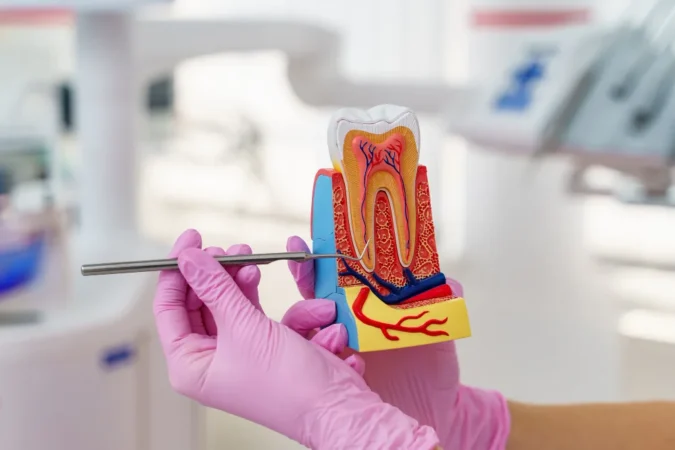
That last detail explains something that confuses a lot of patients. Gum tissue attaches to the tooth at a set distance above the bone. If tissue is simply trimmed back without respecting that distance, the body tends to rebuild it — which is why the gum can look right at two weeks and creep back by three months. Where the reshaping needs to go further, recontouring the bone at the same time is what makes the new position hold. It is the difference between a trim and a properly planned crown-lengthening procedure, and it is decided from the measurements taken at your assessment, not from a photograph.
Gum contouring is usually elective — a cosmetic procedure to improve how the gums, teeth and smile look, rather than something medically required. It is also performed as a functional step in restorative dentistry: where a tooth has broken close to the gum, crown lengthening exposes enough tooth for a crown to be fitted properly, and where veneers are planned, evening the gum line first is often what makes the final result look natural.
What contouring does not do — receding gums
This is worth stating plainly, because it is the most common misunderstanding about the procedure.
Gum contouring removes tissue. It cannot put tissue back. If your concern is the opposite problem — gums that have receded, exposing the root and making teeth look long — contouring is not the treatment for it, and any page suggesting otherwise has the direction of the procedure backwards. Rebuilding lost gum is gum grafting, a different operation with different planning.
There is a second reason the distinction matters. Recession usually has an active cause behind it — periodontal disease, heavy brushing, or the way the teeth sit in the bone — and treating the appearance without addressing that cause means it continues underneath. Where gum disease is involved, the inflammation is treated first; the NHS describes professional cleaning by a dentist or hygienist as the starting point for gum disease, with deeper cleaning where it is more advanced.2
What Causes a Gummy Smile or an Uneven Gum Line?
Several different things produce the same appearance, and each one leads somewhere different. This is the part of the assessment that decides whether contouring will work for you.
- Altered passive eruption. The gum never finished migrating to its adult position, so it still covers part of the crown and the teeth look short and square. This was the most common finding in the study above, present in 73.2% of patients with excessive gingival display.1 It is also the cause that responds best to contouring.
- A high or hypermobile upper lip. The gums are in a normal position; the lip simply lifts further than average when you smile. Removing gum tissue does not change how the lip moves, so this one is managed differently.
- Vertical maxillary excess. The upper jaw is vertically long, which shows gum at rest and in a smile. This is skeletal, and contouring alone will not resolve it.
- Gingival overgrowth. Swollen, enlarged gum tissue — either from inflammation and plaque, or as a known effect of certain medications including some calcium-channel blood pressure drugs, anticonvulsants and immunosuppressants. Here the cause is treated first, and a review of the medication with your doctor may come before any surgery.
- Short teeth from wear. Grinding or erosion has shortened the crowns, so the proportion looks wrong even though the gum is where it should be. This is a restorative problem, not a surgical one.
- Genetics. Gum height, tooth shape and lip length all run in families, which is why an uneven gum line often appears without any illness behind it at all.
Why the causes rarely arrive alone
Because more than half of patients have two or more of these at once,1 a proper plan often sequences treatments rather than choosing one. That is a longer conversation than “we’ll trim the gums” — and it is the conversation that determines whether you like the result.
Who Is a Candidate for Gum Contouring?
You may be a good candidate if:
- Excess gum tissue covers part of your teeth and makes them look short — a gummy smile
- Your gum line is uneven, so one or two teeth look shorter than their neighbours
- Your gums are healthy and free of active inflammation
- You are planning veneer or crown work, and evening the gum line is part of designing the final result
- A tooth has broken near the gum and needs crown lengthening before it can be restored
Contouring is not the right answer on its own if your gums have receded, if the gum display comes mainly from lip movement or jaw height, if there is untreated gum disease, or if the teeth are short because they have worn down. In those situations the assessment should tell you so — and being told that contouring is not your answer is a useful result, not a wasted appointment.
Gum reshaping is also frequently combined with other treatments — aligners, whitening, veneers — as part of a planned sequence rather than as isolated procedures.
The Gum Contouring Process: What To Expect
The procedure is carried out at the clinic and begins with a consultation, where your dentist or periodontist examines the gum line, measures where the bone and attachment sit, discusses your goals and identifies which of the causes above applies to you.
- Planning and design. The new gum line is mapped out before anything is cut, so you know what shape you are agreeing to. Where veneers or crowns are also planned, the two designs are worked out together — the gum position and the tooth proportions have to be decided as one.
- Anaesthesia. The area is numbed with a local anaesthetic so the procedure is comfortable. Your dentist will explain each step before starting.
- Reshaping. The gum tissue is contoured with a scalpel or a laser. A laser seals the tissue as it works, which typically means less bleeding during the procedure. Where the correction is more than a small trim, the bone level is recontoured at the same time so the tissue heals to a stable position rather than growing back.
- Healing. Mild discomfort, swelling and sensitivity are normal for the first few days. You will be given aftercare instructions — usually soft foods for a short period and careful cleaning of the area — and pain relief where it is appropriate for you.
One point about timing, particularly if you are combining this with veneers or crowns: gum tissue needs time to settle before final restorations are fitted, because the finished margins have to be designed against the healed gum line rather than a swollen one. Your dentist will tell you what that means for your case and how many visits it implies.
What are the Benefits of Gum Contouring?
Where it is the right procedure for the right cause, gum reshaping offers:
- A more even, symmetrical gum line across the smile
- Better proportions between the teeth and the gum framing them
- More of each tooth visible, so teeth no longer look short or square
- A foundation for veneer or crown work, where the gum position is part of the design rather than an afterthought
- Enough exposed tooth structure for a broken tooth to be restored properly
For many patients the practical effect is simply that they stop editing photographs of themselves — which is a modest-sounding outcome and, in our experience, the one people mention afterwards.
What are the Potential Risks of Gum Contouring?
Gum reshaping is generally safe, and like any procedure it has points worth knowing before you agree to it:
- Temporary discomfort and swelling, usually settling within a few days.
- Sensitivity to hot and cold where slightly more tooth is exposed. This normally eases as the area heals.
- Regrowth. Gum tissue can rebuild toward its original level, which is the body restoring the attachment distance described earlier — and the reason a case that needs bone recontouring should get it, rather than a soft-tissue trim that will not hold.
- Infection risk, which is why aftercare and keeping the area clean during healing matter.
The single largest factor in the result is not the instrument used but the diagnosis behind it. Almost every disappointing outcome traces back to the same thing: tissue removed without establishing why the gum was sitting where it was.
Why Many Patients Choose Turkey
Turkey has become a common destination for cosmetic and periodontal work because of:
- Experienced periodontal and cosmetic specialists with high case volume
- Clinics equipped for laser and conventional periodontal surgery as routine
- Appointment availability without long waits
- Travel support — airport pickup, hotel coordination, translation
- A lower cost base rather than a lower standard
Costs are lower than in the UK, US and much of Europe, and the reason is worth stating precisely: the difference comes from the local cost base — staffing, premises and laboratory work — not from doing less. Treat any figure you find online as an approximate range rather than a quote; what your case costs depends on how many teeth are involved and whether bone recontouring or restorative work forms part of the plan, and it is confirmed in writing after an assessment. The wider picture is in our guides to dental treatment prices in Turkey and dental tourism in Turkey.
One practical note if you are travelling: where contouring is being combined with veneers or crowns, the gum needs healing time before the final restorations are fitted. Ask for the visit schedule before booking flights.
Why Choose DentSpa
At DentSpa you benefit from:
- PhD-level specialist dentists, with professors and associate professors supervising complex cosmetic and periodontal cases.
- An assessment that identifies which cause is producing your gum display before any treatment is proposed — because more than half of patients have more than one.1
- Gum design and tooth design planned together where restorative work is involved, rather than in sequence by accident.
- Both laser and conventional technique available, chosen for the case rather than for the brochure.
- Full A–Z care from your online consultation through to follow-up.
You don’t have to take our word for the standard. DentSpa was named best dental clinic in Europe in the odontology category at the European Awards in Medicine,3 is licensed by the Turkish Ministry of Health, certified to ISO 9001 and ISO 10002, and a member of the Turkish Dental Association. For treatment planned from abroad it also holds the Certification for Excellence in Medical Travel Patient Experience from Global Healthcare Accreditation.4 More than 50,000 international patients have been treated since the clinic was founded in Istanbul in 2018 — see real cases in the smile gallery and read the verified reviews.
Next Steps
Gum reshaping changes a smile substantially when it is matched to the right cause. The useful first step is not booking the procedure — it is finding out what is producing the gum display in your case, because that determines whether contouring is the whole answer, part of it, or the wrong treatment entirely.
Book a free consultation or message us on WhatsApp. If you are comparing clinics, the questions worth asking any of them are in how to find a dentist in Turkey.
Frequently asked questions
What is gum reshaping or gum contouring?
Can gum contouring fix receding gums?
Will contouring fix my gummy smile?
Is gum reshaping painful?
How long does recovery take?
Can the gum grow back afterwards?
Can medication cause a gummy smile?
Can gum reshaping be combined with veneers?
Sources
- Alshammari A, et al. — Etiologies of excessive gingival display in a Saudi population. The Saudi Dental Journal, 2024.
- NHS — Gum disease
- The European Awards in Medicine — DentSpa Clinic — European Award in Medicine in Odontology
- Global Healthcare Accreditation — DentSpa Strengthens Global Trust in Turkey’s Dental Services with GHA Certification













 70%
70%