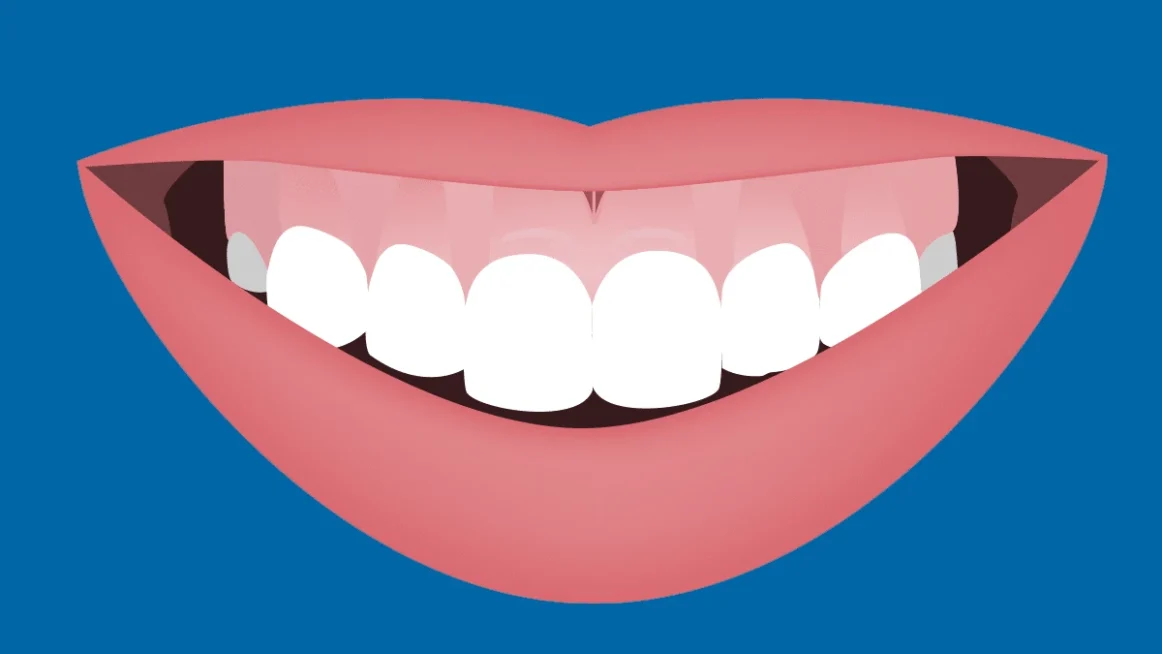
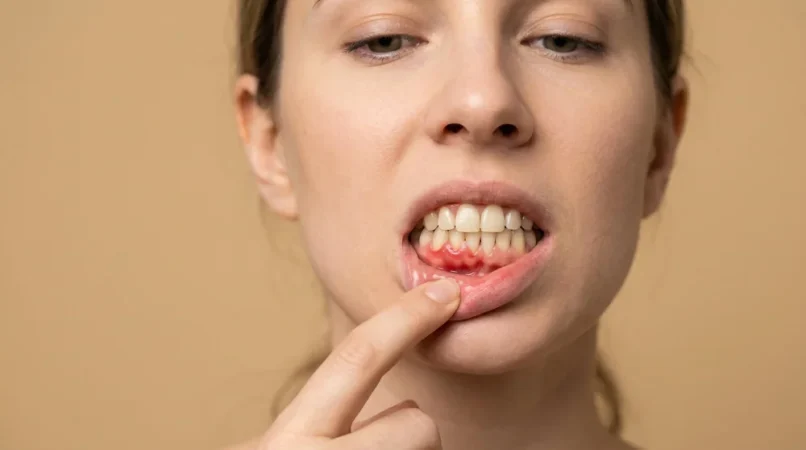
A gummy smile — clinically, excessive gingival display — is when a noticeable band of gum shows above the upper teeth when you smile. It is common, it is treatable, and it is nobody’s medical emergency.
The part that decides everything is the diagnosis, not the procedure. The same appearance can come from the gums, the lip, the jaw or the teeth — and the treatment that fixes one does nothing for another. A 2024 systematic review of 633 patients put it directly: each treatment modality is tailored to a specific cause, with skeletal causes needing jaw surgery, soft-tissue causes needing soft-tissue treatment, and dental causes addressed dentally.1
This guide covers what causes a gummy smile, the four main treatments and what each one actually does, and how to work out which applies to you — including the honest differences in how long each result holds.
What is a gummy smile?
A gummy smile, also called excessive gingival display, is defined in the research literature as more than 2 mm of gum showing above the upper incisors at maximum smile.1 In practice many clinicians use around 3 mm as the point at which most people start to notice it — the threshold is a guide, not a hard line, and how much it bothers you matters more than the millimetre.
When the proportions are balanced, the teeth, gums and upper lip sit in a relationship that reads as harmonious without anyone consciously analysing it. People with a gummy smile often describe the opposite feeling: that their teeth look too small, or that their gums are taking up space the teeth should occupy.
Causes of a Gummy Smile
The cause can be dental, skeletal or soft-tissue. The main ones:
- Altered passive eruption. The gum never finished migrating to its adult position after the teeth came through, so it still covers part of each crown and the teeth look short and square. In one clinical study of patients with excessive gingival display, this was the most common finding — present in 73.2% of them.2
- Gingival overgrowth (gingival hypertrophy). Enlarged gum tissue, from genetics, inflammation caused by plaque, or as a known effect of certain medications including some calcium-channel blood pressure drugs, anticonvulsants and immunosuppressants.
- Vertical maxillary excess. The upper jaw is vertically long, so gum shows both at rest and when smiling. This one is skeletal — the gums and teeth may be entirely normal.
- A short or hyperactive upper lip. The lip is short, or the muscles lifting it pull further than average, exposing gum that would otherwise stay covered. Nothing about the gums or teeth is wrong here at all.
- Tooth position and wear. Over-erupted upper front teeth bring the gum margin down with them; teeth worn short by grinding or erosion throw the gum-to-tooth ratio off from the other direction.
Two things are worth knowing before you read the treatment options. First, these causes frequently occur together — in that same study, 55.3% of patients had more than one at the same time.2 Second, that is why a plan often sequences two treatments rather than choosing between them, and why an assessment is more useful than a decision made from a mirror — a point the clinical literature has made consistently: thorough examination followed by a correct diagnosis is what makes the result predictable.3
Treatment Options for a Gummy Smile
Gummy smile treatment is not one-size-fits-all. The right option depends entirely on what is causing the gum display. Below are the main treatments, each targeting a specific cause.
1. Gum contouring (gingivectomy / crown lengthening)
Best for: excess gum tissue covering the teeth, and altered passive eruption.
Gum contouring removes a controlled amount of gum tissue to expose more of the natural crown and evens the gum line across the smile. Where the correction needs to go beyond a small trim, the bone level is recontoured at the same time — which is the difference between a gingivectomy and a full crown-lengthening procedure.
That distinction decides how well the result holds. Gum attaches to the tooth at a set distance above the bone, so tissue trimmed back without respecting that distance tends to rebuild — which is why a case that needs bone recontouring should get it rather than a soft-tissue trim that will not hold. Planned to the correct level, the result is stable; planned as a trim alone, it can creep back within months.
- Suitable for: gum overgrowth, an uneven gum line, or gum covering part of the crown
- Healing: soft-tissue discomfort typically settles within the first week or two
- Stability: holds where the level has been planned against the bone, not just the tissue
2. Botulinum toxin for a hyperactive lip
Best for: a hyperactive upper lip, where the gums and teeth are proportionate and the lip simply lifts too far.
Small doses relax the muscles that elevate the upper lip, limiting how high it rises during a smile. It is the least invasive option on this list, and for the right cause it works well.
The published evidence on how long it holds is worth reading before you choose it. In the 2024 meta-analysis, non-surgical treatment and surgery produced almost identical results at one month — a mean reduction of 3.43 mm versus 3.50 mm. By six months the gap had opened: 0.51 mm for non-surgical against 2.86 mm for surgical. Surgical results stayed stable through twelve months; non-surgical results partially relapsed at six months and had returned to baseline by twelve.1
The same review found non-surgical treatment more effective in mild cases and surgery more effective in severe ones.1 So this is a genuine option — provided you choose it knowing it is a repeating treatment rather than a one-off, and that it suits a mild display better than a pronounced one.
3. Jaw surgery (orthognathic surgery)
Best for: skeletal causes — an upper jaw that is vertically long.
Where the gum display comes from the structure of the jaw itself, no amount of gum or lip treatment reaches the cause. The upper jaw is repositioned to reduce gum exposure and to improve facial balance and bite function together. It is the most involved option here and the one that produces the largest structural change, which is why it is reserved for cases where the skeletal cause has actually been established from imaging rather than assumed.
- Suitable for: confirmed vertical maxillary excess, and cases where soft-tissue treatment cannot reach the cause
- Healing: a recovery measured in weeks rather than days, with a schedule your surgeon sets for your case
- Stability: addresses the underlying structure rather than its appearance
4. Veneers or crowns
Best for: teeth that are short or worn, making the gums look more prominent than they are.
Where the ratio is off because of the teeth rather than the gums, veneers or crowns restore the proportion by lengthening the visible part of the tooth — without touching the gum tissue at all. Where teeth have worn short from grinding, the cause of the wear is worth addressing alongside, or the same thing happens to the new restorations.
- Suitable for: proportionally short teeth relative to gum display
- Healing: minimal — this is restorative rather than surgical
- Note: frequently combined with gum contouring, in which case the gum line and the tooth proportions are designed together
The planning process is set out in our guide to veneers in Istanbul.
Quick comparison
Read the last column as the honest difference between the options, rather than as a ranking — each row treats a cause the others cannot.
| Treatment | Cause it treats | Healing | How the result holds |
|---|---|---|---|
| Gum contouring | Excess gum tissue, altered passive eruption | About a week or two | Stable where planned to the bone level; can rebound if only the tissue is trimmed |
| Botulinum toxin | Hyperactive upper lip | None | Partial relapse by 6 months, back to baseline by 12 — a repeating treatment1 |
| Jaw surgery | Vertical maxillary excess (skeletal) | Weeks | Surgical results remained stable through 12 months1 |
| Veneers or crowns | Short or worn teeth | Minimal | Depends on the restoration and on managing any grinding |
Which Treatment is Right for You?
The most important step is identifying the cause. The same appearance has very different origins, and the wrong treatment will not work no matter how well it is performed. Use this as a starting guide:
- Your upper lip rises very high when you smile, but the gums and teeth look proportionate — likely a hyperactive lip muscle, and botulinum toxin is the usual first option to consider.
- Your teeth look short and square, and gum covers part of each crown — likely altered passive eruption or gum overgrowth, and gum contouring or crown lengthening is the approach.
- Your teeth are worn down or naturally small, so the ratio is off because of the teeth — veneers restore proportion without any gum treatment.
- Gum shows even when your face is at rest, or soft-tissue treatment has not held — the cause may be skeletal, and jaw surgery is what reaches a structural cause.
- Your gums are swollen, red or bleed when you brush — treat the inflammation first. Some of the apparent excess resolves once the tissue is healthy, and no cosmetic surgery should be planned on inflamed gums.
Because more than half of patients have more than one cause at once,2 these categories overlap in real cases more often than a list suggests. A clinical assessment is the reliable way to know which applies to you — and a correct diagnosis at the start saves the frustration of a treatment aimed at the wrong thing.
Book a free consultation at DentSpa to find out what is actually causing your gummy smile.
Is Gummy Smile Treatment Right for You?
A gummy smile is not a medical problem — but that does not mean it should be dismissed. For many people it is a real source of self-consciousness that changes how they smile, how they photograph and how comfortable they feel in social and professional situations.
Treatment is worth considering if:
- You manage your smile — holding your lip down, smiling closed-mouth, or avoiding photographs.
- Your gum display is beyond the usual range — more than about 2 to 3 mm above the upper teeth at a full smile.1
- Your teeth look short or out of proportion, even though they are perfectly healthy.
- You have been told the cause is structural — jaw position will not change on its own.
- Your gums and teeth are otherwise healthy. Most of these treatments assume that baseline, so active gum disease or decay is resolved first.
And treatment is not necessary for everyone. A mild gummy smile that does not bother you needs no intervention at all, and any clinic worth consulting will tell you that rather than talk you into something. If it is something you think about regularly, the options today are well established and mostly minimally invasive.
Why Many Patients Choose Turkey
Turkey has become a common destination for this kind of work because of experienced cosmetic and periodontal specialists with high case volume, clinics equipped for both laser and conventional periodontal surgery, appointment availability without long waits, and full travel support — airport pickup, hotel coordination and translation.
Costs are lower than in the UK, US and much of Europe, and the reason matters: the difference comes from the local cost base — staffing, premises and laboratory work — not from doing less. Treat any figure you find online as an approximate range rather than a quote; what your case costs depends on which cause is being treated and whether restorative work forms part of the plan, and it is confirmed in writing after an assessment. The wider picture is in our guides to dental treatment prices in Turkey and dental tourism in Turkey.
One practical note for travelling patients: where gum treatment is combined with veneers or crowns, the tissue needs to settle before final restorations are fitted, because the margins are designed against a healed gum line. Ask for the visit schedule before booking flights.
Why Choose DentSpa
- Diagnosis before treatment. The assessment establishes which cause — or which combination — is producing your gum display, because more than half of patients have more than one.2 That is what determines whether a treatment will work.
- PhD-level specialist dentists, with professors and associate professors involved in complex cosmetic and surgical cases.
- 3D imaging to establish whether the cause is skeletal before any surgical plan is proposed, rather than inferring it from a photograph.
- Gum design and tooth design planned together where restorative work is involved, so the two are not decided in the wrong order.
- Full A–Z care from the online consultation through to follow-up.
You don’t have to take our word for the standard. DentSpa was named best dental clinic in Europe in the odontology category at the European Awards in Medicine,4 is licensed by the Turkish Ministry of Health, certified to ISO 9001 and ISO 10002, and a member of the Turkish Dental Association. For treatment planned from abroad it also holds the Certification for Excellence in Medical Travel Patient Experience from Global Healthcare Accreditation.5 More than 50,000 international patients have been treated since the clinic was founded in Istanbul in 2018 — see real cases in the smile gallery and read the verified reviews.
Book a free consultation or message us on WhatsApp. If you are comparing clinics, the questions worth asking any of them are in how to find a dentist in Turkey.
Frequently asked questions
What counts as a gummy smile?
What causes a gummy smile?
How do I know which treatment I need?
How long does Botox for a gummy smile last?
Is gum contouring permanent?
Can a gummy smile be fixed without surgery?
Can medication cause a gummy smile?
Do I need to treat a gummy smile at all?
References
- Maleki M, Huang B, Mendes VC, Caminiti MF, Finer Y. A Systematic Review and Meta-Analysis Comparing Surgical and Nonsurgical Treatments for Excessive Gingival Display. Dentistry Journal, 2024;12(6):154. University of Toronto.
- Alshammari A, et al. Etiologies of excessive gingival display in a Saudi population. The Saudi Dental Journal, 2024.
- Silberberg N, Goldstein M, Smidt A. Excessive gingival display — etiology, diagnosis, and treatment modalities. Quintessence International, 2009;40(10):809–818.
- The European Awards in Medicine — DentSpa Clinic — European Award in Medicine in Odontology
- Global Healthcare Accreditation — DentSpa Strengthens Global Trust in Turkey’s Dental Services with GHA Certification














 70%
70%