
Table of content
Table of content
Not yet — and the honest reason is worth knowing before anyone offers it to you. The evidence for exosomes in periodontal regeneration is genuinely encouraging, but it is entirely preclinical. A 2025 systematic review and meta-analysis pooled the research and found 17 studies, all of them in animals, showing real improvements in bone volume around the teeth. Its conclusion: great promise, but “more standardized and robust trials are needed.”1 There are no human clinical trials to point at, and the FDA states there are currently no FDA-approved exosome products for any use.2
What does work for periodontitis is proven, available and well documented. Here’s the full picture.
A lot of people come in with the same two complaints: “my gums bleed sometimes” and “my breath isn’t great.” And that’s it — they live with it. The problem is that periodontitis isn’t just that.
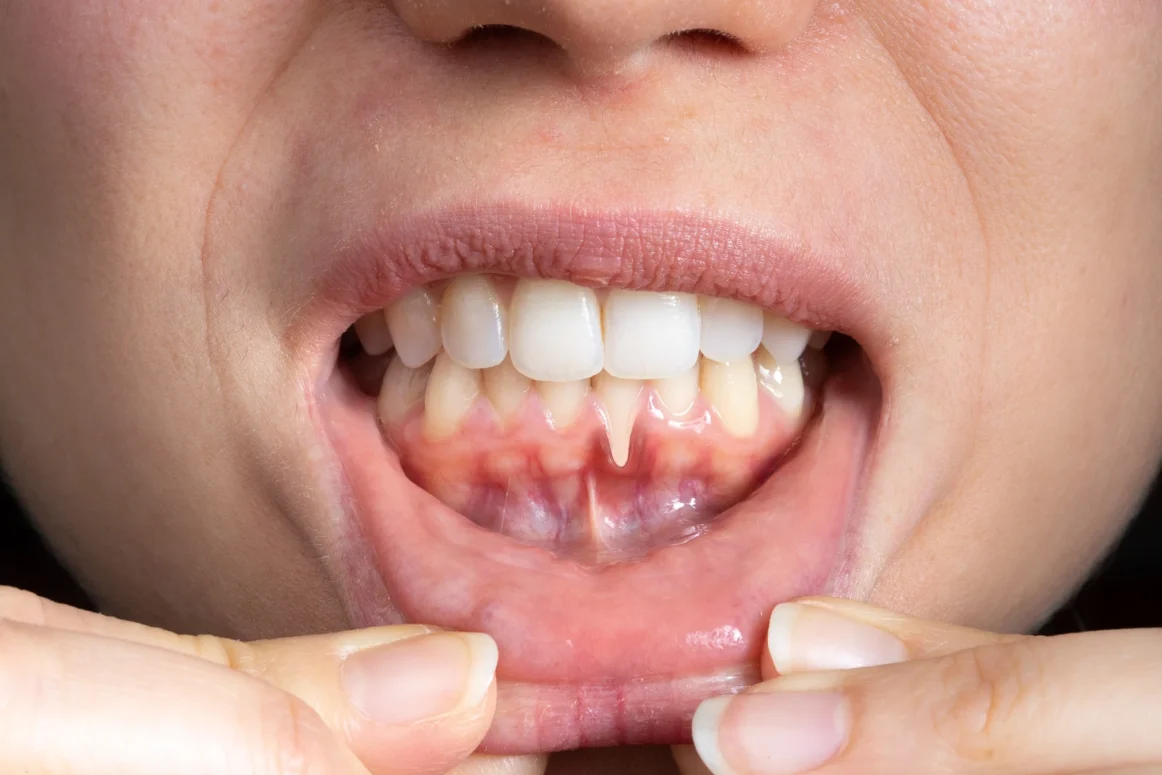
It isn’t “sensitive gums.” It’s an infection that slowly breaks down what holds your teeth in place — the gum and the bone. And you usually don’t feel how bad it is at the start. Things seem more or less normal until one day a tooth feels strange, or your bite feels off, or gaps start changing. By then some damage is already done.
What Periodontitis Actually Does
It starts quietly. Plaque builds up, the gums become inflamed, and the infection moves deeper under the gum line. The body responds with a chronic immune reaction — and that ongoing inflammation begins destroying the tissue anchoring the teeth: gum attachment is lost, supporting bone breaks down, deep pockets form around the teeth, and eventually teeth loosen.
It’s also common. A systematic review of 57 studies put the prevalence of peri-implant and periodontal inflammation high enough that this isn’t a rare condition — and the wider health picture is why dentists take it seriously. A 2025 study matched 47,498 patients with periodontitis against 47,498 without and followed outcomes over 19 years, finding higher odds of heart disease, cancer overall and premature mortality in the periodontitis group.3 Those are associations rather than proof of cause, but they explain why “we’ll keep an eye on it” stopped being an acceptable answer.
What Conventional Treatment Does — and Where It Stops
Standard treatment is effective and still absolutely necessary. It means scaling and root planing — deep cleaning below the gum line — sometimes antibiotics to control infection, and in advanced cases surgery to clean deep areas and reshape the tissue.
The American Dental Association’s clinical practice guideline reviewed the evidence and voted in favour of scaling and root planing as the initial nonsurgical treatment for chronic periodontitis, grading the benefit as moderate and judging it to outweigh the potential adverse effects.4 Worth noting from the same guideline: it recommends against lasers as an adjunct, on the grounds that the clinical benefit isn’t established. Useful to know if it’s ever presented to you as an upgrade.
But there’s a real limitation. Stopping the disease is not the same as rebuilding what’s already gone. Once bone and supporting tissue are lost, the body doesn’t reliably restore them on its own. That gap is where regenerative approaches enter the conversation — and where the marketing tends to run ahead of the science.
Where Exosomes Fit — and What the Research Actually Shows
Exosomes are tiny signals cells send to each other. Your body does this constantly when something is inflamed or injured. They aren’t new gum or new bone and they don’t build anything themselves — what they can do is nudge the cells around an area to behave differently during healing. The wider family of these approaches is explained in what regenerative dentistry actually is.
The theory for gums is appealing: calm inflammation that won’t settle, help the gum-repair cells (fibroblasts) work better, and support healing of the tissues that hold the tooth in place.
And in the laboratory it holds up. The 2025 meta-analysis screened 1,360 articles and pooled 17 preclinical studies, finding a clear benefit on bone volume around the teeth and on the distance from the enamel junction to the bone crest — the measures that matter in periodontal regeneration.1
The word doing the heavy lifting there is “preclinical.” All 17 were animal studies. Encouraging animal results are how good treatments start — and also how a great many treatments that never reach the clinic start. Until there are human trials, nobody can tell you what this does in a human mouth, and any clinic that says otherwise is selling ahead of the evidence.
The regulatory position is equally clear. The FDA states there are currently no FDA-approved exosome products, and issued a public safety notification after serious adverse events in patients treated with unapproved products marketed as containing exosomes. It also advises anyone considering such a product outside the United States to check what regulations cover it locally and to understand that the FDA has no oversight of treatments performed abroad.2 We’re a clinic outside the United States, so that applies to us too — better said than left out.
For the implant side of the same question, see exosome therapy for dental implants. And it’s worth knowing that where the equivalent human trials have been run — on stem cells in jaw-bone regeneration — conventional grafting came out ahead. That’s a useful reminder that promising biology doesn’t automatically translate.
So Can Gum Tissue Be Regenerated At All?
Partially, yes — with established techniques, not experimental ones. Guided tissue regeneration, bone grafting and grafting materials have decades of clinical use behind them, and where gum recession is the problem, that has its own treatment path.
The realistic goals of regenerative periodontal therapy are to stabilise the disease, improve tissue quality where possible, and protect the teeth long term. Not a full rebuild of everything lost, and not overnight.
What actually determines whether it works has little to do with which biological product is used:
- the underlying infection being treated properly first
- daily cleaning that doesn’t slip back afterwards
- regular professional maintenance, more frequent than the standard six months for the first year or two
- and controlling risk factors — smoking above all, which impairs blood supply and healing, and poorly controlled diabetes
Regeneration works on top of good basics, never instead of them. If the pockets come back because the cleaning stopped, no biological product would have changed that.
Who Should Even Be Thinking About This
Most patients with periodontitis don’t need regenerative therapy at all — they do well on conventional treatment, and the ADA guideline supports exactly that as the first step.4 Regenerative approaches are considered in more advanced cases where tissue healing is limited or the risk of progression is high.
Anything described as “biological” or “regenerative” needs proper medical control: clear application methods, careful patient selection, proper protocols and realistic expectations. And where a treatment has no human trials behind it, the honest position is to say so rather than to charge for it.
Why Patients Look to Turkey for Periodontal Treatment
When gum problems get serious it stops being a cleaning appointment — there are scans, treatment stages, healing time, sometimes surgery. At which point a lot of people ask where to actually get it done.
For many patients in Europe, the UK and the US, Turkey comes up. The cost difference isn’t about cheaper materials; it’s lower operating costs and a different healthcare market. Any figure you read is an approximate market range rather than a quote — your own is confirmed in writing after a free consultation. How the trip works is in our guide to dental tourism in Turkey.
There’s a practical side too. Rather than squeezing appointments into a busy life, treatment gets planned as one organised trip with actual time to recover.
How DentSpa Handles Periodontal Care
Treating periodontitis isn’t about quick fixes. It’s controlling the infection, protecting what’s still there, and giving the tissue the best chance to heal.
In practice that means a thorough diagnosis first — gums, bone levels and overall oral health assessed with imaging and a full clinical exam, so decisions rest on what’s actually happening rather than guesswork. Treatment is then staged according to how advanced the disease is, because periodontitis doesn’t look the same in any two patients. Periodontal work is carried out by specialists including Dr. Damla Öztürk, a periodontology specialist with 10 years’ experience whose interests include regenerative periodontal therapy and the oral–systemic health link, and whose research has been presented internationally.
Regenerative techniques are used only where they make medical sense — not as a routine add-on, and not because they’re available. On current evidence that means established methods, and being straight with you about what’s still preclinical.
The credentials are checkable: licensed by the Turkish Ministry of Health, certified to ISO 9001 and ISO 10002, a member of the Turkish Dental Association, and holder of the Certification for Excellence in Medical Travel Patient Experience from Global Healthcare Accreditation.5 DentSpa was named best dental clinic in Europe in the odontology category at the European Awards in Medicine, and over 50,000 international patients have been treated at the Şişli clinic — their feedback is in the verified Trustpilot and Google reviews. For international patients, scheduling and aftercare are organised in advance; see international guests and after treatment.
Get your gums properly assessed
Every mouth is different, and the only way to know what’s possible in yours is to have it measured rather than guessed at. If you’re dealing with gum disease or worried about tissue loss, book a free consultation for an honest evaluation and a plan that fits your actual situation — including, where it applies, being told that the proven treatment is the one you need.
Frequently asked questions
Can exosome therapy regrow gum tissue?
What actually works for periodontitis?
Can lost gum and bone grow back?
Is exosome therapy for gums safe?
Do I need regenerative treatment for my gum disease?
Why do dentists treat gum disease so seriously?
Sources
- 1. Zhou L, Cai W, Zhang Y, Zhong W, He P, Ren J, Gao X. Therapeutic effect of mesenchymal stem cell-derived exosome therapy for periodontal regeneration: a systematic review and meta-analysis of preclinical trials. 2025 (PROSPERO CRD42024546236). pubmed.ncbi.nlm.nih.gov/39780243
- 2. U.S. Food and Drug Administration — Public Safety Notification on Exosome Products, 6 December 2019.
- 3. Weinbecker F, Nahles S, Preissner R, Heiland M, Kernen F, Preissner S. The systemic impact of periodontitis in about 100,000 patients: associations with heart diseases, cancer, and mortality. Clinical Oral Investigations. pubmed.ncbi.nlm.nih.gov/41420778
- 4. American Dental Association — Nonsurgical Treatment of Chronic Periodontitis Clinical Practice Guideline (2015).
- 5. Global Healthcare Accreditation — DentSpa Strengthens Global Trust in Turkey’s Dental Services with GHA Certification, 16 July 2026.













 70%
70%