Table of content
Table of content
On the best evidence available: no, not better than a conventional bone graft. A 2026 systematic review and meta-analysis of six randomised controlled trials — 74 patients and 222 implants — found no significant difference in implant success between stem-cell-supported regeneration and conventional grafting, and on bone formation the results actually favoured conventional grafting. The authors’ conclusion is blunt: MSC-based therapies “do not appear to offer a significant clinical advantage over conventional grafting.”1
That’s not the answer most articles on this subject give you, and it’s the one worth having before anyone offers it to you as an upgrade. For the overwhelming majority of people who need bone before an implant, standard bone grafting remains the proven, predictable choice — and, on this data, the better-performing one.
Now the longer version, because the nuance is what actually matters.
Most people never think about their jawbone. You lose a tooth, you get used to it, life goes on. Then one day you ask about an implant and the dentist says, “You don’t have enough bone here.” Suddenly it feels more complicated than you expected.
Why Bone Matters So Much for Implants
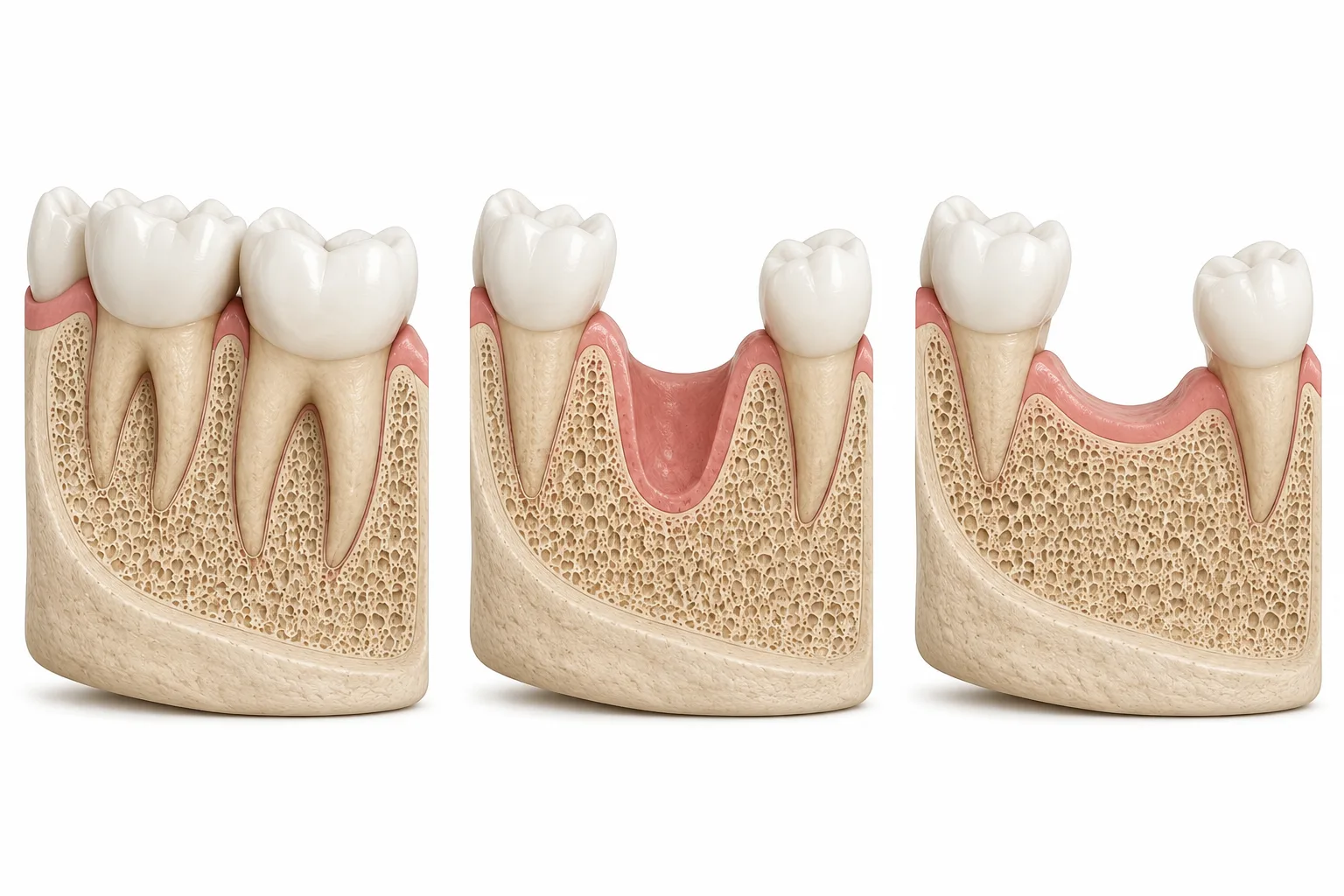
An implant isn’t really “a tooth.” It’s closer to a post that has to sit inside your jaw and stay there for years while you chew, talk and forget it’s there. That only works if there’s enough bone to hold it.
The frustrating part is that bone disappears quietly. After a tooth is removed the ridge underneath starts to shrink, and faster than most people expect: measured across 20 human studies, an untreated extraction site loses 29–63% of its ridge width and 11–22% of its height within six months, with 32% of the width already gone at three months.2 You don’t feel it. You don’t see it. Everything seems fine until a scan shows there isn’t much left to work with.
Gum disease, old infections and long-ago extractions make it worse. If a scan shows you’re short on bone, it helps to understand what actually counts as a bone deficiency before an implant — the type and severity are what decide whether a simple graft is enough or something more involved is needed. The wider picture is in our guide to bone loss in the jaw and how it’s rebuilt.
Put simply: no solid bone, no solid implant.
The Usual Solution: Bone Grafting
For decades, bone grafting has been the standard way to handle this, and it has a long clinical track record. The idea is straightforward: graft material is placed in the weak or missing area, and your body gradually replaces it with your own bone. That material can be your own bone (autograft), donor bone (allograft), animal-derived bone (xenograft) or a synthetic substitute — the differences are set out in our guide to bone grafting for dental implants.
It works, every day, all over the world. And implants placed in grafted sites hold up: a systematic review following patients for at least ten years found similar survival to implants in untouched bone, with reported rates from 91.6% to 100%.3
But grafting has limits. Healing takes months. Sometimes more than one procedure is needed. And the result depends a lot on how well you heal — which is why the first weeks matter; here’s how to look after the area after a graft so it has the best chance to take. In harder cases bone growth can be slower or less predictable, and that’s where clinicians started looking for ways to support healing rather than just fill space. Which brings in stem cells.
So… What Are Stem Cells?
Less mysterious than they sound. Your body already has them: cells that haven’t “picked a job” yet, and can become bone, cartilage or other tissue depending on what’s needed.
In dentistry, “stem cells” usually means mesenchymal stem cells (MSCs) — found in bone marrow, fat and dental pulp. Their main role is repair. In the laboratory and in animal studies they can turn into bone-forming cells, help recruit blood supply and release signals that encourage regeneration. Think of them as cells that encourage rebuilding rather than a material that does the rebuilding. How they differ from the related approaches is covered in what regenerative dentistry actually is.
What the Human Trials Actually Found
This is the part that’s easiest to oversell, so here it is precisely.
Stem cells aren’t injected to magically create bone. Where they’re used, they go in with a graft material: the graft provides the structure, and the cells are meant to make the healing environment more biologically active. The rationale is sound and the animal data is encouraging.
In humans, it hasn’t borne out. The 2026 meta-analysis pooled six randomised controlled trials covering 74 patients and 222 implants and reported:1
- No significant difference in implant success between MSC and control groups.
- Bone formation favoured the control group — conventional grafting — by a medium-to-large effect the authors describe as clinically perceptible.
- Certainty of evidence rated high for bone formation and moderate for implant success.
In other words, this isn’t the usual “promising but we need more studies” position. On sinus augmentation specifically, the best available randomised evidence found conventional grafting performed better on bone formation, and the certainty of that finding was rated high.
Stem cells aren’t the only regenerative idea you’ll encounter, either. Exosome therapy around implants is a related and newer approach — and worth reading before anyone offers it to you, because it’s even earlier in its evidence, and there are no FDA-approved exosome products at all.
Where Does That Leave It?
Research continues, and the science may still get there — better cell sources, better scaffolds, better delivery. Regenerative medicine has a habit of taking longer than the headlines suggest and then arriving properly.
But for a patient making a decision today, the practical position is straightforward. If you have bone loss and need an implant, conventional grafting is what the evidence supports. Stem-cell-supported regeneration isn’t a premium upgrade you’re missing out on — the trials that compared the two found conventional grafting formed more bone.
Where the real gains are, in a difficult case, is in the things that aren’t experimental at all: accurate 3D imaging, the right graft material and technique for your defect, enough healing time before loading, and controlling the risks that actually predict failure. Smoking is the clearest of those — pooled across 292 publications and more than 150,000 implants, failure risk in smokers came out at roughly 2.4 times that of non-smokers.4 Stopping does more for your outcome than any biological add-on currently on offer.
Safety and Regulation — Read This Part
Anything involving stem cells is medical treatment, not wellness and not a cosmetic add-on. Regulators have repeatedly warned about clinics marketing unproven “stem cell” and exosome products. The FDA warns patients that many such products haven’t been reviewed for safety or effectiveness, that there are currently no FDA-approved exosome products, and that serious harms have been reported — and it advises anyone considering such treatment outside the United States to check what regulations cover the product in that country, and to understand that the FDA has no oversight of treatments performed abroad.5
We’re a clinic outside the United States, so that advice applies to us as much as to anyone, and it’s better said than left out.
A legitimate clinic will only consider these approaches where simpler, proven methods aren’t enough, use them within proper medical standards and supervision, comply with local law, and never sell them as a miracle or a guarantee. If anyone promises certainty, that’s your cue to be cautious — and, on this particular treatment, to ask them which trials they’re relying on.
Why Planning Still Beats Any “Advanced” Technique
No biological technique rescues poor planning. Long-term success still comes down to proper 3D imaging, accurate diagnosis, precise surgical placement, a sound bite design and enough healing time. Stem cells might, one day, support healing. They can’t fix bad dentistry — and the current evidence says they don’t outperform a well-done graft.
Why Some Patients Choose Turkey for Complex Cases
Once bone loss and advanced implant planning enter the picture, two things become obvious: it has to be done properly, and it gets expensive at home. That’s why many patients from the UK, US and across Europe look at Turkey — not because standards are lower, but because operating and laboratory costs are, using the same materials and experienced teams. Any figure you see is an approximate market range rather than a quote; your own is confirmed in writing after a free consultation. How the trip works is in our guide to dental tourism in Turkey, and the numbers are in implant costs in Turkey.
How DentSpa Handles Bone Regeneration
Regenerative steps aren’t treated as “extras” here — they’re part of a surgical plan. In practice that means full CBCT scans and bone analysis before any decision, digital planning for safe and accurate placement, a conservative and evidence-based approach to regenerative techniques (which, on the data above, means not offering them as an upgrade where a conventional graft does the job better), established implant systems and materials, a multidisciplinary team for complex cases, and an aftercare department that follows up once international patients are home.
The credentials are checkable. DentSpa is licensed by the Turkish Ministry of Health, certified to ISO 9001 and ISO 10002, a member of the Turkish Dental Association, and holds the Certification for Excellence in Medical Travel Patient Experience from Global Healthcare Accreditation.6 It was named best dental clinic in Europe in the odontology category at the European Awards in Medicine, and for implants Straumann publishes the number placed here over a full year on its own verification page — see the Straumann Achievement Award. Over 50,000 international patients have been treated at the Şişli clinic; you can read the team’s backgrounds on the doctors page and patient feedback in the verified Trustpilot and Google reviews.
The goal isn’t to place an implant. It’s to make sure the bone underneath can support it for years.
So — can stem cells regrow your jaw bone?
Not better than the graft you’d get anyway. The biology is real and the research continues, but the randomised trials that compared the two found no advantage in implant success and better bone formation with conventional grafting.1 For a patient deciding today, that’s the answer — and it’s good news, because the proven route is also the available one.
If you’ve been told you don’t have enough bone for implants, the next step isn’t guessing — it’s proper imaging and honest advice. Book a free consultation, review your scans with the doctor, and leave with a clear picture of your real options.
Frequently asked questions
Can stem cells regrow jaw bone better than a normal bone graft?
Can stem cells replace a bone graft completely?
Do most implant patients need any of this?
Do implants in grafted bone last as long as implants in natural bone?
Is stem cell therapy for jaw bone safe?
How long does bone grafting take to heal before an implant?
Sources
- 1. Can Mesenchymal Stem Cells Improve Bone Regeneration in Maxillary Sinus Augmentation? A Systematic Review and Meta-Analysis. Stem Cells International, 2026 (PROSPERO CRD42023488758). pmc.ncbi.nlm.nih.gov/articles/PMC12814210
- 2. Tan WL, Wong TLT, Wong MCM, Lang NP. A systematic review of post-extractional alveolar hard and soft tissue dimensional changes in humans. Clin Oral Implants Res. 2012;23(Suppl 5):1–21. pubmed.ncbi.nlm.nih.gov/22211303
- 3. Gurbanov S, Plugmann P. Dental Implants Placed in Grafted and Non-Grafted Sites: A Systematic Review. Oral Health & Preventive Dentistry. 2024. pubmed.ncbi.nlm.nih.gov/39555856
- 4. Smoking and Dental Implants: A Systematic Review and Meta-Analysis (292 publications; OR 2.402). pmc.ncbi.nlm.nih.gov/articles/PMC8780868
- 5. U.S. Food and Drug Administration — Public Safety Notification on Exosome Products, 6 December 2019.
- 6. Global Healthcare Accreditation — DentSpa Strengthens Global Trust in Turkey’s Dental Services with GHA Certification, 16 July 2026.











 70%
70%