
Table of content
Table of content
In England, there are three NHS dental bands. Band 1 costs £27.90 for a check-up, necessary X-rays and clinically needed scaling. Band 2 costs £76.60 and includes fillings, root canal treatment and extractions. Band 3 costs £332.10 and covers more complex work, including crowns, dentures and bridges. These charges apply from 1 April 2026.1 2
What are the NHS dental bands in 2026?
The NHS dental treatment price list in England is divided into three bands. The band you pay depends on the treatment your dentist decides you need, not the number of appointments or individual procedures.
Here are the current NHS dental costs, effective from 1 April 2026.1 2
| NHS treatment category | Price from 1 April 2026 | What it covers |
| Band 1 | £27.90 | Examination, check-up, clinically necessary X-rays, preventive advice and basic gum treatment |
| Band 2 | £76.60 | Everything in Band 1, plus fillings, root canal treatment and extractions |
| Band 3 | £332.10 | Everything in Bands 1 and 2, plus crowns, dentures, bridges and certain orthodontic appliances |
| Urgent treatment | £27.90 | Assessment and treatment for urgent dental problems |
Urgent dental care in England has a charge of £27.90, the same amount as Band 1. It is not an extra fee added on top of a Band 1, 2 or 3 charge for the same urgent course of treatment. The care may include an emergency assessment, X-rays where needed, a temporary filling, drainage of a dental abscess, treatment of infection or removal of up to two teeth. If you need further treatment after the urgent appointment, an additional charge may apply depending on the treatment required.1 2
Why do some websites show different prices?
Before 1 April 2026, the charges in England were £27.40 for Band 1, £75.30 for Band 2 and £326.70 for Band 3. Urgent treatment cost £27.40. If you find an older NHS dental price list showing these amounts, it has not been updated to reflect the April 2026 changes.2
The important point is that these are fixed NHS patient charges in England. You do not pay a separate NHS fee for every filling, X-ray or appointment within the same course of treatment.
What does each NHS dental band cover?
Each band includes different types of dental care. Your dentist assesses your teeth and gums before deciding which treatment is clinically necessary.
Band 1: Check-ups, examinations and preventive care
Band 1 costs £27.90. It covers routine examinations and basic preventive treatment.
It can include:
- A dental check-up and examination.
- Assessment and advice about your oral health.
- X-rays when clinically necessary.
- Fluoride treatment.
- Simple gum disease management, including scaling when needed.
- Impressions or moulds of your teeth.
- Minor adjustments to dentures or orthodontic appliances.
A Band 1 appointment is not necessarily just a quick look at your teeth. It can include several of these services during the same course of treatment.
Gum treatment is also included when it is appropriate. If you want to understand the different procedures used to manage gum problems, read our guide to gum disease treatment and its available options.1
Band 2: Fillings, root canal treatment and extractions
Band 2 costs £76.60. It includes everything in Band 1, plus a range of treatments to repair or treat dental problems.
These can include:
- Fillings to repair teeth affected by decay.
- Root canal treatment.
- Tooth extractions.
- Other oral surgery procedures.
- Sealants for small holes or grooves in teeth.
- Extensive gum disease treatment.
- Certain adjustments and additions to existing dentures.
- Some appliances used to correct your bite.
Root canal treatment is included when clinically necessary. It treats infection or inflammation in the centre of a tooth and may require several appointments. If you want to understand the procedure and the factors involved in treatment, see our guide to root canal treatment costs in the UK.1
Are white fillings included in Band 2?
Yes, when they are clinically necessary. For example, a white filling may be provided for a front tooth.
For back teeth, your dentist may recommend a silver-coloured amalgam filling if it is considered the more appropriate option. If you prefer a white filling where it is not clinically necessary, you may need to pay privately. Your dentist should explain the available choices and their costs before proceeding.1
Band 3: Crowns, dentures and bridges
Band 3 costs £332.10. It includes all the treatments covered by Bands 1 and 2, as well as more complex restorative and replacement work.
Band 3 can include:
- Dental crowns.
- Inlays and onlays.
- Full or partial dentures.
- Dental bridges.
- Clinically necessary orthodontic treatment.
- Other custom-made dental appliances, excluding sports guards.
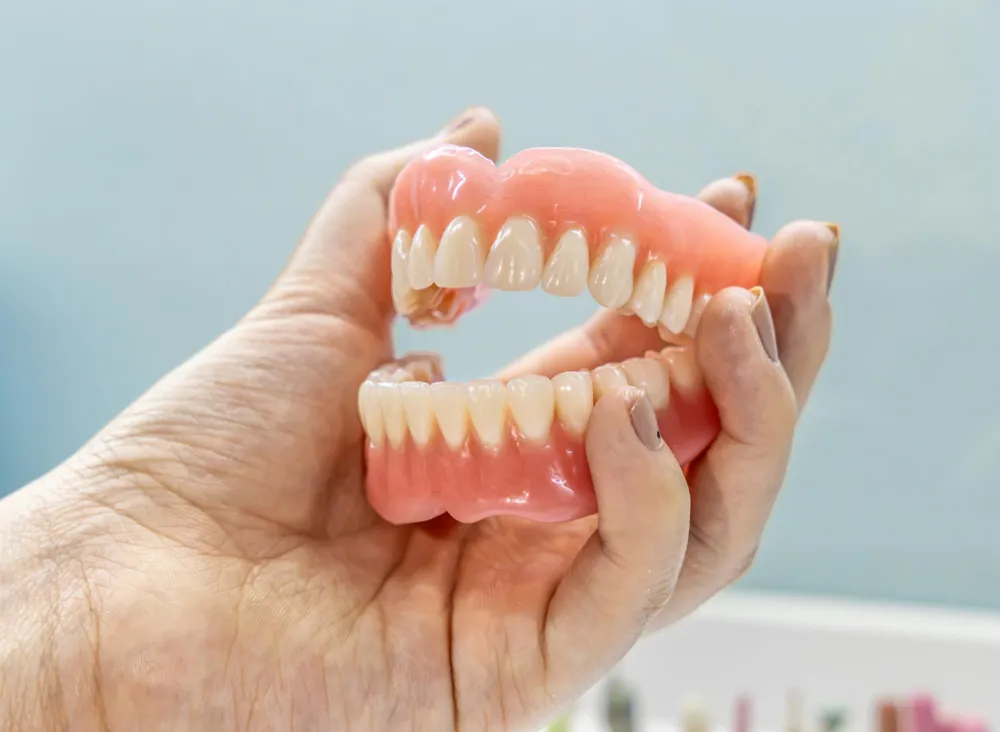
A crown covers an existing tooth, while a bridge replaces one or more missing teeth using supporting teeth. Dentures are removable replacements for missing teeth.
For a closer look at the treatment and considerations involved, you can read our guides to UK dental crown costs and UK denture costs.1
Orthodontic treatment, including braces, may also be available on the NHS when a clinical assessment establishes that it is necessary. Eligibility is not automatic. You can read more about braces and orthodontic treatment in the UK.1
Urgent dental treatment: £27.90
Urgent NHS dental treatment in England costs £27.90 from 1 April 2026. This is the charge for the urgent course of treatment; it is not an additional fee on top of another band charge for the same urgent course. It is intended to address the immediate problem, rather than automatically cover any separate restorative treatment that may be needed afterwards.
Depending on your needs, it may include:
- An emergency examination and assessment.
- Necessary X-rays.
- A temporary filling.
- Emergency partial root canal treatment.
- Treatment following a dental injury or knocked-out tooth.
- Refitting a crown, bridge or inlay.
- Removal of up to two teeth.
- Drainage of a dental abscess and treatment of infection.
- Treatment for certain sudden and severe dental conditions.
- One urgent filling.
If you need further treatment after the urgent course, you may have to pay a separate NHS charge for that further course, depending on the treatment required.1
How do the NHS dental band rules work?
The NHS charges you once for a course of treatment, based on the highest band involved. This is important because several procedures do not automatically mean several charges.
For example, if your dentist identifies three teeth that each need a crown during the same course of treatment, you pay one Band 3 charge of £332.10, rather than £332.10 for each crown.
Similarly, if you need several fillings during one course of treatment, you pay one Band 2 charge of £76.60, rather than a separate charge for every filling.1
There are three main rules to understand:
1. You pay the highest band involved.
If your treatment includes procedures from Band 1 and Band 2, you pay the Band 2 charge. If it includes treatment from all three bands, you pay the Band 3 charge.
2. Multiple procedures within the same band share one charge.
The number of fillings, crowns or other procedures does not multiply the band fee when they form part of the same course of treatment.
3. Further treatment within two months may be free.
If you need additional NHS dental treatment within two months of completing a course, you do not pay extra when the new treatment falls within the same band or a lower band. If the further treatment falls into a higher band, you pay the higher band’s charge. After two months, further treatment may incur a new charge.1
When should your dentist tell you the price?
Before treatment starts. Your dental professional should explain what treatment is needed and how much you will pay. You should know which band applies before agreeing to proceed.
There are also some NHS dental services that are free regardless of the band charge. These include:
- Having stitches removed.
- Treatment to stop bleeding from your mouth.
- Repairs to existing dentures.
If dentures cannot be repaired and need replacing, the replacement may be chargeable.1
Who gets free NHS dental treatment?
Not every adult has to pay the standard NHS dental charges. In England, certain circumstances and benefits qualify you for free NHS dental appointments and treatment.3
You may qualify if:
- You are under 18.
- You are under 19 and in full-time education.
- You are pregnant or have had a baby in the previous 12 months.
- You have experienced a stillbirth within the previous 12 months.
- You receive qualifying benefits, including Income-related Employment and Support Allowance or Pension Credit Guarantee Credit.
- You receive Universal Credit and meet the NHS income-related eligibility conditions. Receiving Universal Credit does not automatically make every claimant eligible; check the current criteria before claiming free treatment.
- You receive qualifying War Pension Scheme or Armed Forces Compensation Scheme payments and the treatment relates to your accepted disability.
- You are receiving treatment from a hospital dentist in an NHS hospital, although some charges for dentures or bridges may still apply.
Dependants under 20 may also qualify when their parent or partner receives certain qualifying benefits.3
What if you have a low income but do not qualify for free treatment?
You may be able to receive help through the NHS Low Income Scheme.
There are two certificates to understand:
- HC2: Provides full help with eligible NHS health costs, including NHS dental treatment.
- HC3: Provides partial help. The certificate explains how much you are expected to contribute towards treatment.
Eligibility depends on your financial circumstances, including income, savings, housing costs and essential living expenses.3 4
There is also a savings and capital limit. In England, you generally cannot get help through the NHS Low Income Scheme if you or your partner have more than £16,000 in savings, investments or property, excluding the home you live in. The limit is £23,250 for people who live permanently in a care home. Eligibility also depends on your income and necessary living costs.4 7
If you think you qualify, check your eligibility with the NHS Business Services Authority before your dental appointment. Bring the relevant certificate or evidence when asked.
Are NHS dental charges the same in Wales and Scotland?
No. NHS dental charges differ across the UK. England uses three treatment bands, while Wales introduced a care-package system on 1 April 2026. Scotland calculates patient contributions differently.2
Here is a comparison of the systems:
| Country | How charges work | Examples of charges |
| England | Three treatment bands | Band 1 £27.90, Band 2 £76.60, Band 3 £332.10 |
| Wales | Individual care packages | New patient assessment £27.21; urgent care £37.50; simple restorative £36.03; extensive restorative £68.75; periodontal care £48.53; crown or bridge £140.44; posterior root canal £182.72 |
| Scotland | 80% of treatment cost, subject to a maximum | Maximum patient contribution of £384 per course of treatment |
Wales
From 1 April 2026, Wales moved away from the previous three-band structure to a care-package system.
Instead of one charge covering all treatment within a particular band, patients pay according to the care package required. From 1 April 2026, examples include £27.21 for an adult new-patient assessment, £37.50 for urgent care, £36.03 for simple restorative care, £68.75 for extensive restorative care, £48.53 for periodontal care, £140.44 for a crown or bridge, and £182.72 for posterior root canal treatment. Anterior root canal treatment costs £91.18. Some packages may exclude laboratory charges, which can be payable separately.2 8
Scotland
In Scotland, NHS dental examinations (including review examinations) are free for everyone. Patients who pay for treatment generally contribute 80% of the treatment cost, up to a maximum of £384 for each course of treatment. People who qualify for free NHS dental treatment are exempt from these treatment charges.2 9
Northern Ireland
Northern Ireland operates its own dental charging arrangements. If you live there, check the current charges and eligibility rules with the relevant local health service rather than relying on the English price list.
What is not covered by the NHS?
The NHS provides dental treatment that is clinically necessary to keep your teeth, mouth and gums healthy. Treatment that is primarily cosmetic is usually not included in NHS funding. Whether a procedure qualifies depends on your dentist’s clinical assessment.5 6
This distinction matters. A treatment may be available privately even when a similar procedure is not considered necessary under NHS guidelines.
Here are some common examples.
Dental implants
Dental implants are usually available privately rather than through the NHS.
There are rare exceptions. Implants may be provided on the NHS in particular circumstances, such as when a patient cannot wear dentures because of mouth cancer or an accident.
Your dentist will need to assess whether your circumstances meet the clinical requirements.6
If you are considering this option, our guide to dental implant costs in the UK explains the treatment and the factors to consider.
Dental veneers
Veneers are generally provided privately because they are usually used to improve the appearance of teeth.
There may be exceptions where a clinical need can be demonstrated. Your dentist should explain whether your particular situation qualifies for NHS treatment.6
For more information about the procedure, read our guide to dental veneers and their UK costs.
Teeth whitening
Teeth whitening is considered cosmetic treatment. It is therefore generally only available privately, rather than as an NHS dental service.6
If you are considering whitening, our guide to teeth whitening costs in the UK explains the treatment options.
White fillings in back teeth
White fillings are not automatically excluded from NHS treatment. They are available when clinically necessary.
However, your dentist may recommend an amalgam filling for a back tooth if it is considered the more appropriate clinical option. If you prefer a white filling when it is not clinically necessary, you may need to pay for the private option.5
Cosmetic changes to existing teeth
Treatments intended primarily to change the appearance of healthy teeth will generally fall outside NHS provision. This is why it is important to distinguish between repairing a damaged tooth and changing its appearance.
What should your treatment plan show?
If your dentist recommends a combination of NHS and private treatment, the treatment plan must identify which procedures are NHS-funded and which are private. It should also show the associated costs.
You should be able to understand what is being recommended, why it is appropriate and what you will pay before agreeing to treatment. You can ask your dentist to explain the clinical reasons behind each option.5
What do private dentists charge?
Private dentist costs vary because private dental practices set their own fees. There is no single official private dental price list across the UK.
The price depends on the treatment being considered and the individual practice’s fees. This is why it is useful to look at specific treatments rather than rely on one general figure for private dentistry.
For a more detailed breakdown, the treatment guides linked above cover root canal treatment, crowns, dentures, implants, veneers, whitening, braces and gum disease treatment.
Remember that NHS dental bands and private treatment fees work differently. The NHS uses standard charges in England, whereas private practices determine their own prices.
NHS vs private dental treatment: when might you compare your options?
NHS treatment is designed to provide clinically necessary care to keep your teeth, mouth and gums healthy. In England, the band charge is fixed for each course of NHS treatment, while private dentists set their own fees. The right route depends on your dental needs, the treatment available locally, the options your dentist recommends and what you can afford.
It may be worth discussing private treatment when you want to compare material or treatment options that are not clinically available on the NHS, when a service is not offered by your NHS practice, or when you are considering a mainly cosmetic procedure. This does not mean private treatment is automatically better or more suitable. Ask your dentist to explain the clinical benefits, risks, alternatives, timescale and full cost of each option before deciding.
If you are considering treatment outside the UK, compare the total cost rather than the advertised procedure price alone. Include travel, accommodation, any necessary return visits and the arrangements for aftercare if a complication occurs once you are home. Ask for a written treatment plan and an itemised quote, and make sure you understand who will provide follow-up care.
Treatment abroad: what should you ask first?
For procedures that the NHS does not usually cover, or when you are comparing private treatment options, some people consider having dental treatment abroad. It is a decision worth approaching carefully.
Start with the clinical assessment. You should understand the condition being treated, the recommended procedure and why it is appropriate for your teeth. Do not choose a clinic on price alone, and do not assume that a treatment is suitable without an individual examination.
Then consider three practical questions:
- Is the clinic properly licensed and certified? Check its regulatory status and the quality standards it follows.
- Who explains the treatment? You should be able to discuss your findings, options, risks and expected treatment in a language you understand.
- What happens after you return home? Ask how follow-up is organised, who you can contact and how ongoing care is handled.
DentSpa is based in Şişli, Istanbul. The clinic is licensed by the Turkish Ministry of Health, certified to ISO 9001, ISO 10002 and ISO 7101 standards, and is a member of the Turkish Dental Association (TDB).
It also holds the Global Healthcare Accreditation, Certification for Excellence in Medical Travel Patient Experience, referred to as GHA. This certification relates to the patient journey, including communication before treatment, coordination during treatment and follow-up afterwards.
You can check the clinic’s accreditations and certifications to understand its credentials.
Ask the clinic to explain its follow-up process before you travel, including how you can contact the clinical team after returning home, what remote reviews can and cannot assess, and what happens if you need an in-person examination. DentSpa says it continues follow-up from Istanbul after patients return home. You can read more about what GHA certification means for a dental clinic in Turkey.
The starting point should always be a proper assessment and a clear explanation of the treatment being recommended.
Frequently asked questions
How much is 3 crowns on the NHS?
How many fillings can I have on Band 2?
What does Band 3 mean at the dentist?
How much will an NHS dental check-up cost in 2026?
Do I have to pay again if I need more treatment within two months?
Are dental implants available on the NHS?
Is a scale and polish free on the NHS?
Considering your next dental treatment?
Understanding NHS dental bands can help you decide what questions to ask before agreeing to treatment. If you are comparing private options in the UK with treatment abroad, the next step is not to assume one option is best, but to obtain a clear clinical assessment and compare like-for-like treatment plans.
DentSpa offers a free consultation to review your dental findings and understand what you would like to achieve. The consultation should help you discuss the proposed treatment, why it may be appropriate, the alternatives, the expected stages and the costs. Ask for a written plan and make sure you understand the arrangements for follow-up before making a decision.
You can read patient reviews and review the clinic’s accreditations and certifications for further information.
If you would like to discuss your case, contact DentSpa in Şişli, Istanbul, to ask about a free consultation.
Sources
- NHS, How much NHS dental treatment costs. https://www.nhs.uk/nhs-services/dentists/how-much-nhs-dental-treatment-costs/
- NHS Business Services Authority, What are the NHS dental charges?. https://faq.nhsbsa.nhs.uk/knowledgebase/article/KA-02003
- NHS, Who can get free NHS dental treatment or help with dental costs. https://www.nhs.uk/nhs-services/dentists/who-can-get-free-nhs-dental-treatment/
- NHS Business Services Authority, NHS Low Income Scheme. https://www.nhsbsa.nhs.uk/nhs-low-income-scheme
- NHS, Dental services available on the NHS. https://www.nhs.uk/nhs-services/dentists/what-dental-services-are-available-on-the-nhs/
- NHS, Dental treatments. https://www.nhs.uk/live-well/healthy-teeth-and-gums/dental-treatments/
- NHS, NHS Low Income Scheme. https://www.nhs.uk/nhs-services/help-with-health-costs/nhs-low-income-scheme-lis/
- Welsh Government, NHS dental charges and exemptions. https://www.gov.wales/nhs-dental-charges-and-exemptions
- NHS inform Scotland, Receiving NHS dental treatment in Scotland. https://www.nhsinform.scot/care-support-and-rights/nhs-services/dental/receiving-nhs-dental-treatment-in-scotland/














 70%


