

Table of content
Table of content
A root canal usually takes two or more appointments, with each session lasting approximately one to two hours. Some teeth can be treated in a single visit, depending on their condition and complexity. The total time depends on the number of canals, the extent of infection and whether a crown is needed afterwards.
How long does a root canal take, appointment by appointment?
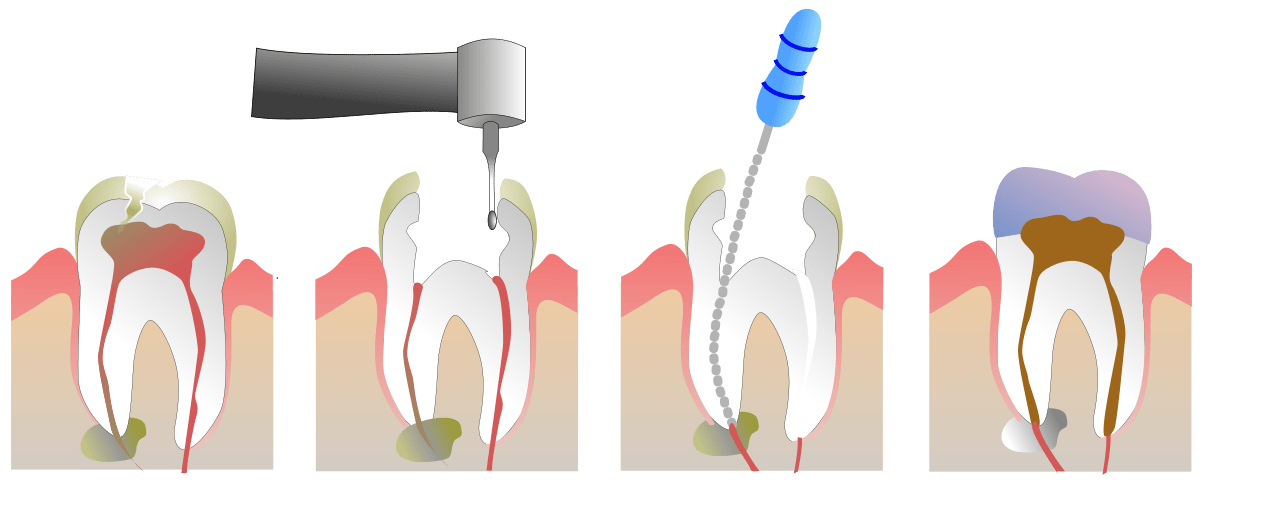
For most patients, root canal treatment involves at least two appointments. The first focuses on removing the infected tissue and cleaning the inside of the tooth. The second completes the treatment with a permanent filling. A temporary filling protects the tooth between visits.1 2 3
Here is what typically happens during each stage.
First appointment: Cleaning and preparing the tooth
Your dentist begins by examining the tooth and administering local anaesthetic. Once the area is numb, they make a small opening in the tooth to reach the infected or inflamed pulp.
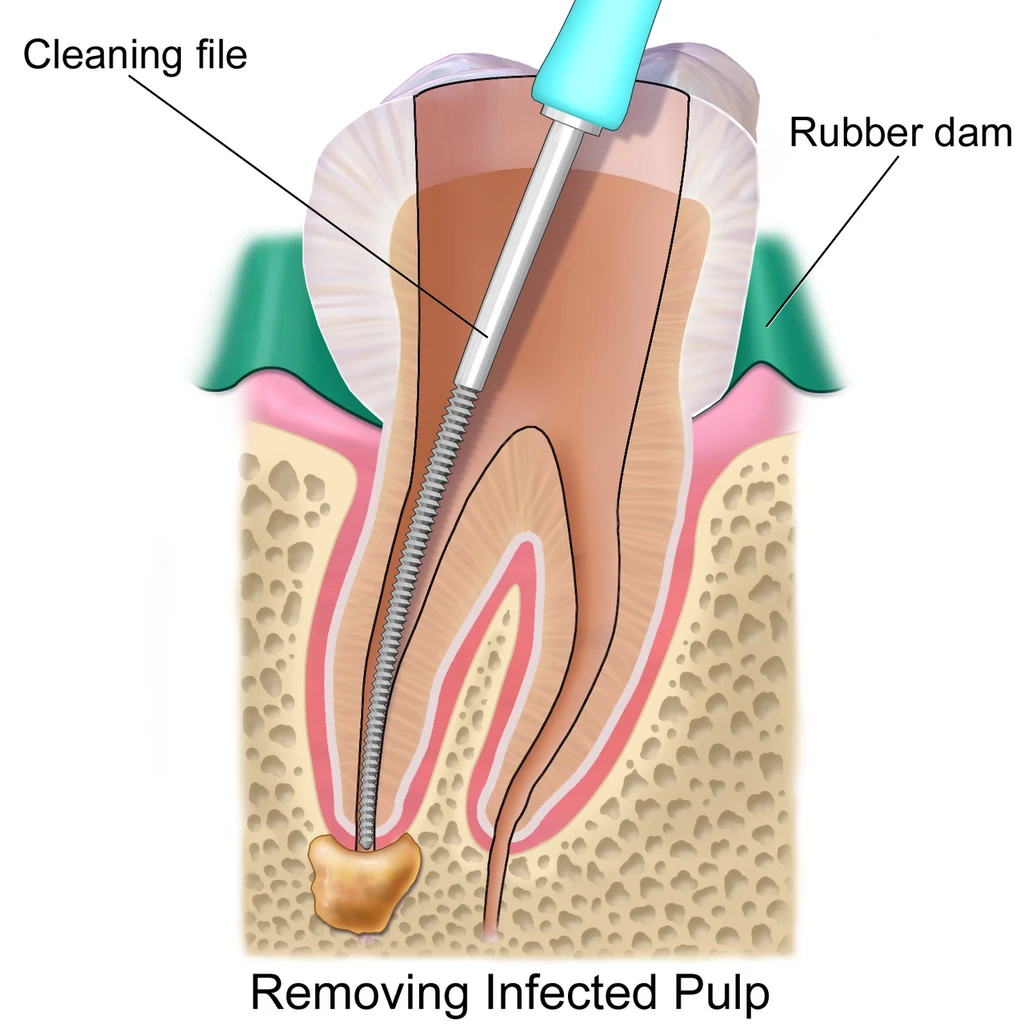
The infected tissue is removed. The dentist then cleans and shapes the root canals to prepare them for filling. This step is important because the canals need to be thoroughly cleaned before they are sealed.
A temporary filling is placed to protect the tooth until your next appointment.
Second appointment: Completing the root canal
At the next visit, your dentist checks the tooth and completes the treatment. The cleaned canals are filled and sealed to help prevent bacteria from entering again.
Depending on how much of the original tooth structure remains, a permanent restoration or crown may also be recommended.
| Appointment | What happens | Typical length |
| First visit | Local anaesthetic, removal of infected pulp, cleaning and shaping, temporary filling | 1–2 hours |
| Second visit | Checking the tooth, permanent root canal filling and sealing | 1–2 hours |
Why do some root canals take longer than others?
Not every root canal is the same. The time needed depends on the tooth being treated and the condition of its internal structure.
The position of the tooth
Front teeth generally have fewer root canals than back teeth. Molars can have several canals, sometimes with complex shapes or narrow passages. Each canal needs to be located, cleaned and prepared, which can make treatment more involved.
The extent of infection
A tooth with significant infection or inflammation may need additional attention. Your dentist must assess the condition of the canals and determine whether they are ready to be sealed.
If the treatment needs to be completed over more than one visit, a temporary filling protects the tooth in the meantime.
Whether you need a crown
Root canal treatment removes infected tissue from inside the tooth, but it can leave the remaining tooth structure more vulnerable to fracture.
A crown may therefore be recommended to protect the tooth. This is a separate restorative stage and can add to the overall treatment time.
These factors explain why one patient may complete treatment relatively quickly while another needs additional appointments.
One visit or two: does it make a difference?
Some root canals can be completed in one appointment, while others are divided into two or more sessions. Both approaches can be effective when selected appropriately.
A Cochrane review by Mergoni and colleagues (2022), which examined 13 studies involving 1,505 teeth, found that single-visit and multiple-visit root canal treatments were equally effective at one year.
However, the review also found that patients treated in a single visit experienced more pain during the first week after treatment.4
This does not mean that one approach is always better. The decision depends on the condition of the tooth, the complexity of the canals and the dentist’s clinical assessment.
Your dentist should explain why a particular treatment schedule is recommended and what you can expect afterwards.
Do root canals hurt?
One of the biggest concerns patients have is whether a root canal will hurt. The treatment itself is carried out under local anaesthetic, which numbs the area around the tooth. You should not feel sharp pain during the procedure.1 2
The discomfort associated with root canal treatment is often related to the infection or inflammation that existed before the appointment.
Research provides a useful picture of how pain changes over time.
A systematic review by Pak and White (2011), published in the Journal of Endodontics, examined pain prevalence and severity before, during and after root canal treatment. It reported the following findings:5
- Before treatment: Around 81% of patients reported pain.
- 24 hours after treatment: Around 40% reported pain.
- One week after treatment: Around 11% reported pain.
The review also measured average pain severity on a 100-point scale:
| Time | Average pain score | Approximate score out of 10 |
| Before treatment | 54/100 | 5.4/10 |
| 24 hours afterwards | 24/100 | 2.4/10 |
| One week afterwards | 5/100 | 0.5/10 |
These are averages from a systematic review, not predictions for every individual. They show that pain generally decreases considerably following treatment.
If you are waiting for an appointment and experiencing toothache, you can also read our guide to managing toothache and finding relief in the UK.
Root canal recovery time: what is normal afterwards?
Most people can return to their usual activities relatively quickly. However, the treated tooth and surrounding area may remain tender for a short time.
According to the American Association of Endodontists, the numbness from local anaesthetic can last approximately two to four hours. Many patients are able to return to work on the same day.2
The Oral Health Foundation explains that tenderness can continue for a few days. The NHS also notes that the treated area may feel sore or swollen for a couple of weeks, with symptoms gradually improving.1 3
What can you take for discomfort?
Paracetamol or ibuprofen can help manage discomfort after treatment, provided you can safely take these medicines. Follow the instructions on the packaging or your dentist’s advice.1
Mild tenderness does not necessarily mean something has gone wrong. However, contact your dentist if the pain becomes worse rather than gradually improving, or if you develop swelling that concerns you.
Root canal timeline at a glance
- First visit: The infected pulp is removed, the canals are cleaned and a temporary filling is placed.
- 2–4 hours: The local anaesthetic gradually wears off.
- First day: Many patients return to work and normal daily activities.
- First week: Tenderness usually settles, with average pain levels falling considerably.
- Couple of weeks: The treated area should be improving, although some tenderness may remain.
Recovery varies according to the original condition of the tooth and the treatment required.
How long does a root canal last?
A root-filled tooth can last for many years with appropriate care. The Oral Health Foundation reports that root-filled teeth last an average of five to ten years, with many lasting considerably longer.3
The long-term condition of the tooth depends partly on how well it is restored and maintained.
A crown may be recommended after treatment because a tooth that has undergone root canal therapy can become more brittle and vulnerable to fracture. A crown covers and protects the remaining tooth structure.1 3
If your dentist recommends this additional restoration, you can read our guide to understanding dental crown costs in the UK.
You may also want to understand the alternatives before making a decision. Our article explaining root canal treatment versus tooth extraction discusses the differences between the two approaches.
What does it cost and how long does it take in the UK?
On the NHS in England, root canal treatment falls under Band 2 dental treatment, currently costing £76.60.6 Private treatment costs vary according to the tooth, complexity and restoration required. If you are considering private care, our guide to root canal treatment costs in the UK explains the factors that influence the price.
Having a root canal at DentSpa
If you are considering having root canal treatment in Istanbul, the first step at DentSpa is a consultation based on your dental findings and what you want to achieve.
DentSpa is located in Şişli, Istanbul. Root canal treatment is carried out by endodontic specialists, including Dr Ahmet Çetinkaya, who has 10 years of experience, and Dr Mehmet Kalcay, who has seven years of experience.
You can explore Dr Ahmet Çetinkaya’s profile and Dr Mehmet Kalcay’s profile to learn about their training and the root canal work they carry out.
How is treatment planned?
Planning begins with an examination and digital imaging. Depending on the clinical requirements, this may involve X-rays or 3D scans to assess the tooth and understand the position and structure of its root canals before treatment.
During the free consultation, the dentist explains the findings in your own language. They discuss why one approach is recommended and why another may not be suitable.
The aim is to make the treatment decision understandable. Quality is not reduced to reach a particular price. Differences in treatment costs between the UK and Turkey reflect the local cost base, rather than a decision to reduce the work involved or use less suitable materials.
If you want to understand the treatment offered at DentSpa, the root canal treatment page explains the procedure and the service available at the clinic.
If you are travelling from the UK, it is also worth understanding the practical arrangements involved. Our guide to root canal treatment in Turkey explains more about the treatment journey.
Standards and patient experience
DentSpa is licensed by the Turkish Ministry of Health, certified to ISO 9001, ISO 10002 and ISO 7101, and is a member of the Turkish Dental Association (TDB).
You can read more about what ISO 7101 certification means for a dental clinic.
DentSpa also holds Global Healthcare Accreditation — Certification for Excellence in Medical Travel Patient Experience (GHA). This certification relates to the patient journey, including communication before treatment, coordination during treatment and follow-up afterwards. Further details are available in the explanation of DentSpa’s GHA certification.
Follow-up continues from Istanbul after you return home. If a crown is needed after your root canal, your stay may need to be a little longer, or you may need to return once the temporary filling has settled.
You do not have to take our word for it. You can read patient reviews and visit DentSpa on Instagram, where patients talk about their treatment in their own words.
Frequently asked questions
How painful is a root canal on a scale of 1 to 10?
Is root canal pain normal afterwards?
Can I go to work after a root canal?
Can a root canal be done in one visit?
How long does a root canal last?
Why does a root canal take so long?
Do I need a crown after a root canal?
Talk to DentSpa about your root canal
Your free consultation starts with your dental findings and what you want to achieve. A dentist explains the recommended approach, and why other options may not be suitable, in your own language. Treatment quality is never reduced to reach a particular price. To discuss your situation and arrange a consultation, contact DentSpa.
Sources
- NHS, Root canal treatment. https://www.nhs.uk/tests-and-treatments/root-canal-treatment/
- American Association of Endodontists, What is a root canal? https://www.aae.org/patients/root-canal-treatment/what-is-a-root-canal/
- Oral Health Foundation, Root canal treatment. https://www.dentalhealth.org/root-canal-treatment
- Cochrane, Mergoni G et al. (2022), Single versus multiple visits for endodontic treatment of permanent teeth. https://www.cochrane.org/evidence/CD005296_single-versus-multiple-visits-endodontic-treatment-permanent-teeth
- Pak JG, White SN (2011), Pain prevalence and severity before, during, and after root canal treatment: a systematic review. Journal of Endodontics. https://doi.org/10.1016/j.joen.2010.12.016
- NHS, How much will I pay for NHS dental treatment? https://www.nhs.uk/nhs-services/dentists/how-much-nhs-dental-treatment-costs/














 70%


