
Table of content
Table of content
Loose dentures are more than a daily annoyance. They affect how you eat, how you speak, and how you feel in company. Many people assume the looseness is inevitable — that it comes with the territory. It isn’t, and it doesn’t.
Understanding why dentures become loose, and which solutions address the cause rather than the symptom, is what makes the difference between managing the problem forever and actually resolving it.
And the evidence on that is unusually clear. A meta-analysis of five randomised controlled trials pooling 441 patients compared implant-supported lower overdentures against conventional dentures using the Oral Health Impact Profile — a validated measure of how much your mouth interferes with your life. The implant group scored significantly better on every measure except physical pain: functional limitation, psychological discomfort, physical disability, psychological disability and handicap.1
Why Dentures Become Loose
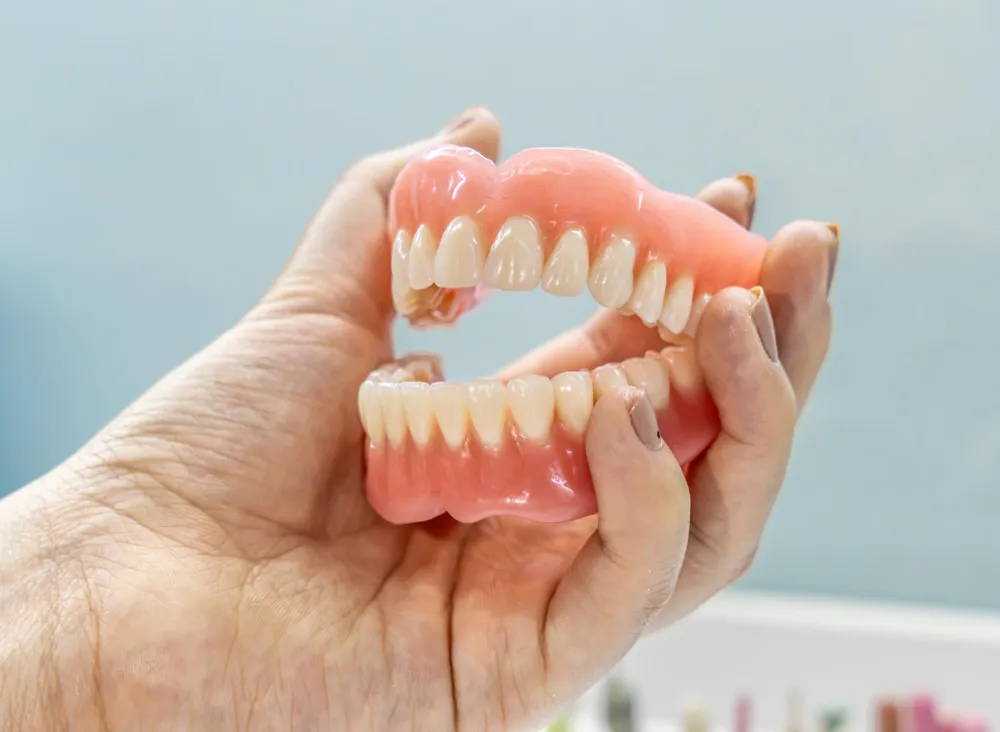
Dentures sit on the gums, held by suction, fit and the muscles around them. Over time, the surface they’re sitting on changes.
Bone resorption is the main cause. When a tooth is removed, the jawbone loses the stimulation the tooth root provided, and it begins to shrink. This isn’t gradual in the way people expect — measured across 20 human studies, an untreated extraction site loses 29–63% of its ridge width within six months, with 32% of that gone by three months.2 Resorption then continues for years. As the ridge flattens, the denture that fitted it stops fitting.
That’s the crucial point most guides skip: a loose denture is usually a symptom of a shrinking jaw, not a badly made denture. Which is why fixes aimed at the denture rather than the jaw only ever buy time. The full picture is in our guide to bone loss in the jaw.
Gum tissue also changes with age, weight change and general health, altering the fit further. And the denture itself wears — small changes accumulate through years of eating and cleaning.
Adhesives: What They Can and Can’t Do
Denture adhesive creams and powders do improve short-term stability. They reduce movement while speaking or eating and stop food slipping underneath. For an occasional social occasion, they’re genuinely useful.
What they don’t do is address the cause. They don’t slow bone loss, they need reapplying every day, and — the part worth taking seriously — heavy daily use can mask a fit problem that needs looking at. If you’ve gone from occasional adhesive to needing it every morning, that change is itself the information: something underneath has shifted.
Relining: A Maintenance Fix, Not a Permanent One
Relining reshapes the underside of a denture to match your current gum contours. It works well for mild to moderate looseness, on dentures that are structurally sound, in the earlier stages of bone and gum change.
Its limits follow from the same cause: it doesn’t stop the resorption that made the denture loose, so it typically needs repeating every few years, and it isn’t suitable once bone loss is advanced. Relining improves comfort and function — it’s maintenance, not a solution.
Implant-Supported Dentures: Addressing the Cause
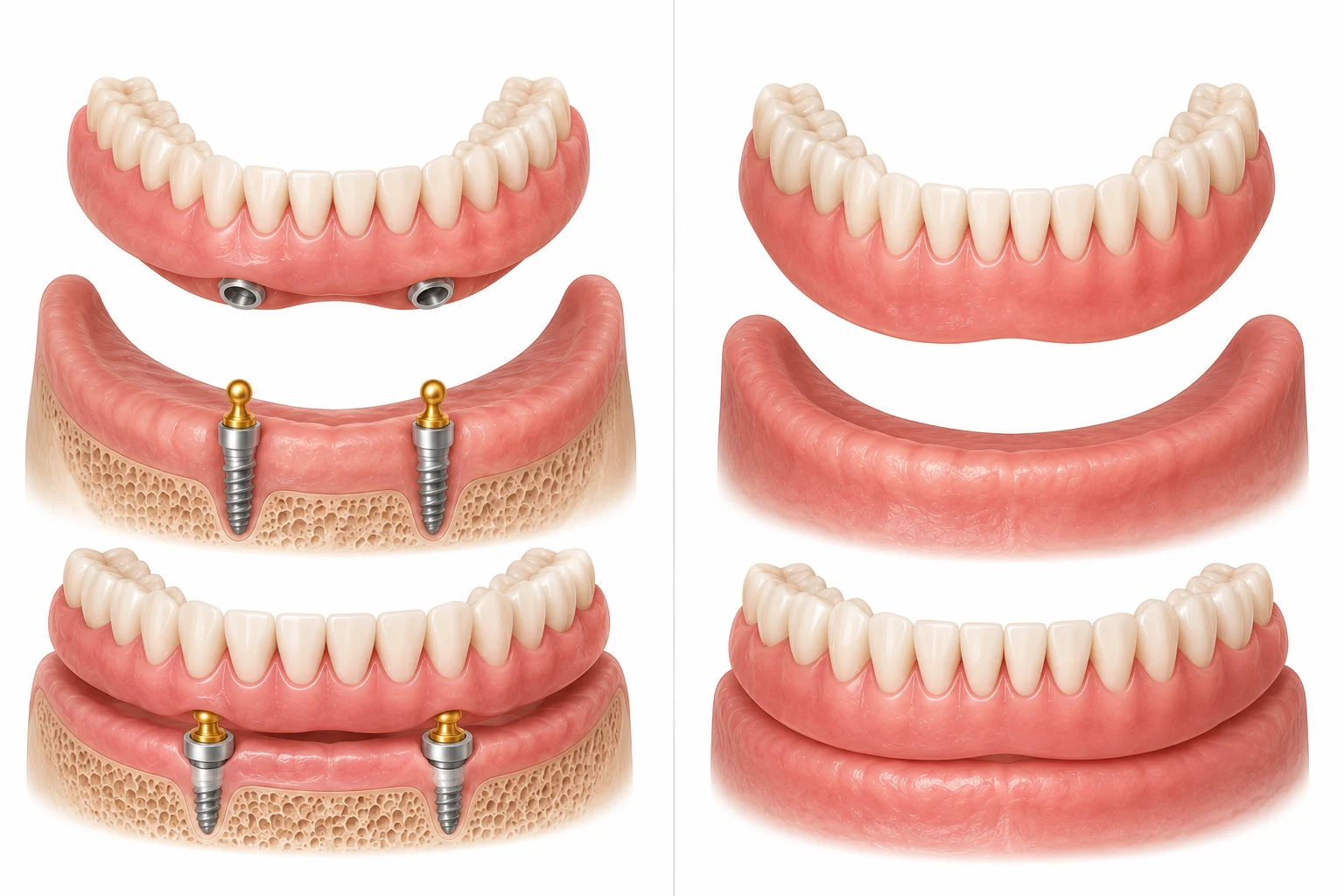
Dental implants replace the tooth root, anchoring into the bone. The denture is then held by the implants rather than resting on the gums — which changes both the stability and, because the bone is being loaded again, the trajectory of the resorption underneath.
There are two routes:
- Snap-on (implant-retained) dentures — removable by you for cleaning, but firmly attached to the implants in use.
- Fixed implant-supported dentures — permanently attached, functioning much like natural teeth.
Both give considerably more stability than a conventional removable denture. Which suits you depends on bone condition, how much cleaning you want to do yourself, and preference — not on which is “better”.
Where bone is already thin after years of denture wear, it can be rebuilt first with a bone graft before implants go in; the timeline that adds is set out in our implant timeline guide. For patients missing several rather than all teeth, see implants for multiple teeth and multiple teeth replacement.
Snap-On vs Fixed vs Conventional
Snap-on dentures are more stable than conventional ones, easier to clean than a fixed bridge, and usually need fewer implants than a fully fixed solution — a practical middle ground.
| Feature | Conventional dentures | Implant-supported dentures |
|---|---|---|
| Stability | Relies on suction and fit | Anchored to implants |
| Adhesive | Often required | Rarely needed |
| Bone stimulation | None — the ridge continues to resorb | The implant loads the bone |
| Chewing efficiency | Limited by movement | Substantially better |
| Cleaning | Removed and cleaned | Removable (snap-on) or brushed in place (fixed) |
If you’d rather have teeth that never come out at all, a full-arch approach like All-on-4 fixes a complete bridge onto four implants — worth comparing against snap-on if you’re deciding how permanent you want the result to be. There’s more on how that works in our guide to All-on-4 in Turkey, and on the differences between denture types in types of dentures and immediate vs permanent dentures.
Daily Habits That Help
Whatever route you take, these reduce discomfort and protect the fit you have:
- Clean your dentures daily with a proper denture cleaner — not ordinary toothpaste, which is abrasive enough to scratch the surface.
- Rinse after meals to clear trapped food.
- Go easy on very sticky or very hard foods, which pull at the fit.
- Never adjust, file or repair a denture yourself. Home adjustments ruin the fit surface and often make a repairable denture unrepairable.
- Keep your check-ups. Fit is assessed against gums that are still changing, so it needs looking at periodically rather than only when something hurts.
When to See a Dentist
Get it looked at if your dentures move while speaking or chewing, you’re getting sore spots or ulcers, you now need adhesive every day, or your dentures are more than five to seven years old.
Sore spots in particular shouldn’t be tolerated as normal. A denture that rubs is a denture that no longer fits the ridge underneath, and the longer it’s worn that way, the more it accelerates the very resorption causing the problem.
Considering Treatment Abroad
Implant-supported dentures in Turkey are often considered by international patients, largely on cost — the difference driven by lower clinic and operating costs rather than by different materials. Any figure you read online is an approximate market range rather than a quote; your own depends on how many implants your case needs and is confirmed in writing after a free consultation. How the trip works is in our guide to dental tourism in Turkey.
How DentSpa Approaches It
Every case starts with diagnostics and digital planning rather than a package: a CBCT scan shows how much bone is actually left, which is the single fact that determines whether snap-on, fixed or a graft-first approach is right for you. Each step is explained before anything is done.
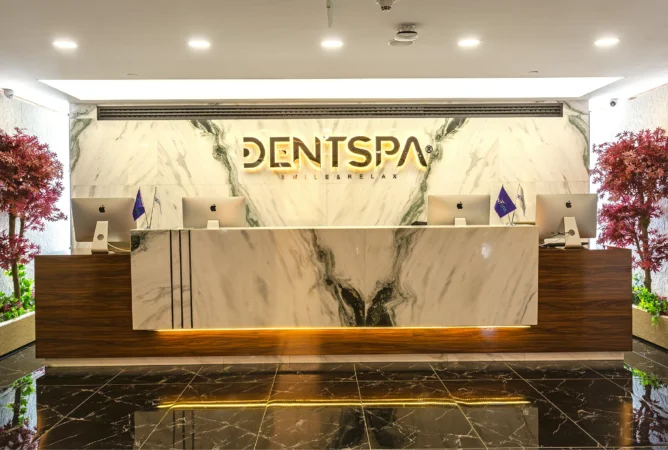
Over 50,000 international patients have been treated at the Şişli clinic, which matters here mostly as scheduling experience — resorbed-ridge cases and travel timetables both need planning. You can read the clinical team’s backgrounds on the doctors page, and patient feedback in the verified Trustpilot and Google reviews.
The credentials are checkable: licensed by the Turkish Ministry of Health, certified to ISO 9001 and ISO 10002, a member of the Turkish Dental Association, and holder of the Certification for Excellence in Medical Travel Patient Experience from Global Healthcare Accreditation.3 DentSpa was named best dental clinic in Europe in the odontology category at the European Awards in Medicine, and for implants Straumann publishes the number placed here over a full year on its own verification page — see the Straumann Achievement Award. Scheduling, language support and aftercare are arranged in advance; see international guests.
You don’t have to live with it
Loose dentures are almost always a symptom of changes to the jawbone and gums underneath — and that’s treatable. The question isn’t whether something can be done, but which approach fits your bone, your routine and what you want from the result.
Book a free online consultation and get your case assessed before you decide anything.
Frequently asked questions
Why have my dentures become loose?
Are denture adhesives a real solution?
How long does denture relining last?
Are implant-supported dentures actually better?
What's the difference between snap-on and fixed implant dentures?
Can I have implants if I've worn dentures for years?
When should I see a dentist about my dentures?
Sources
- 1. Comparison of implant-supported mandibular overdentures and conventional dentures on quality of life: a systematic review and meta-analysis of randomised controlled studies (5 studies; 441 patients). pubmed.ncbi.nlm.nih.gov/26836981
- 2. Tan WL, Wong TLT, Wong MCM, Lang NP. A systematic review of post-extractional alveolar hard and soft tissue dimensional changes in humans. Clin Oral Implants Res. 2012;23(Suppl 5):1–21. pubmed.ncbi.nlm.nih.gov/22211303
- 3. Global Healthcare Accreditation — DentSpa Strengthens Global Trust in Turkey’s Dental Services with GHA Certification, 16 July 2026.












 70%
70%