
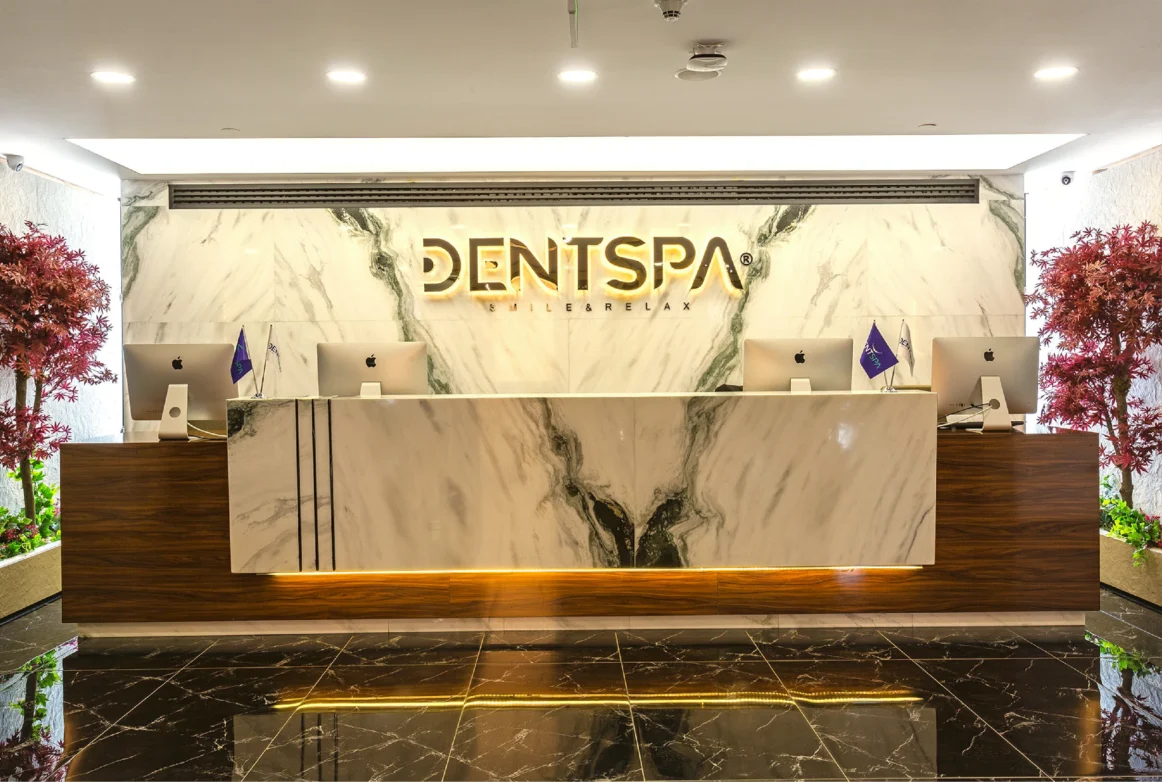
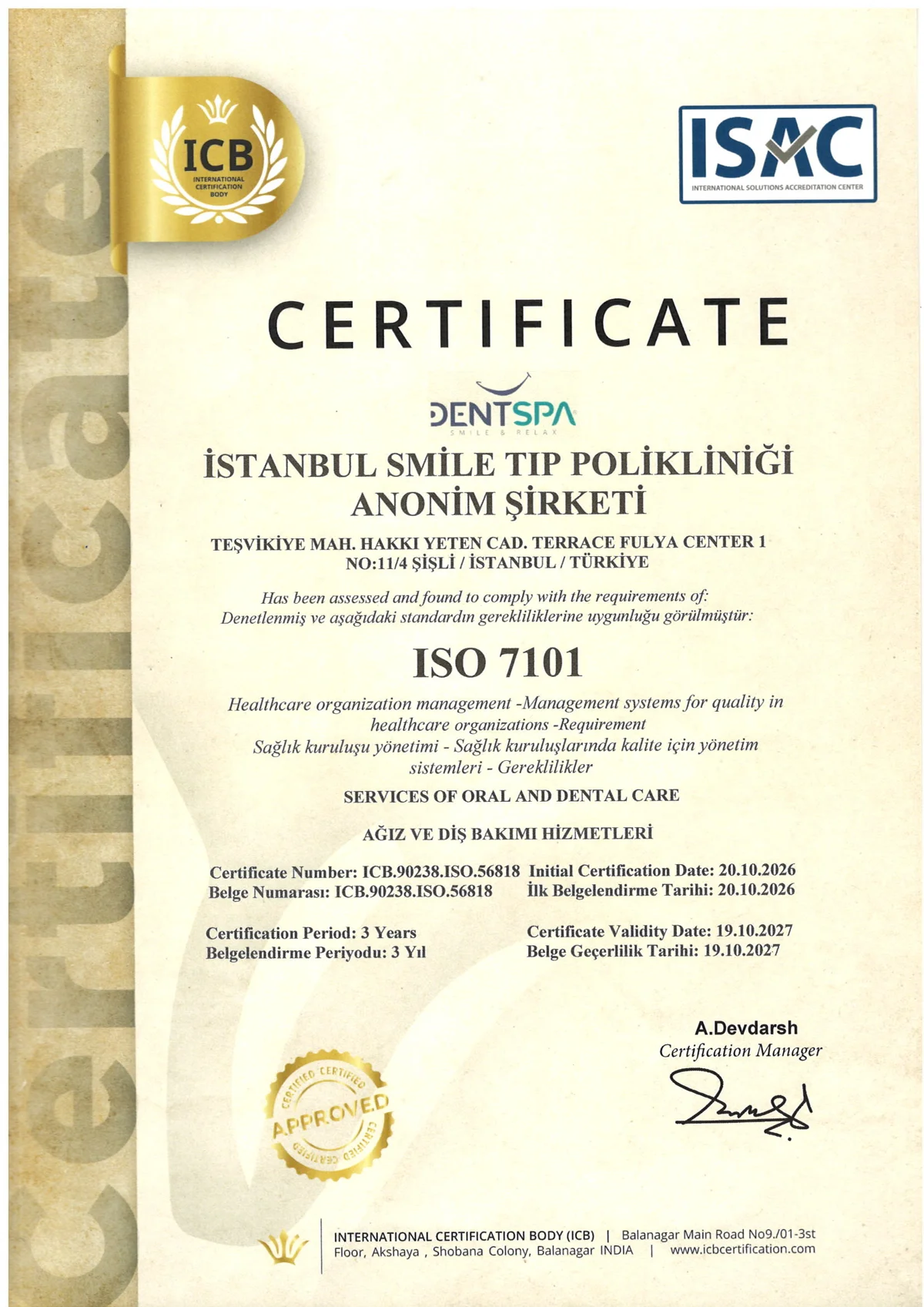
DentSpa has received ISO 7101 certification for its oral and dental care services. The certificate, issued by International Certification Body (ICB) to İstanbul Smile Tıp Polikliniği A.Ş., carries the DentSpa logo and states that the organisation was assessed and found to comply with the requirements of ISO 7101. The initial certification date is 20 October 2026, and the certification period is three years.1
The certificate identifies the scope as “Services of oral and dental care” and lists the clinic’s address in Şişli, Istanbul. Patients can read the certificate PDF and check certificate number ICB.90238.ISO.56818 on ICB’s public certificate verification page.1 2
For patients travelling from the UK, Europe or the US for dental treatment, the distinction matters: ISO 7101 concerns how a healthcare organisation manages quality. It is not a promise about the result of an individual treatment.
What is ISO 7101?
ISO 7101:2023 is an international standard titled Healthcare organization management — Management systems for quality in healthcare organizations — Requirements. Published in October 2023, it was developed by ISO technical committee ISO/TC 304. ISO describes it as the first international consensus standard for healthcare quality management.3
The standard sets requirements for how healthcare organisations establish, manage, monitor and improve the quality of their services. It addresses areas including leadership, patient-centred care, risk management, safety, documented processes and the evaluation of performance. It is designed for healthcare organisations of different sizes, from small clinics to large hospitals.3
For a dental clinic, the standard provides a framework for managing quality across the organisation rather than focusing solely on individual clinical procedures. It gives patients a reference point when asking how a clinic approaches quality management, while leaving them free to assess whether its services meet their own clinical needs.
What the standard asks of a clinic
ISO 7101 sets out several requirements for healthcare organisations. Understanding them can help patients travelling for dental treatment recognise what a quality management standard is intended to address.3
A culture of quality starting with senior management
Quality management should begin with the organisation’s leadership. For patients, this means the standard addresses how responsibility for quality is established across an organisation, rather than treating it as a matter for individual clinicians alone.
People-centred care, respect, compassion, co-production, equity and dignity
The standard places people at the centre of healthcare. In a dental setting, these principles are relevant when discussing treatment options, understanding a patient’s preferences and ensuring that decisions take account of the person receiving care.
For international patients, communication about their needs and expectations is an important part of making informed decisions.
Identifying and addressing risks
Healthcare organisations are expected to identify risks and take steps to address them. This requirement is relevant to the management of potential problems within healthcare services.
Patient and workforce safety and wellbeing
The standard includes safety and wellbeing for both patients and the people working in healthcare. This makes safety an organisational concern, not simply an isolated consideration during a treatment appointment.
Controlling service delivery through documented processes and information
Documented processes help an organisation define and manage how its services are delivered. For patients, this requirement concerns the systems used to support consistent service management.
Monitoring and evaluating clinical and non-clinical performance
ISO 7101 addresses the monitoring of both clinical and non-clinical performance. The distinction recognises that healthcare quality involves clinical care as well as the wider management of services. The standard calls for performance to be evaluated rather than assumed.
Continually improving processes and results
The standard requires organisations to pursue ongoing improvement. Quality management is therefore intended to be a continuing activity, not simply a certificate displayed after an assessment.
Why we chose external certification
ISO explains that an organisation can demonstrate conformity with ISO 7101 in four ways: through self-declaration, confirmation from interested parties, certification or registration of its healthcare quality management system by an external organisation. The standard does not make external certification the only possible route.3
DentSpa chose external certification. ICB assessed the named organisation and issued the certificate against ISO 7101, with the scope specified as services of oral and dental care.1
External certification gives patients a document they can examine and verify with the issuing body. The certificate identifies the standard, the organisation, the scope, the initial certification date and the certification period. These details allow patients to check what has been certified rather than relying on a general statement about quality.
ISO 7101 also makes clear that conformity with the standard does not override an organisation’s legal responsibilities.3 Certification should be understood alongside the applicable legal requirements and the clinical information relevant to each patient’s treatment.
What ISO 7101 does not mean
An ISO 7101 certificate is evidence of conformity with a healthcare quality management standard within the stated scope. It is not a guarantee of a particular clinical result.
It does not mean that every patient is suitable for every treatment, or that all treatment plans will produce the same outcome. Individual results depend on clinical circumstances and other factors specific to the patient.
Nor does the certificate replace a consultation, an assessment of clinical suitability or a discussion of the potential benefits and risks of treatment. Patients should still ask questions, understand their proposed treatment and make decisions based on their own circumstances.
The scope on DentSpa’s certificate is specifically services of oral and dental care. The certificate should not be interpreted as covering services outside that stated scope.1
How to check it yourself
You do not need to rely on a clinic’s description of its certification. You can inspect the document and check the certificate number with its issuer.
- Read the certificate: Open the DentSpa ISO 7101 certificate PDF.1
- Note the certificate number: The number printed on the document is ICB.90238.ISO.56818.1
- Check with ICB: Visit the ICB certificate verification page and enter the certificate number.2
Any patient can ask a clinic to provide its certificates and check the details with the issuing organisation. It is reasonable to confirm the standard, the organisation named, the scope and the certification dates before relying on a certification claim.
How it sits with our other credentials
ISO 7101 is part of DentSpa’s wider set of credentials. Each has its own stated purpose and should be considered on its own terms.
Global Healthcare Accreditation (GHA)
DentSpa holds the Global Healthcare Accreditation (GHA) Certification for Excellence in Medical Travel Patient Experience, which looks at the journey around treatment: communication before arrival, coordination during the stay and follow-up after patients fly home. You can read our GHA certification explanation and consult the GHA announcement.
Straumann Achievement Award
DentSpa places more than 1,000 Straumann implants a year, a figure Straumann publishes on its own verification page. Our article about the Straumann Achievement Award provides further context.
European Award in Medicine
DentSpa has received the European Award in Medicine in the Odontology category, described as “Best Dental Clinic in Europe”. Further information is available in our article about the European Award in Medicine.
Turkish Ministry of Health licence
DentSpa is licensed by the Turkish Ministry of Health. This is distinct from ISO certification, which concerns conformity with the requirements of a specified management system standard.
ISO 9001 and ISO 10002
DentSpa also holds ISO 9001 and ISO 10002. These are separate standards and should not be treated as interchangeable with ISO 7101, which is written specifically for healthcare organisations.
Turkish Dental Association
DentSpa is a member of the Turkish Dental Association (TDB). Association membership is a separate credential from certification against an ISO management system standard.
Patients can find further information about DentSpa’s certificates and credentials on our accreditations and certifications page.
About DentSpa
Founded in 2018 in Istanbul’s Şişli district, DentSpa works almost entirely with international patients. Its services are centred on oral and dental care for people travelling to Istanbul for treatment.
A consultation begins with the clinical findings and what the patient wants to achieve. The purpose is to discuss the patient’s needs and the available treatment options, rather than start with a predetermined procedure. Patients can learn about our dentists and the arrangements available through our international guest services.
Treatment follow-up continues from Istanbul after patients fly home. Our after-treatment information explains more about follow-up once a patient has returned home.
Quality is never reduced to reach a price. Treatment decisions should be based on clinical findings, the patient’s needs and an appropriate plan.
If you are considering dental treatment in Istanbul, you can request a free consultation through our contact page. This provides an opportunity to discuss your aims and the clinical information needed to consider your options.
Frequently asked questions
What is ISO 7101?
Is DentSpa an ISO 7101 certified dental clinic?
Who issued DentSpa's ISO 7101 certificate?
How can I verify DentSpa's ISO 7101 certification?
Does ISO 7101 guarantee my dental treatment result?
What is the difference between ISO 7101 and ISO 9001?
Sources
- DentSpa, ISO 7101 Certificate, International Certification Body (ICB), certificate no. ICB.90238.ISO.56818. dentspa.com
- International Certification Body (ICB), Certificate Verification. icbcertification.com
- International Organization for Standardization (ISO), ISO 7101:2023 — Healthcare organization management — Management systems for quality in healthcare organizations — Requirements. iso.org













 70%


