
Table of content
Table of content
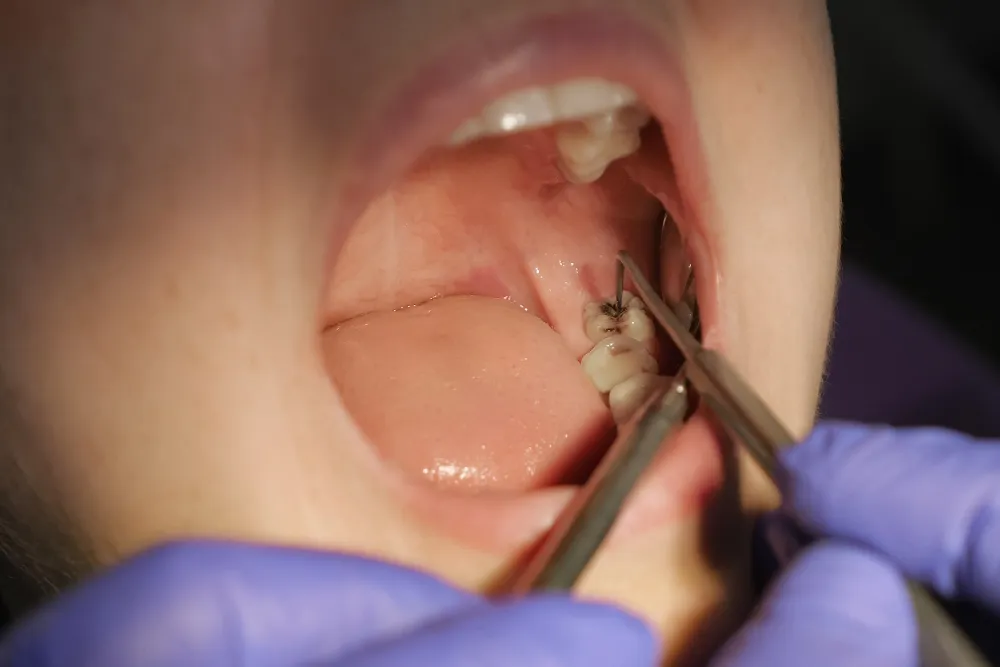
A cavity between teeth is decay on the side of a tooth, right where it touches its neighbor. You usually can’t see it, and early on it rarely hurts, which is why most people only hear about it after a dental X-ray. Caught early, it can sometimes be stopped without drilling. Otherwise, it’s a filling.
What is a cavity between teeth?
On your chart it might say interproximal cavity (or proximal or approximal caries). Different name, same disease. Plaque bacteria eat sugars and starches and make acid. That acid pulls minerals out of the enamel a little at a time until the surface gives way and there’s a hole [1].
So why there? Mostly because your toothbrush never really gets in. The tight spot where two teeth meet can hold plaque for days, and research confirms these side surfaces are especially prone to decay [2]. Having had decay somewhere is also incredibly common. A national US survey found that 91% of adults between 20 and 64 had experienced it in their permanent teeth [3]. If your dentist has just tapped a shadow on the screen and said “there’s something here,” you’re in very ordinary company.
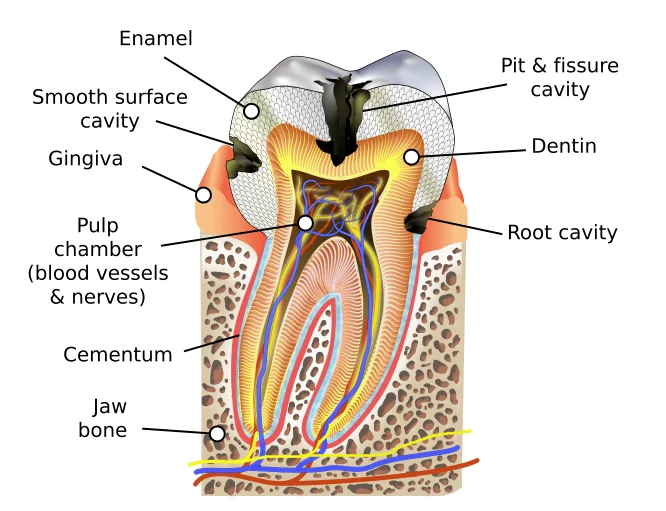
Decay doesn’t stay put, though. It starts in the enamel, can move into the softer dentin underneath and, given years rather than weeks, heads toward the nerve. The stage it’s reached decides the repair, and our guide to how tooth decay is fixed at each stage walks through each one. If you’d rather get the bigger picture first, our page on cavity treatment options is the place to start.
How do you know if you have a cavity between teeth?
Honestly? A lot of the time you don’t. Tooth decay often causes no symptoms at first [4], and that goes double for a surface you can’t see. When the signs of a cavity between teeth do show up, they’re usually small and easy to shrug off. A quick, sharp twinge from ice cream or hot coffee is a common one [4]. So is floss that frays or snaps in the same gap every time, or food that keeps wedging into one particular spot after meals. Some people notice a white, brown or black mark on the tooth [4], or a grayish shadow showing through near the contact point. Real toothache tends to mean the decay has gone deeper [1].
It stays quiet for so long for a simple reason: enamel has no nerves. Sensitivity and aching usually only start once decay pushes further in [1].
That’s where X-rays earn their keep. A bitewing (the small film or sensor you bite down on) shows the upper and lower back teeth side by side, and a cavity in between teeth appears on it as a darker patch in the enamel or dentin. X-rays pick up damage a dentist can’t see during a regular exam, new cavities included, and how often you need them depends on your age, oral health and risk [5].
One reassuring finding: this kind of decay is usually slow. Swedish researchers who followed 536 young people with bitewing X-rays from age 11 to 22 saw decay on these surfaces creep up slowly but steadily, rather than appear all at once [6].
Cavity between back teeth and molars
Back teeth get the worst of it. Molars and premolars are broad, they touch their neighbors over a wide, flat contact, and getting floss back there takes some wrist work. In the Swedish study, the first molar alone (its chewing surface plus its two sides) made up 60% of every filled surface by age 21 [6]. Plenty of lesions were still early, too. At 21, X-rays showed enamel-only decay on 29% of the side surfaces of back teeth, against 14% that had reached the dentin [6].
A cavity between molar teeth is almost always fixed from the top. The tooth next door is in the way, so the dentist makes a small opening in the chewing surface, clears out the decay and rebuilds the missing side wall. The fiddly part is the contact. Too loose and food packs in every time you eat; too tight and your floss shreds. When it’s right, floss goes through with a little snap, the same as between two healthy teeth.
Sometimes the decay sits right at the gum line or just under it, especially where gums have pulled back and left some root exposed [1]. Your dentist will check that on the X-ray, and with a probe, before deciding how to repair it.
Cavity in between front teeth
Here, decay tends to get spotted earlier. Front teeth are thinner and let light through, so decay can show up as a faint gray tint or a thin dark line where two teeth meet.
Cavities in between teeth at the front are usually repaired from behind, on the tongue side, which leaves the part everyone sees untouched. Once the decay is out, the dentist builds the gap back up with composite in thin layers, shade-matched to the tooth. A good one is genuinely hard to find afterward, even if you know where to look.
How dentists fix a cavity between teeth
Once there’s a hole, it needs filling. The dentist removes the decayed tissue and fills the space [7], and these days that’s usually a tooth-colored composite filling. Composite has become the go-to for a lot of dentists, partly because people prefer fillings that match their teeth and partly because the materials have gotten much better [7].
What actually happens in the chair? You’re numbed first. Then the decay comes out, and a thin band goes around the tooth with a small wedge pushed in between the teeth. Together they act as a temporary wall to shape the composite against. The filling goes in layer by layer, each one hardened with a curing light, and then it’s trimmed and polished until your bite feels normal and floss passes cleanly.
Bigger damage is a different conversation. When a large chunk of the tooth is gone, a big filling isn’t always the strongest option, and your dentist may suggest an inlay or onlay instead. It’s made outside the mouth to fit precisely, then bonded in.
If decay has reached the pulp, the soft center of the tooth, root canal treatment removes the infected tissue, cleans out the inside and seals it. A crown on top is sometimes needed if the tooth was badly affected [8].
Fillings don’t last forever, either (they may need replacing at some point [7]), so it’s worth knowing the signs of when a filling needs replacing before a small issue turns into a bigger one.
Can an early cavity between teeth be reversed?
Yes, if there’s no hole yet. NIDCR describes what goes on in your mouth all day as a tug-of-war. Acids from plaque pull minerals out of enamel, while calcium and phosphate from saliva, helped along by fluoride, push them back in [9]. If the acid side keeps winning, a chalky white spot forms. That’s early decay, and at that point it can still be stopped or even reversed [9]. Once the enamel actually caves in and a cavity forms, though, the damage is permanent and needs a filling [9].
For decay at this stage, the usual plan is fluoride, either a varnish your dentist paints on or a prescription-strength mouthwash [4], and then comparing X-rays at later visits to make sure the spot isn’t growing. There’s more on this in our piece on remineralizing early enamel damage.
There’s also an in-between option called resin infiltration. A very runny resin soaks into the weakened enamel and seals off the tiny channels acid travels through, with no drilling at all. A 2023 systematic review pooling 11 randomized trials found firm evidence that it stops early side-surface lesions from progressing, in adult teeth and baby teeth alike [2]. The trials weren’t flawless (each carried some risk of bias), but the conclusion lines up with earlier reviews. It only works while the surface is still intact, so whether it suits you is your dentist’s call.
How to prevent cavities between teeth
Plaque is what starts all of this, and toothbrushes are bad at reaching between teeth. That’s the whole reason cleaning those gaps gets recommended as an extra step [10].
How much does it help? A Cochrane review of 35 trials found that adding floss or interdental brushes to brushing may reduce gum inflammation, with interdental brushes possibly doing a bit better than floss [10]. None of the trials ran long enough to measure decay between teeth, and the evidence overall was low certainty [10]. Public health bodies still advise cleaning between your teeth daily with floss or interdental brushes [4][1].
The habits that matter are fairly unglamorous. Brush twice a day with fluoride toothpaste, and spit afterward instead of rinsing [4]. Clean between your teeth once a day; interdental brushes are easier in wider gaps, floss in the tight ones. Watch how often you snack, not just what you snack on, because every snack is another acid attack and fewer of them give enamel a chance to recover [9]. Skip anything sugary after your bedtime brush, since saliva flow drops while you sleep and teeth repair less well overnight [9]. And keep your check-ups, with X-rays whenever your dentist recommends them [5].
Treatment at DentSpa in Istanbul
At DentSpa, planning for a cavity between teeth starts with the clinical findings: what your X-rays show, how deep the decay goes and the state of the teeth on either side. Then it’s about what you want. Some patients care most about keeping as much natural tooth as they can. Others want a front-tooth repair nobody will spot, or something that’ll hold up on a molar that’s already been filled twice.
Your dentist then explains why one approach makes sense for you and why another doesn’t. That might be why an onlay protects a weakened molar better than another large filling, or why a small early lesion is better watched than drilled. Quality is never reduced to reach a price.
Treatment at DentSpa costs up to 70% less than private prices in the US. The difference comes from local staff and laboratory costs in Istanbul. It doesn’t come from doing less work or using different materials.
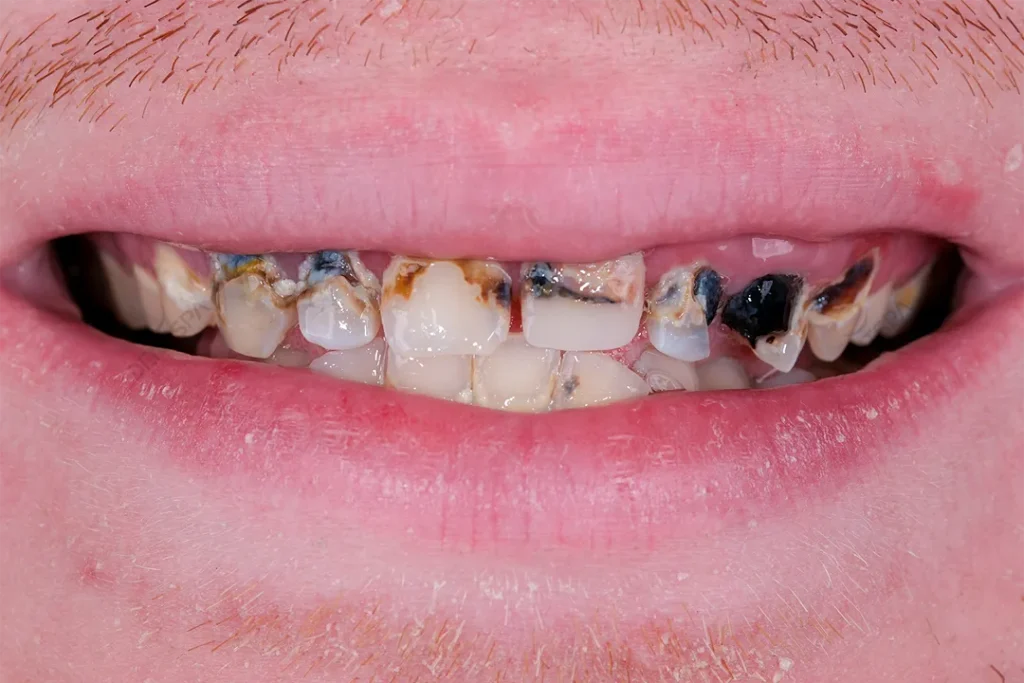
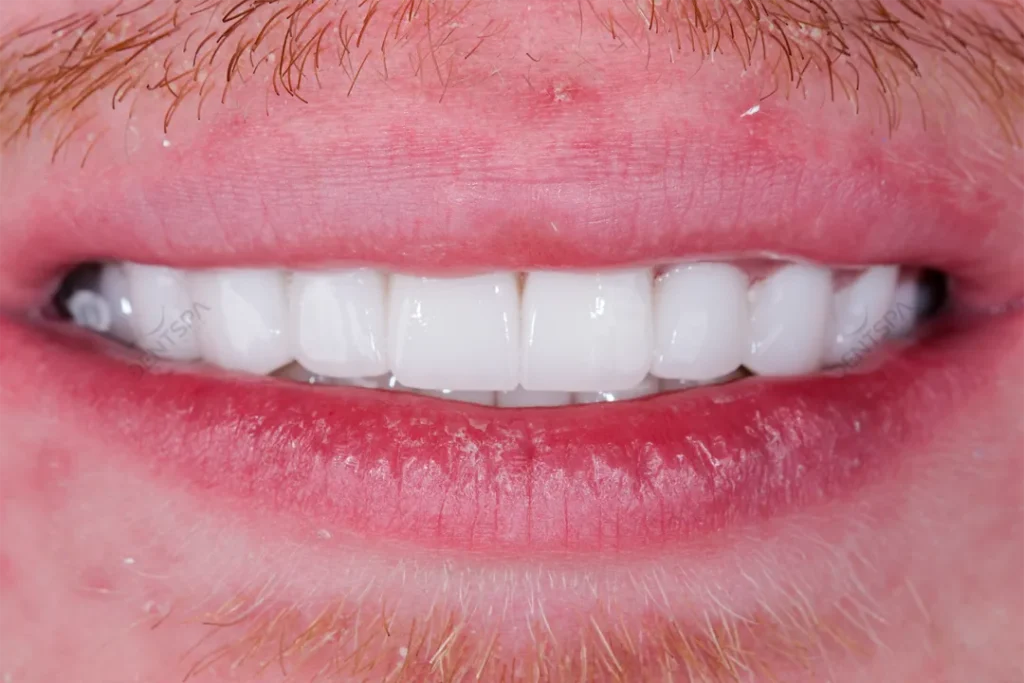
Ready to have that cavity checked?
These cavities are common, they usually move slowly, and they’re treatable at every stage. The sooner one is found, the more of your own tooth you get to keep. So if you’ve been told you have one, or you’re suspicious because of a shadow, a twinge or floss that keeps shredding, book a free consultation with the DentSpa team. A dentist will go through your findings with you, ask what matters to you and explain which approach fits your teeth.
Frequently asked questions
How do you prevent cavities between teeth?
How do dentists fix side cavities between teeth?
Can a cavity in between teeth be fixed?
What does a cavity between teeth look like?
How do they fill cavities in between teeth?
When is it too late to fix a cavity?
How do I tell if I have a cavity in between teeth?
Sources
- National Institute of Dental and Craniofacial Research (NIDCR). Tooth Decay. https://www.nidcr.nih.gov/health-info/tooth-decay
- Cebula M, Göstemeyer G, Krois J, Pitchika V, Paris S, Schwendicke F, Effenberger S. Resin Infiltration of Non-Cavitated Proximal Caries Lesions in Primary and Permanent Teeth: A Systematic Review and Scenario Analysis of Randomized Controlled Trials. J Clin Med. 2023;12(2):727. https://pmc.ncbi.nlm.nih.gov/articles/PMC9864315/
- Dye BA, Thornton-Evans G, Li X, Iafolla TJ. Dental Caries and Tooth Loss in Adults in the United States, 2011–2012. NCHS Data Brief No. 197. Centers for Disease Control and Prevention, 2015. https://www.cdc.gov/nchs/products/databriefs/db197.htm
- NHS. Tooth decay. https://www.nhs.uk/conditions/tooth-decay/
- American Dental Association, MouthHealthy. X-rays. https://www.mouthhealthy.org/all-topics-a-z/x-rays
- Mejàre I, Källestål C, Stenlund H, Johansson H. Caries Development from 11 to 22 Years of Age: A Prospective Radiographic Study. Prevalence and Distribution. Caries Res. 1998;32(1):10–16. https://researchonline.lshtm.ac.uk/id/eprint/4649264
- National Institute of Dental and Craniofacial Research (NIDCR). Dental Fillings. https://www.nidcr.nih.gov/health-info/dental-fillings
- NHS. Root canal treatment. https://www.nhs.uk/tests-and-treatments/root-canal-treatment/
- National Institute of Dental and Craniofacial Research (NIDCR). The Tooth Decay Process: How to Reverse It and Avoid a Cavity. https://www.nidcr.nih.gov/health-info/tooth-decay/more-info/tooth-decay-process
- Worthington HV, MacDonald L, Poklepovic Pericic T, et al. Home use of interdental cleaning devices, in addition to toothbrushing, for preventing and controlling periodontal diseases and dental caries. Cochrane Database Syst Rev. 2019;4:CD012018. https://www.cochrane.org/evidence/CD012018_home-use-devices-cleaning-between-teeth-addition-toothbrushing-prevent-and-control-gum-diseases-and














 70%


