
Table of content
Table of content
On the NHS in England, a dental bridge is a Band 3 treatment costing £332.10. This is one charge for the course of treatment, regardless of how many teeth the bridge covers. Private practices set their own prices, which depend on the bridge type, the number of teeth involved and the materials used.1 2
How much does a dental bridge cost in the UK?
The dental bridge cost in the UK depends first on whether you receive treatment through the NHS or pay privately. NHS charges are set by the relevant health service, while private practices determine their own fees.
Here is how the costs compare:
| Where you receive treatment | What you pay | Important detail |
| NHS England | £332.10, Band 3 | One charge for the course of treatment, including a bridge. |
| NHS Wales | £140.44, Crown or Bridge | A set charge for the relevant treatment category. |
| NHS Scotland | 80% of the treatment cost, up to £384 per course | The patient contribution is subject to the maximum charge. |
| Eligible free-treatment groups | £0 for eligible NHS treatment | Eligibility depends on your circumstances. |
| Private dental practice | Set by the practice | The fee depends on the treatment and materials. |
These figures show why it is important to check which NHS system applies to you. England, Wales and Scotland have different charging arrangements.
In England, Band 3 covers complex procedures, including crowns, dentures and bridges. You pay the Band 3 charge for the course of treatment rather than a separate fee for every individual tooth.1
For a clearer explanation of what each NHS band includes and when the charges apply, read our guide to NHS dental bands.
The private cost is less straightforward. There is no single UK-wide fee for bridge work dental cost because practices set their own prices. The treatment plan, bridge design and materials all influence the final estimate.
Is a 3-tooth bridge more expensive on the NHS?
No. In England, a 3-tooth bridge is covered by the same Band 3 charge of £332.10 as other NHS bridge treatments, provided it is included in the same course of treatment. You do not pay three separate Band 3 charges simply because the bridge involves three units.1
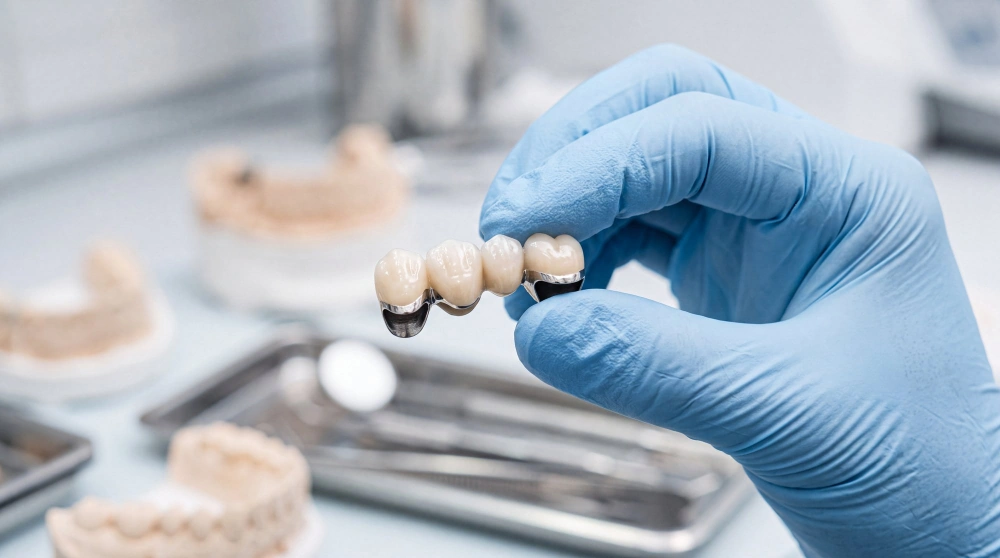
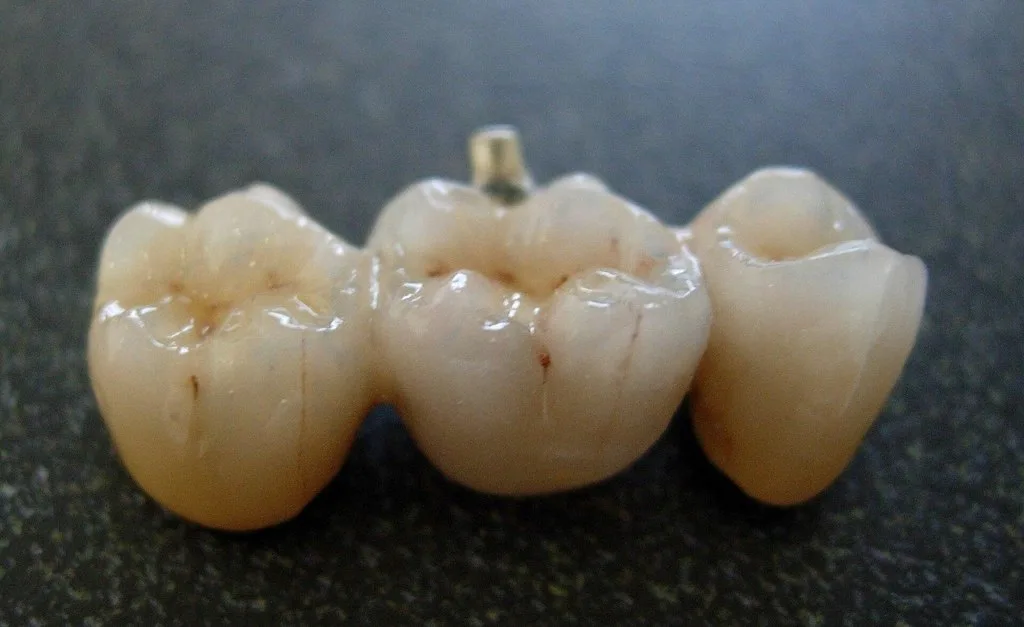
A three-tooth bridge usually means one false tooth replacing a missing tooth, held in place by crowns fitted over the natural teeth on either side of the gap. The replacement tooth is called a pontic, while the supporting teeth are known as abutments.3
This is a traditional fixed bridge. The two supporting teeth are prepared to receive crowns, which hold the replacement tooth securely in position.
The supporting crowns are an important part of the treatment. If you want to understand their purpose and the factors that affect their price, our guide to dental crown costs in the UK explains this in more detail.
A three-unit bridge does not necessarily mean three missing teeth. It describes the number of units in the restoration, which can include supporting crowns and the replacement tooth.
What changes the price of a private bridge?
The private dental bridge cost varies because not every missing tooth requires the same design. According to the Oral Health Foundation, three main factors influence the price: the type of bridge, the number of teeth involved and the materials used.3
1. The type of bridge
Different bridge designs work in different ways. Two common options are traditional bridges and adhesive bridges.
| Bridge type | How it works |
| Traditional bridge | A false tooth is supported by crowns fitted over the teeth on either side of the gap. |
| Adhesive or Maryland bridge | A false tooth is attached using a metal or porcelain wing bonded to the back of a nearby tooth. |
A traditional bridge involves preparing the supporting teeth for crowns. An adhesive bridge uses a different attachment method and does not require the same crown preparation.
If you are considering an adhesive option, read our explanation of Maryland bridges to understand how this type of restoration works.
2. The number of teeth involved
The number of units affects the amount of restorative work required. A single replacement tooth supported by two crowns has a different design from a longer bridge replacing several missing teeth.
This is one reason why a quoted tooth bridge cost should always be considered alongside the exact treatment plan. The number of missing teeth alone does not tell you everything about the final restoration.
3. The materials used
The material also affects the treatment. NHS bridges are usually made using metal and porcelain.4
For a back tooth, the NHS may offer a metal-coloured crown where appropriate. If you want a different appearance or material, you can discuss the available options privately.1
The most suitable material depends on the position of the bridge and the clinical requirements of the restoration.
Before agreeing to private treatment, ask for a written treatment plan and a detailed cost estimate. The estimate should explain the proposed bridge, how many units are involved and which materials will be used. This gives you a clear basis for understanding the total bridge dental cost UK practices quote.3
Can I get a dental bridge on the NHS?
Yes. Dental bridges are available through the NHS when your dentist considers them clinically necessary. In England, a bridge is a Band 3 treatment, currently costing £332.10.1
You may also qualify for free NHS dental treatment depending on your circumstances.
Groups who may be entitled to free treatment include:
- People under 18.
- People aged 18 who are in full-time education.
- Pregnant women and women who have had a baby in the previous 12 months.
- People receiving qualifying benefits.
- People who meet the relevant NHS Low Income Scheme criteria.
The exact eligibility rules depend on your circumstances. Check the NHS guidance on who can get free dental treatment before your appointment.5
There is one important distinction if you receive dental treatment in an NHS hospital. You may qualify for free hospital dental treatment from a hospital dentist, but you could still have to pay for a denture or bridge.5
It is worth confirming the charges with the hospital before treatment begins.
Bridge, denture or implant: how do the costs compare?
A bridge is not the only way to replace a missing tooth. Dentures and dental implants are other options, and their costs follow different charging arrangements.
On the NHS in England, both bridges and dentures fall under Band 3. This means the charge is the same: £332.10 for the course of treatment.1
If you want to understand how removable dentures are priced and what they involve, read our guide to denture costs in the UK.
Dental implants are different. They are usually available privately rather than as a routine NHS treatment.4 An implant is placed in the jawbone and can support a replacement tooth or a bridge.
The main options have different characteristics:
- Dental bridge: A fixed replacement supported by neighbouring teeth or, in some cases, dental implants.
- Denture: A removable replacement for one or more missing teeth.
- Dental implant: A replacement tooth root that can support a crown or bridge.
For a closer explanation of the differences, including how each approach works, see our dental bridge versus implant guide.
So, what is a cheaper alternative to a dental bridge? On the NHS in England, dentures have the same Band 3 charge as bridges. Privately, denture and bridge prices are set by individual practices and vary according to the treatment required.
The right option depends on the clinical assessment. The condition of the surrounding teeth, the number of missing teeth and the suitability of the available treatments all need to be considered before making a decision.
When can a bridge be fitted after an extraction?
A dental bridge is not always fitted immediately after a tooth extraction. In most cases, the gums need time to heal before the permanent restoration is placed.
Healing can take around six months. The exact timing depends on the individual circumstances and the condition of the extraction site.3
Your dentist may offer a temporary replacement while the area heals. This can provide an interim solution before the permanent bridge is fitted.
If you are planning treatment after an extraction, ask your dentist when the area should be ready for the next stage. The timing should be based on the healing of the tissues rather than a fixed appointment date.
How do you look after a dental bridge so it lasts?
A dental bridge can last many years with good oral hygiene and regular dental care. However, the bridge itself is not the only area that needs attention. The supporting teeth and the gum tissue around the restoration also need to remain healthy.3
The false tooth creates an area underneath that can be difficult to reach with an ordinary toothbrush. Food debris and plaque can collect there if the area is not cleaned properly.
Your daily care should include:
- Brushing your teeth regularly with a toothbrush.
- Cleaning underneath the false tooth using special floss or suitable interdental cleaning aids.
- Paying attention to the supporting teeth and surrounding gums.
- Attending regular dental check-ups.
Your dentist can show you which cleaning aid is appropriate for your particular bridge design.
A bridge is a fixed restoration, but that does not mean it can be ignored once fitted. Consistent cleaning and routine check-ups help maintain the restoration and the teeth supporting it.
Dental bridges at DentSpa, Istanbul
DentSpa provides dental bridge treatment at its clinic in Şişli, Istanbul, for patients travelling from the UK and other countries.
The clinic makes conventional, cantilever, Maryland (resin-bonded) and implant-supported bridges. The appropriate design depends on the missing tooth, the condition of the surrounding teeth and the findings of the dental examination.
Understanding your treatment options
Your consultation starts with the clinical findings and what you want to achieve. A dentist explains, in your own language, why one approach may be recommended and why another may not be suitable.
For example, depending on the condition of the teeth and the gap, a bridge, an implant or a denture may be considered. The decision follows the clinical assessment, not a predetermined treatment package.
You can find out more about the available options on DentSpa’s dental bridges treatment page.
Treatment and timing
Conventional bridge treatment typically takes one to two visits over five to seven days. Implant-supported bridges require additional months because the implants need time to heal before the final restoration can be completed.
The treatment schedule is discussed with you according to the approach recommended by the dentist.
Your treating specialist
Dr Simay Kocaağa is a prosthodontics specialist with more than eight years of experience. Her work includes crown and bridge treatment. You can read more about her professional background on Dr Simay Kocaağa’s profile.
Licensing, certification and patient experience
DentSpa is licensed by the Turkish Ministry of Health and certified to ISO 9001, ISO 10002 and ISO 7101. The clinic is also a member of the Turkish Dental Association (TDB).
You can read more about what ISO 7101 means for healthcare organisations in our guide to ISO 7101-certified dental clinics.
DentSpa also holds the Global Healthcare Accreditation — Certification for Excellence in Medical Travel Patient Experience (GHA). This certification relates to the patient journey, including communication before treatment, coordination during treatment and follow-up afterwards. You can read about the certification on the Global Healthcare Accreditation announcement.
Follow-up continues from Istanbul after you return home. The clinic’s approach to patient communication does not end when your visit to Turkey finishes. For more detail about how this is organised, read our guide to GHA-certified dental clinics in Turkey.
Understanding the cost of treatment in Turkey
Private dental treatment prices in Turkey reflect the local cost base. A price difference does not mean that the clinical work or materials are reduced to meet a lower figure.
DentSpa does not adapt treatment to a budget or compromise the recommended clinical approach to reach a particular price. The treatment plan comes first, and the price follows the treatment that has been recommended.
For current treatment pricing and a breakdown of bridge options, visit our dental bridge cost guide for Turkey.
Frequently asked questions
Can I get a dental bridge on the NHS?
How many teeth are needed for a bridge?
Are dental bridges worth the money?
What is a cheaper alternative to a dental bridge?
How much is a 3-tooth bridge on the NHS?
Do I pay for a bridge if I'm treated in an NHS hospital?
How long after an extraction can I have a bridge?
Considering a dental bridge?
If you have been advised to replace a missing tooth, understanding the available treatments is the first step. At DentSpa, the consultation begins with your dental findings and what you want to achieve. A dentist explains the recommended approach in your own language, including why other options may not be suitable. You don’t have to take our word for it: read our patient reviews and see our work and updates on Instagram. To discuss your situation and arrange a consultation, contact DentSpa.
Sources
- NHS — How much NHS dental treatment costs. https://www.nhs.uk/nhs-services/dentists/how-much-nhs-dental-treatment-costs/
- NHS Business Services Authority — Current NHS dental charges. https://faq.nhsbsa.nhs.uk/knowledgebase/article/KA-02003
- Oral Health Foundation — Bridges. https://www.dentalhealth.org/bridges
- NHS — Dental treatments. https://www.nhs.uk/live-well/healthy-teeth-and-gums/dental-treatments/
- NHS — Who can get free NHS dental treatment. https://www.nhs.uk/nhs-services/dentists/who-can-get-free-nhs-dental-treatment/















 70%