Table of content
Table of content
Most people don’t wake up one day planning to compare dental bridges and implants. It usually starts with something small. A tooth cracks. One gets taken out. Or you’ve had a gap for a while and finally decide to deal with it. Next thing you know, you’re in a dental chair and the dentist says, “So… we can do a bridge, or we can do an implant.”
At first it sounds like two names for the same fix. They’re not. They work differently, they’re priced differently, and they affect your mouth differently over time. This isn’t about picking the “best” or “most modern” option — it’s about what makes sense for your teeth, your budget, and how you want things to hold up years from now.
Here’s the comparison in plain language, with the survival numbers from the research rather than the ones you usually see quoted.
First, What’s the Difference in Simple Terms?
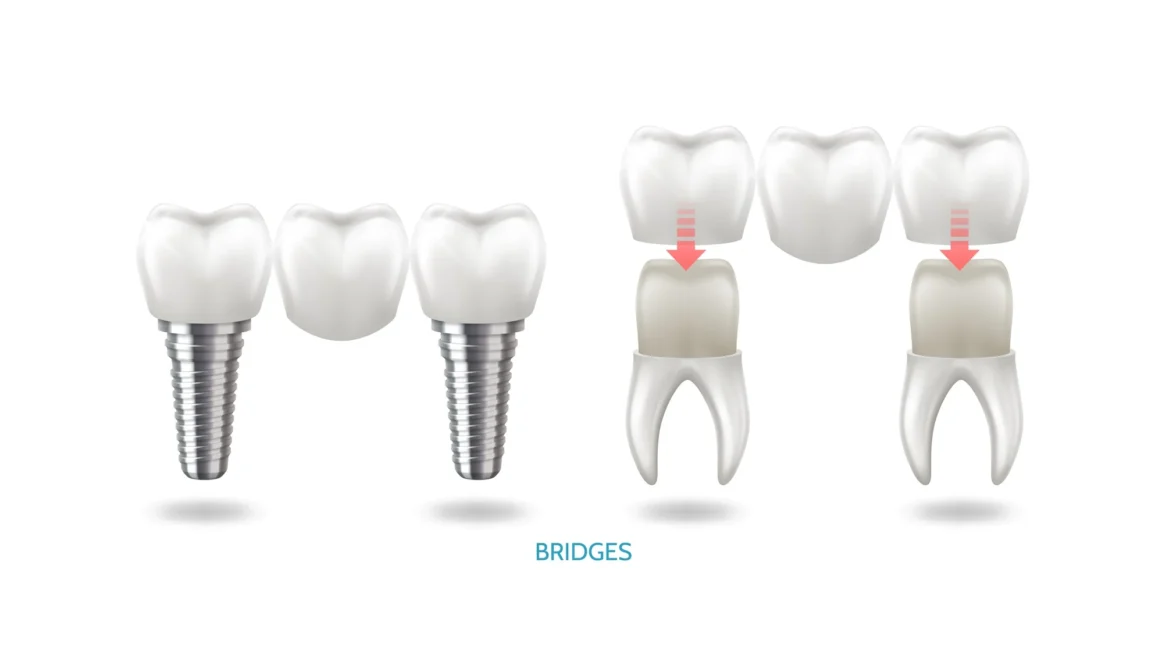
A dental bridge fills the gap by “bridging” between the teeth on either side. Those teeth act as pillars, a false tooth sits in the middle, and the whole thing is fixed in place — it doesn’t come out. Bridges have been used for decades and are still very common.
A dental implant replaces not just the visible tooth but the root. A titanium post goes into the jawbone, the bone heals around it, and a crown is fitted on top. Instead of leaning on the neighbouring teeth, it stands on its own foundation — like a natural tooth.
That single structural difference is where every other difference comes from.
How Long Each One Actually Lasts
This is where most comparisons hand you round numbers with nothing behind them. Here’s what the research actually reports.
Bridges. A systematic review of 40 studies covering 1,796 metal-ceramic and 1,110 all-ceramic fixed bridges put five-year survival at 94.4% for metal-ceramic, 90.4% for zirconia, 89.1% for reinforced glass ceramic and 86.2% for glass-infiltrated alumina.1 So the material matters, and the traditional metal-ceramic bridge is still the most durable of the group.
Implants. The longest view available is a meta-analysis following implants out to 20 years, which found survival of 92% in prospective studies and 88% in retrospective ones.2 Two decades on, roughly nine in ten were still in place.
Those two figures aren’t measured over the same period, so don’t read them as a head-to-head score. What they do show is the shape of the difference: a bridge is a restoration with a service life, and an implant is a fixture intended to stay. The crown on top of an implant may need replacing at some point, like anything used every day — the post underneath is meant to remain.
And the thing that moves those numbers most isn’t the material at all. It’s how well you clean, whether you actually turn up for check-ups, whether you grind your teeth, and how healthy your gums and bone were to begin with. A well-made bridge or implant in a well-cared-for mouth lasts a long time. The same work in a neglected one won’t. That’s the honest part nobody enjoys hearing.
What Happens to the Bone
Most people don’t think about the bone, because you can’t see it. But your jawbone needs the pressure of chewing to stay active.
With an implant, there’s a new root sitting in the bone, so when you chew, that area still gets used — and bone that gets used tends to stay. With a bridge, the gap is closed from the top, which is fine for appearance and for chewing, but underneath there’s nothing loading the bone. It can slowly shrink. You won’t notice it happening; it’s gradual.
How fast that happens is measurable: across human studies, an untreated extraction site loses 29–63% of its ridge width within six months.3 The full picture is in our guide to bone loss in the jaw.
None of that makes a bridge a bad idea — for plenty of people it works very well. It means that if what you care about is keeping the bone as close to normal as possible, implants have the edge. And where bone has already been lost, it can be rebuilt first with a bone graft.
In more advanced cases, implants aren’t only used for single teeth — they can carry full-arch bridges, using systems like the Malo Bridge or All-on-4.
What Happens to the Teeth Next to the Gap
This is the factor dentists weigh most heavily and patients think about least.
With a conventional bridge, the teeth either side have to be trimmed so the bridge can sit over them. That’s permanent. And there’s a documented consequence: the same review found a significantly higher incidence of decay in the supporting teeth under zirconia bridges compared with metal-ceramic ones.1 Those pillar teeth aren’t passengers — they take on the load and the risk.
An implant doesn’t touch them. It goes into the bone and stands alone; the teeth beside it stay exactly as they were.
Which makes the practical rule fairly simple. If the neighbouring teeth are already heavily filled or crowned, using them for a bridge is reasonable — they needed work anyway. If they’re healthy and untouched, an implant is usually the better trade, because you’re not cutting down two sound teeth to replace one missing one.
There’s no single right answer. It depends on the state of your own teeth — which is why two people with the same missing tooth can reasonably end up with different treatments.
What the Procedure Involves
What patients actually want to know is what happens in the chair, and how many visits it takes.
| Aspect | Dental bridge | Dental implant |
|---|---|---|
| Initial exam | The gap, nearby teeth, gums and bite are checked; X-rays or scans confirm the supporting teeth are strong enough. | Bone density, gums, bite and anatomy are assessed with 3D imaging to plan the implant position safely. |
| What gets prepared | The teeth next to the gap are shaped to take crowns that will hold the bridge. | No neighbouring teeth are touched. A titanium post is placed into the jawbone. |
| Surgery | Usually none — the work is on the supporting teeth. | Yes, a minor surgical procedure to place the implant. |
| Temporary | A temporary bridge is usually worn while the final one is made. | Sometimes a temporary tooth, depending on the case and the stability achieved. |
| Healing | No bone healing needed; teeth and gums may be sensitive briefly. | Months, while the bone fuses with the implant (osseointegration). |
| Final restoration | The permanent bridge is cemented onto the supporting teeth. | An abutment, then a crown, are fitted once healing is confirmed. |
| Total treatment time | Typically a few weeks. | Typically a few months, because of the healing phase. |
| What carries the load | The neighbouring teeth. | The jawbone, through the implant. |
| Effect on nearby teeth | Reshaped and permanently involved. | Untouched. |
| Bone | The root isn’t replaced, so the bone underneath isn’t stimulated. | The root is replaced, keeping the bone loaded. |
| Daily care | Cleaning around and under the bridge, with floss threaders or interdental brushes. | Brushed and cleaned like a natural tooth. |
Seeing it laid out explains why dentists don’t give everyone the same answer. Neither option is high-maintenance, but both need proper care — and the bridge asks slightly more of you day to day.
Cost: Short Term vs Long Term
Bridges cost less upfront: no surgery, fewer steps, faster treatment. Implants cost more at the start because there’s surgery, a healing period, more components and more planning.
Over a longer horizon the picture shifts, because a bridge is more likely to need replacing sooner — and when it’s replaced, the supporting teeth get worked on again. So the honest summary is:
- Bridge — lower short-term cost.
- Implant — higher initial cost, potentially better long-term value.
“Potentially” is doing real work in that sentence: it holds if your gums and bone stay healthy, and it doesn’t if they don’t. Country-by-country prices are in our guide to dental bridge costs in Turkey, and for the crown side of it, what a crown costs.
So Which One Is Better?
Neither, automatically.
A bridge often makes more sense if you want a faster solution, you’d rather avoid surgery, the neighbouring teeth already need crowns, or you’re working to a tighter budget.
An implant often makes more sense if you want to preserve bone, your neighbouring teeth are healthy and untouched, you’re thinking long-term, or you want a solution that doesn’t depend on other teeth staying sound.
Which is why a proper assessment looks at your bone, your teeth and your goals before naming a treatment — not the other way round.
Bridges and Implants in Turkey
Patients from the US, UK and Europe often compare both options in Turkey, where treatment costs are considerably lower than at home. The difference comes from local operating and laboratory costs and from clinics that do this work at volume — not from thinner materials. Any figure you read online is an approximate market range rather than a quote; your own depends on the number of teeth and the material, and is confirmed in writing after a free consultation. How the trip itself works is covered in our guide to dental tourism in Turkey.
How DentSpa Approaches Tooth Replacement
Replacing a missing tooth affects how you chew, how you speak, how your bite works and how your jaw changes over time. So it’s planned as a long-term functional decision rather than a cosmetic one.
Every case starts with an assessment of bone density and jaw structure, gum health, the condition of the neighbouring teeth, and bite alignment — using 3D CBCT imaging and digital planning, so implant position, sinus boundaries and nerve position are known rather than estimated.
Materials are CE-marked and named in your treatment plan, so any dentist can read your case later. With an in-house laboratory, restorations are produced on site and refined between dentist and technician — which means a better fit, and a shorter turnaround if you’ve travelled.
It’s a team job: surgeons for placement, prosthodontists for bite and restoration design, technicians for fabrication — which matters most for implant-supported bridges and full-mouth reconstruction, where surgery, prosthetics and bite mechanics all have to agree. You can read each clinician’s background on the doctors page before you commit.
The credentials are checkable. DentSpa is licensed by the Turkish Ministry of Health, certified to ISO 9001 and ISO 10002, a member of the Turkish Dental Association, and holds the Certification for Excellence in Medical Travel Patient Experience from Global Healthcare Accreditation.4 It was named best dental clinic in Europe in the odontology category at the European Awards in Medicine. For implants specifically, Straumann publishes the number placed here over a full year on its own verification page — see the Straumann Achievement Award and how to check it.
More than 50,000 international patients have been treated at the Şişli clinic, with a dedicated coordinator handling scheduling and logistics and an aftercare team that stays reachable once you’re home — see international guests, after treatment, and the verified Trustpilot and Google reviews.
Start with the right question
If you’re stuck between a bridge and an implant, “which is best” is the wrong question — it’s what makes sense for your mouth, your budget and how much upkeep you want to take on.
Send your photos and any existing X-rays for a free consultation, and you’ll get an assessment of what would work in your case and what wouldn’t be worth doing — before you commit to anything.
The point isn’t to fill the space where a tooth used to be. It’s to fix it in a way you stop thinking about.
Frequently asked questions
Which lasts longer, a bridge or an implant?
Do implants prevent bone loss?
Does a bridge damage the teeth next to it?
Is a bridge or an implant better for front teeth?
Which is cheaper, a dental bridge or an implant?
How many implants can be placed at one time?
Can I have an implant if I've lost bone where the tooth was?
Sources
- 1. Pjetursson BE, Sailer I, Makarov NA, Zwahlen M, Thoma DS. All-ceramic or metal-ceramic tooth-supported fixed dental prostheses (FDPs)? A systematic review of the survival and complication rates. Part II: Multiple-unit FDPs. Dental Materials. 2015. pubmed.ncbi.nlm.nih.gov/25935732
- 2. How far can we go? A 20-year meta-analysis of dental implant survival rates. Clinical Oral Investigations, 2024. pmc.ncbi.nlm.nih.gov/articles/PMC11416373
- 3. Tan WL, Wong TLT, Wong MCM, Lang NP. A systematic review of post-extractional alveolar hard and soft tissue dimensional changes in humans. Clin Oral Implants Res. 2012;23(Suppl 5):1–21. pubmed.ncbi.nlm.nih.gov/22211303
- 4. Global Healthcare Accreditation — DentSpa Strengthens Global Trust in Turkey’s Dental Services with GHA Certification, 16 July 2026.















 70%
70%