Table of content
Table of content
A dental flipper is a lightweight, removable false tooth that fills a gap — most often a missing front tooth — quickly and affordably. If you’re missing a front tooth, everything can feel different: the way you smile, the way you talk, and over time, your confidence. A removable dental flipper is the fast, low-cost fix for exactly that. It’s called a temporary solution because it pops in and out, but its convenience and price are hard to beat, and people rely on it for months — sometimes years.
Here’s the thing, though: flippers aren’t the only way to deal with a missing front tooth. There are more permanent options like dental implants, dental bridges, All-on-4/All-on-6 bridges, and modern dentures. This guide tells you exactly what a flipper is, what it costs, how long it lasts, how to live with it (eating and cleaning), and how it stacks up against the stronger alternatives.
What Is a Removable Front-Tooth Replacement or Dental Flipper?
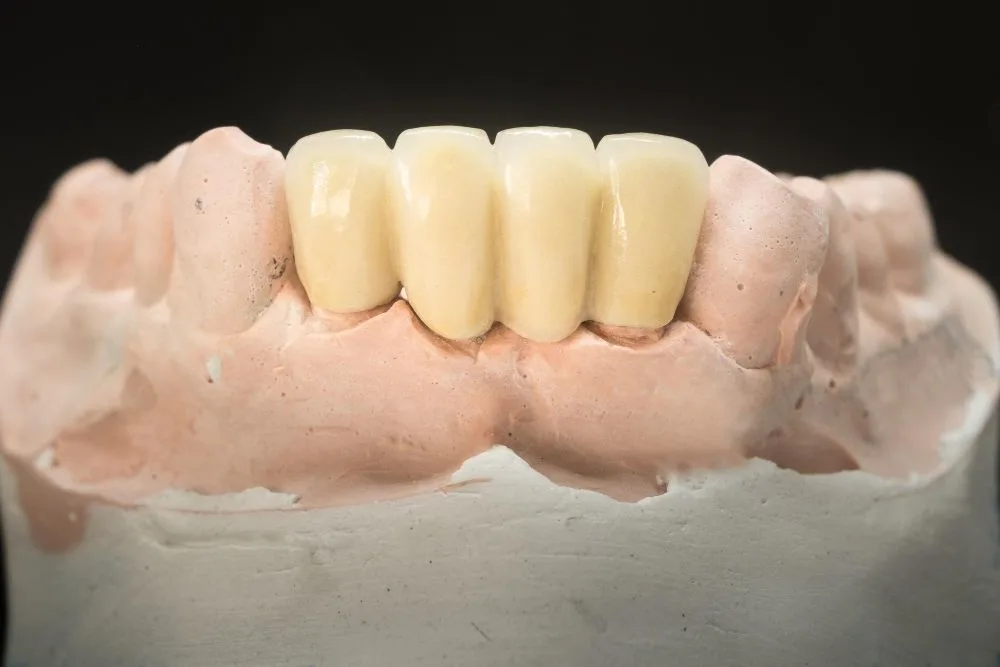
A dental flipper is a simple, removable device made to take the place of a missing tooth, usually at the front of the mouth. It’s a small base matching the colour of your gums, holding a false tooth firmly in place so the empty space in your smile is no longer visible.
Flippers are usually made of acrylic and designed to pop in and out easily. Dentists mostly use them as a temporary fix — while gums heal, or while a permanent plan is being arranged — but plenty of people wear them longer because they do the job.
Front Tooth Flipper Cost
A single flipper for a front tooth typically ranges from $300–$500 in the US, and roughly $200–$400 (CAD or £) in Canada and the UK. The figure moves with the number of missing teeth, the material used, any additional treatment needed first, and your insurance if you have it.
Treat these as approximate market ranges rather than a quote — they vary by case and country. Book a free consultation to get a figure for your own situation in writing.
How Long Does a Dental Flipper Last?
A flipper is built for the short to medium term — usually somewhere between 3 months and 2 years, depending on why you’re wearing it and how well you look after it:
- 3–6 months — while your gums heal after an extraction or surgery.
- 6 months – 1 year — while you wait for a permanent option like an implant or bridge.
- 1–2 years — if a permanent solution isn’t the immediate plan.
Gentle handling and good cleaning extend its life; hard foods and rough handling shorten it. One thing worth knowing early: because the gum and bone underneath change shape over time, a flipper that fits well at first can loosen — which is normally a sign it needs adjusting rather than that anything has gone wrong.
Eating, Cleaning & Caring for Your Flipper
- Eating — yes, you can eat with a flipper. Start with softer foods and avoid hard, sticky or crunchy items (nuts, hard sweets) that can crack it. Many people take it out for tougher meals.
- Cleaning — take it out and brush it gently with a soft brush, rinse it after meals, and avoid hot water, which can warp the acrylic. Soak it as your dentist advises.
- Your own teeth still need cleaning underneath. A flipper covers the gum, and plaque collects where it sits — so brushing and cleaning between the remaining teeth matters more, not less, while you wear one.
- Sleeping — usually best to take it out at night to let the gums rest and keep it clean, unless your dentist tells you otherwise.
Risks and Limitations to Know
Flippers are temporary tooth-replacement options, so a few things are worth knowing before getting one:
- They can break — acrylic isn’t as strong as a fixed restoration, and hard foods or rough handling crack or bend them.
- Discomfort at first — irritation or soreness early on is common; the mouth adjusts with a little patience.
- Dietary care — sticky, hard or crunchy foods shorten a flipper’s life, so most people adapt what they eat while wearing one.
- No bone protection — this is the important one. A flipper rests on the gum, so it does nothing to stop the ridge shrinking underneath after a tooth is lost. That change is what makes a gap harder to restore the longer it is left — see bone loss in the jaw and how it’s rebuilt.
Alternatives to Flippers for Front-Tooth Replacement
As a temporary solution a flipper won’t last forever, and most patients eventually want something stronger and more natural. Here are the alternatives.
Dental implants. An implant replaces the tooth with a titanium post placed in the jawbone. The bone fuses to the post — osseointegration — and a crown is fitted on top. The advantage a flipper can never offer is bone retention: the implant takes the place of the root, so it loads the bone the way a natural tooth did. On longevity, a 20-year meta-analysis put implant survival at around 94.6%,1 and implant-supported single crowns at 89.4% at ten years.2 It costs more and involves minor surgery. See how a single tooth implant works and, for a front tooth specifically, front-teeth implants.
Dental bridges. For patients who want something fixed but aren’t ready for implants, a bridge attaches an artificial tooth to the teeth either side of the gap, which are reshaped and crowned to hold it. It doesn’t move when you talk or eat. The trade-off is that healthy neighbouring teeth are prepared to carry it. Published survival for conventional tooth-supported bridges is 93.8% at five years and 89.2% at ten.2 More in dental bridges in Turkey.
Removable options that go further than a flipper
Modern and partial dentures. Stronger than a flipper and made for longer-term use, often replacing more than one tooth. Full versions cover an entire arch; partial designs cover smaller gaps. They remain removable and rest on the gum, so like flippers they don’t protect bone — but they are a sensible route for patients not ready, or not medically suited, for implants or bridges. Compared side by side in dentures versus implants and implant-supported dentures.
Malo Bridge (All-on-4 / All-on-6). Where many teeth are missing, four or six implants support an entire fixed arch instead of one implant per tooth — see how the Malo Bridge works, All-on-4, and the four-way comparison in full-arch implant rehabilitation. Note that more implants is not automatically better — the number is decided by the bone available, not by preference.
Dental Flipper vs. the Alternatives
A flipper is often the first quick fix — light, removable and inexpensive. A partial flipper is a slightly bigger version holding two or more teeth. Beyond flippers, fixed treatments give more stability and comfort. Here’s how they compare:
| Option | Replaces | Cost | Published survival | Bone health | Comfort |
|---|---|---|---|---|---|
| Dental flipper | Usually one front tooth | Lowest | Short-term by design (3mo–2yr) | Doesn’t protect bone | Light but can loosen |
| Dental implant | Any single tooth | Highest | ~94.6% at 20 years1 | Loads the bone like a root | Fixed, closest to natural |
| Dental bridge | One or more in a row | Moderate | 89.2% at 10 years2 | Doesn’t protect bone | Stable, fixed |
| Malo Bridge (All-on-4/6) | Full arch | High | See full-arch data | Loads the bone like roots | Very stable, fixed |
| Modern / partial denture | Two or more teeth | More than a single flipper | Removable, replaced as fit changes | Doesn’t protect bone | Bulkier than a single flipper |
Survival figures are population data from published studies, not a promise about an individual case — and the right option depends on your bone, your remaining teeth and what you want, which is what an assessment establishes.
Frequently asked questions
How much does a dental flipper cost?
How long does a dental flipper last?
Can you eat with a dental flipper?
How do you clean a dental flipper?
Flipper or implant — which is better?
Does a flipper stop bone loss?
Flipper or partial denture — what is the difference?
Why Choose DentSpa
Losing a front tooth affects how you eat, smile and see yourself, and a dental flipper is a reliable, cost-effective way to restore your smile in the short term. But flippers are temporary — and implants, bridges, Malo bridges and modern dentures last considerably longer. Turkey has become one of the leading destinations for this work, with patients travelling from the UK, US, Canada and beyond.
- PhD-level specialist dentists, with professors and associate professors involved in complex cases.
- Straumann implant systems where an implant is the right route — Swiss-manufactured and among the most extensively documented in the world.
- The temporary and the permanent plan discussed together, so a flipper is a step in a plan rather than an open-ended arrangement.
- Costs and the number of visits set out in writing before treatment begins.
DentSpa was named best dental clinic in Europe in the odontology category at the European Awards in Medicine,3 is licensed by the Turkish Ministry of Health, certified to ISO 9001 and ISO 10002, and a member of the Turkish Dental Association. For treatment planned from abroad it also holds the Certification for Excellence in Medical Travel Patient Experience from Global Healthcare Accreditation.4 Since the clinic was founded in Istanbul in 2018, more than 50,000 international patients have been treated.
Whether you want a short-term fix for a missing front tooth or a permanent replacement, book a free consultation with a DentSpa specialist to find out which option suits your case. If you’re comparing clinics, the questions worth asking any of them are in how to find a dentist in Turkey.
Sources
- Long-term survival of dental implants: systematic review and meta-analysis — implant survival at 20 years, 2024.
- Pjetursson BE, Brägger U, Lang NP, Zwahlen M. Comparison of survival and complication rates of tooth-supported fixed dental prostheses and implant-supported FDPs and single crowns. Clinical Oral Implants Research, 2007;18(Suppl 3):97–113.
- The European Awards in Medicine — DentSpa Clinic — European Award in Medicine in Odontology
- Global Healthcare Accreditation — DentSpa Strengthens Global Trust in Turkey’s Dental Services with GHA Certification









 70%
70%