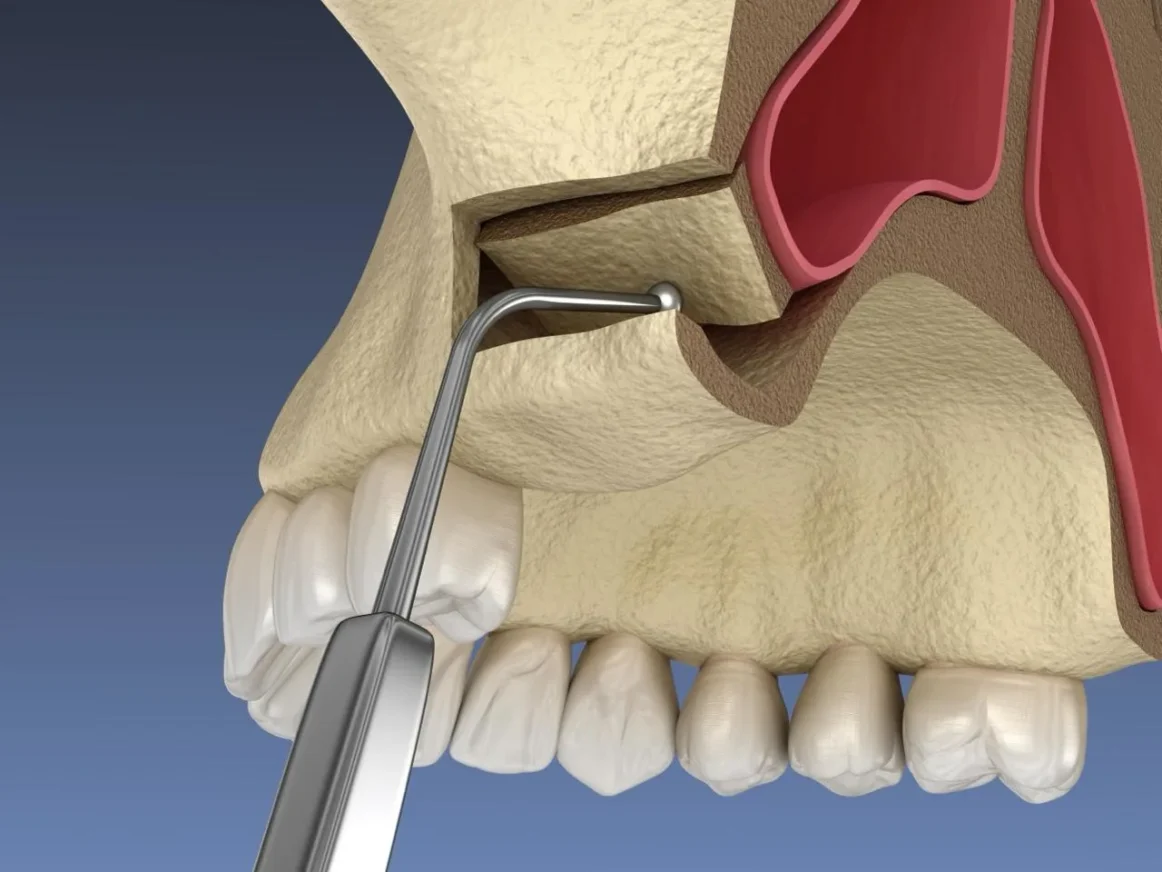
A sinus lift is a safe, routine procedure with a high success rate — implants placed after one survive at around 97–99% over the long term — but, like any surgery, it can have side effects. The good news is that most are mild and temporary, and serious complications are uncommon, especially with an experienced surgeon.¹ Here’s the honest, full picture: the normal after-effects you should expect, the rarer complications to be aware of, the signs of a failed sinus lift, and how to lower your risk.
Normal Side Effects After a Sinus Lift
These are expected, settle within a few days to a couple of weeks, and are not a cause for concern:
- Swelling and bruising around the cheek and upper jaw, usually peaking in the first 2–3 days.
- Mild discomfort or soreness, easily controlled with the painkillers your dentist recommends.
- Minor bleeding or light nasal discharge tinged with blood for a day or two.
- A feeling of pressure or stuffiness in the area, similar to a mild cold.
To protect the healing site, you’ll usually be told to avoid blowing your nose forcefully, sneeze with your mouth open, and skip strenuous exercise for a short while. For the full timeline, see our guide to the sinus lift procedure and recovery.
Possible Complications (and How Common They Are)
Complications are less common and most are manageable:
- Sinus membrane perforation — a small tear in the thin “Schneiderian” membrane is the most common surgical complication, reported in roughly 1 in 5 cases. Importantly, when it’s spotted and repaired during surgery, studies show it does not significantly affect the long-term success of the implants.²
- Sinus infection (sinusitis) — uncommon, and usually treatable with antibiotics if it occurs.
- Graft failure or loss of graft material — rare; the graft may not integrate, or some material can move into the sinus.
- Bleeding or prolonged swelling beyond the normal few days.
Overall, research consistently describes the sinus lift as a safe procedure with a low complication rate and predictable results.¹
Signs of a Failed Sinus Lift
Normal side effects improve day by day. Contact your dentist promptly if instead you notice:
- Pain or swelling that gets worse after the first few days instead of easing.
- Pus, a bad taste or smell, or thick discharge from the nose or gum.
- Fever, or persistent congestion that won’t clear.
- Graft material coming loose, or the area not healing.
These are uncommon and usually simple to treat when caught early — which is exactly what your follow-up checks are for.
Are There Long-Term Side Effects?
For most people, no. Once the area has healed and the graft has integrated, the sinus returns to normal and the new bone simply supports your implants. Long-term studies of sinus augmentation report implant success rates of around 97–98% even up to 15 years, so a well-done sinus lift is built to last rather than to cause ongoing problems.³ A sinus lift does not change the shape of your face — it adds a small amount of bone inside the jaw, not to the outside.
How to Lower Your Risk
Most side effects are minor and most complications are avoidable. You can stack the odds in your favour by:
- Choosing an experienced surgeon who plans the case from a 3D (CBCT) scan to map your sinus and bone precisely.
- Not smoking around the surgery, as it slows healing and raises the risk of infection and graft failure.
- Following your post-operative care instructions and keeping up good oral hygiene.
- Attending your follow-ups so healing can be checked.
Safe Sinus Lifts at DentSpa, Turkey
The biggest factor in a smooth, side-effect-free recovery is the skill behind the procedure. At DentSpa, every sinus lift in Turkey is planned from a 3D scan by experienced specialists, with clear aftercare and follow-up — at the Best Clinic in Dentistry in Europe 2024, trusted by 50,000+ international patients. Book a free consultation to ask any questions about the procedure and what to expect.
Frequently asked questions
Is a sinus lift dangerous?
What are the long-term side effects of a sinus lift?
Does a torn sinus membrane ruin the result?
What are the signs of a failed sinus lift?
How can I avoid complications after a sinus lift?
Sources
- 1. Sinus Lift Procedures — patient information (risks, benefits & what to expect). Cambridge University Hospitals NHS. https://www.cuh.nhs.uk/patient-information/sinus-lift-procedures/
- 2. Influence of Schneiderian membrane perforation on implant survival — systematic review & meta-analysis (perforation ~19%; managed perforation does not significantly reduce implant survival). PMC, 2024. https://pmc.ncbi.nlm.nih.gov/articles/PMC11242322/
- 3. 15-year retrospective study on the success of maxillary sinus augmentation and implants (~97–98%). PMC, 2023. https://pmc.ncbi.nlm.nih.gov/articles/PMC9970713/














 70%
70%