Table of content
Table of content
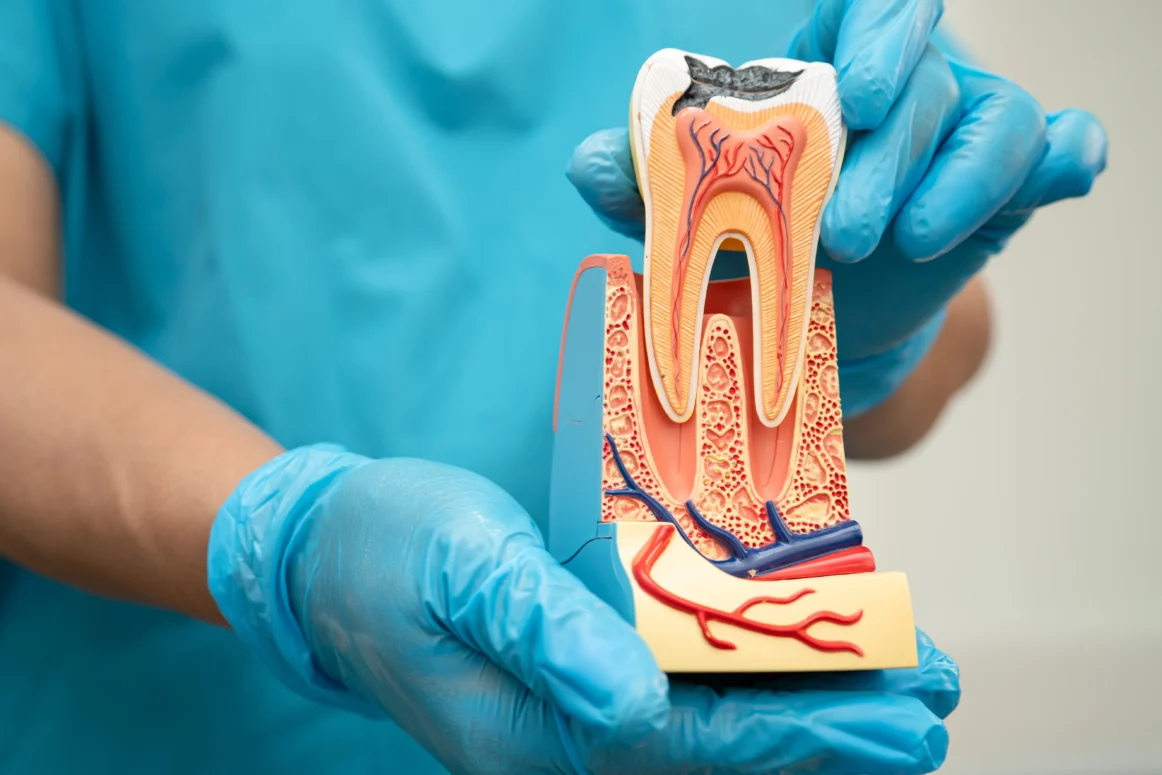
Pulp capping is a conservative treatment for the soft tissue inside your tooth, aka the dental pulp, when decay or an injury gets close to it or just barely exposes it. Its goal is simple: keep that tissue alive and healthy enough that the tooth never needs a root canal down the line. It works well in the right cases, though nothing in dentistry is ever a sure bet, and every so often a tooth still ends up needing more treatment anyway.
What Is the Dental Pulp, and Why Protect It?
The pulp is the soft core of a tooth, the part carrying its nerve and blood supply, basically what keeps it alive. As long as that stays healthy, the tooth responds normally to hot, cold, and pressure, and keeps nourishing itself from within.
Once that tissue takes real damage or gets infected, the tooth starts dying from the inside out, and a root canal becomes the only real path forward. Pulp capping steps in one stage earlier than that; when the pulp is irritated or just barely exposed, but still has a genuine shot at healing if it gets the right help in time.
When Is Pulp Capping Actually Needed?
Three situations call for it most: deep decay that’s come close to the pulp without fully breaking through, a small exposure from an injury or accidental drilling, and reversible pulpitis, where the pulp is inflamed and sensitive but not yet permanently damaged. Catching deep decay early is what makes pulp capping possible at all, which is part of why understanding how to fix tooth decay before it reaches the pulp matters as much as the treatment itself.
Capping isn’t suitable for every case, though. If the pulp is already irreversibly inflamed, infected, or an abscess has formed, capping it won’t solve the underlying problem, and a root canal is the more reliable route. Your dentist makes that call from symptoms, how the tooth responds to testing, and the X-ray, not from how the tooth merely looks.
Direct vs Indirect Pulp Capping
Indirect pulp capping is used when the pulp hasn’t been exposed, just sits close to the decay. The dentist removes most of the decayed tissue while deliberately leaving a thin protective layer near the pulp, places a protective material over it (calcium hydroxide, MTA, or biodentine), and seals the tooth temporarily. A few weeks later, once things have settled, a permanent filling replaces it.
Direct pulp capping is for cases where the pulp has actually been exposed, however slightly. The dentist cleans and disinfects the area, applies the protective material straight onto the exposed pulp, and seals the tooth, often in one visit. It’s more delicate, since the pulp is briefly open, which is part of why its success depends more heavily on which material is used.
How Well Does Pulp Capping Actually Work?
The material your dentist chooses genuinely changes the odds. For direct pulp capping, calcium hydroxide has been the traditional choice, but it doesn’t hold up as well over time: published outcome data shows its success rate around 74% at six months, dropping to roughly 56% by four to five years1.
MTA performs noticeably better across the same stretch, starting around 91% and settling closer to 81% several years out1. A separate meta-analysis comparing the two directly found MTA significantly outperforming calcium hydroxide, with a clearly lower failure rate2. Biodentine, a newer bioceramic material, tends to perform on par with MTA rather than calcium hydroxide2.
Indirect pulp capping, since it doesn’t involve opening the pulp at all, tends to succeed considerably more often, with most published studies reporting rates in the high eighties to high nineties depending on material and follow-up period3.
Results vary by how deep the decay was, how much bleeding occurred at exposure, and how quickly the permanent filling goes in, so “high success rate” means likely to work, not guaranteed, and your dentist will only know how your tooth is responding by checking at follow-up.
Does It Hurt, and What Does Recovery Feel Like?
The procedure is done under local anaesthetic, so you shouldn’t feel anything during it. Afterwards, some tooth sensitivity to hot, cold, or pressure is normal for a few days, gradually settling rather than worsening. If discomfort increases instead of easing, or is still noticeable after a couple of weeks, that’s worth flagging to your dentist.
In the meantime, avoid very hot, cold, or hard foods on that side, keep up normal brushing and flossing, and skip anything heavily sugary or acidic while the area settles.
Pulp Capping vs a Filling vs a Root Canal
These get confused constantly. A filling restores the outer structure of a tooth after decay is removed, without addressing what’s happening deeper inside. Pulp capping goes a layer further, protecting the nerve itself so the tooth has a real chance of staying alive without more invasive treatment. A root canal is the step beyond that, removing the nerve entirely once it’s too damaged to save, the outcome pulp capping is trying to avoid.
If you’ve already had deep tooth decay treated and wondered why your dentist mentioned pulp capping rather than going straight to a filling, this is usually why: the decay sat close enough to the nerve that protecting it first gave the tooth a real shot at staying healthy. If a pulp cap doesn’t settle as it should, a root canal remains there as the fallback, not a sign anything went wrong, just the next layer of treatment doing its job.
Pulp Capping Cost: What Affects the Price
Pulp capping is relatively affordable compared with a root canal, since it’s quicker and less invasive. What moves the price is mostly the material (MTA and biodentine cost more than calcium hydroxide) and whether it’s direct (one visit) or indirect (typically two). In the UK, private pricing for pulp capping plus the associated filling work varies considerably between practices for those same reasons.
At DentSpa, modern materials are used as standard rather than reserved for an upgrade, and our restorative dentists work from detailed imaging to choose the right approach for each tooth rather than defaulting to whichever material is cheapest. If you’re weighing this up for treatment in Istanbul, the clearest next step is a free consultation, where one of our dentists reviews your X-rays and tells you plainly whether pulp capping is realistic for your tooth.
Istanbul draws a steady stream of UK patients each year for the same reason across most treatments: specialist-led care and pricing that reflects local costs rather than a difference in quality.
DentSpa was named Best Dental Odontology Clinic in Europe 2024, recognised for digital dentistry and consistently strong outcomes. Day to day, that means restorative dentists who specialise specifically in conservative, tooth-saving treatment rather than one generalist handling everything, backed by a medical advisor team and an after-care department that checks in long after you’ve gone home.
Ready to Find Out If Your Tooth Can Be Saved?
If you’ve been told you have deep decay or a small pulp exposure, the clearest next step is a free, no-obligation consultation. Send your X-rays to our team on WhatsApp, and one of DentSpa’s dentists will give you an honest answer on whether pulp capping is right for your tooth.
Frequently asked questions
Does pulp capping hurt?
How long does a pulp cap last?
How much does pulp capping cost?
Can pulp capping fail?
Direct vs indirect pulp capping: what’s the difference?
Sources
- Lin, L., Yang, S., Zhao, Y., et al. Efficacy of direct pulp capping for management of cariously exposed pulps in permanent teeth: a systematic review and meta-analysis. International Endodontic Journal. PubMed. https://pubmed.ncbi.nlm.nih.gov/33222178/
- Clinical outcome of direct pulp capping with MTA or calcium hydroxide: a systematic review and meta-analysis. PMC. https://pmc.ncbi.nlm.nih.gov/articles/PMC4694196/
- Success rate of direct pulp capping on permanent teeth using bioactive materials: a systematic review and meta-analysis. PMC. https://pmc.ncbi.nlm.nih.gov/articles/PMC11621314/













 70%
70%